Gary Saretzky Photo Books
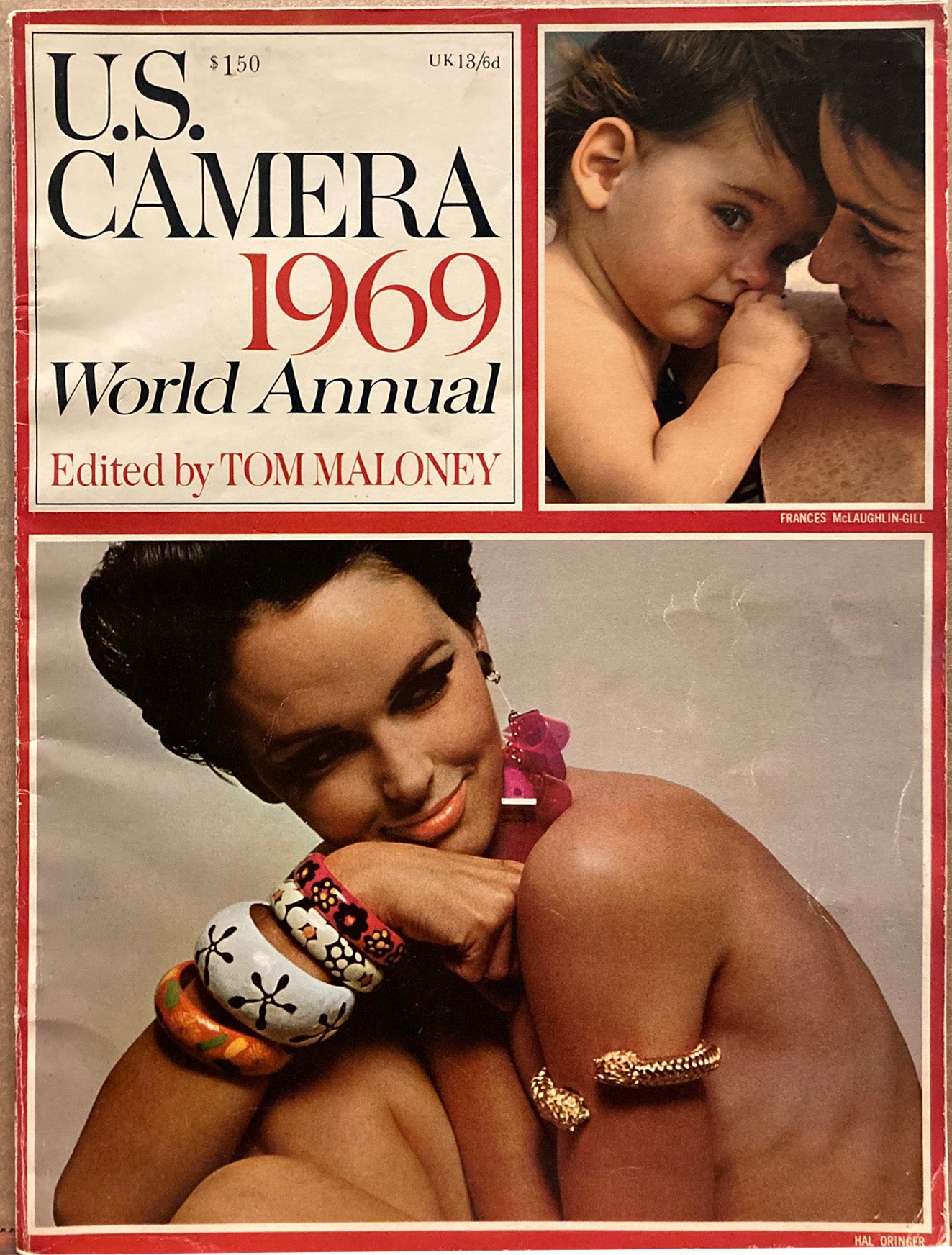
Annuals. U.S. Camera 1969 World Annual.
Annuals. U.S. Camera 1969 World Annual.
Couldn't load pickup availability
U.S. Camera Publishing Co., 1968. Edited by Tom Maloney. Featuring portfolios by/about Skrebneski, Art Rickerby, Richard Davis, Twen, Edward Steichen, Switzerland, Nazare, Philippe Halsman, and Patrick Higgins. Memorials to Robert F. Kennedy and Martin Luther King, Jr. Features: Robert Riger, "Where Have All the Photographers Gone?"; David Douglas Duncan, "I Protest!"; and News Highlights, 1968. Color photography by Frances McLaughlin-Gill, Hal Oringer, Penati, Bob Nemser, Emerick Bronson, Herb Breuer, Lucien Clergue, Robert Pastner, NASA, et al. Also featuring photographs by Kathryn Abbe, Ollie Atkins, Jan Berntsen, Yogi Cohen; Joseph Dankowski; Phoebe Dunn, Eastfoto, Peter Fink, Ken Haak, Walter Hirsch, Karsh, Ed Lada, Robert Lebeck, David McCabe, Roddy McDowell, Mary Ellen Mark, Frances McLaughlin-Gill, Onofrio Paccione, S. Paul, Santo Piano, Dom Quartuccio, Raghunath Rai, Ota Richter, Jerry Sarapochiello, Sovfoto, Wolf Suschitzky, Walter Swarthout, Dawn Mitchell Tress, Athanasios Tsagris, Dick Ustinich, John Varley, Walter Vogel, Harvey A. Weber, Scott Wilson, Rolf Winquist, John M. Zielinski. Also scientific photography, including Eadweard Muybridge, atom bomb blasts, lasers, et al. Very good with small scuff on back cover. Wraps, as issued. Summary:
U.S. Camera 1969 World Annual, edited by Tom Maloney, is one of the most culturally significant volumes in the series. It serves as a visceral, visual eulogy for the year 1968—a period defined by profound social upheaval, political tragedy, and a radical shift in how the camera was used to witness history.
The Year of Tragedy: 1968
The 1969 Annual is dominated by the social and political tremors of the previous year:
-
Memorial Portfolios: The book contains extensive, somber visual tributes to Robert F. Kennedy and Martin Luther King, Jr., documenting both their lives and the global outpouring of grief following their assassinations.
-
David Douglas Duncan ("I Protest!"): A powerful, unapologetic feature on Duncan’s coverage of the Vietnam War. This section focuses on the Siege of Khe Sanh, stripping away military glory to show the grit, fear, and exhaustion of the soldiers.
-
The 1968 News Highlights: A chronological documentation of the year's most explosive moments, including the riots at the Democratic National Convention in Chicago and the student protests in Paris.
Portfolios and Modern Vision
-
Victor Skrebneski: Known for his high-fashion elegance, the annual features his bold, minimalist black-and-white nudes and celebrity portraits, which emphasize sculptural form over ornamentation.
-
Art Rickerby: A showcase of Rickerby’s dynamic approach to sports and news photography, characterized by his ability to capture the "peak action" of a moment.
-
Twen Magazine: The annual examines the influence of the West German magazine Twen, which was then revolutionizing editorial design and erotic-art photography under art director Willy Fleckhaus.
-
Edward Steichen & Philippe Halsman: Continuing its tradition of honoring masters, the book includes technical and aesthetic studies of Steichen’s legacy and Halsman’s psychological portraiture.
Scientific and Historical Photography
The 1969 edition places a unique emphasis on the "invisible" world made visible through technology:
-
The Origins of Motion: A retrospective look at Eadweard Muybridge, the 19th-century pioneer whose stop-motion studies laid the groundwork for cinema.
-
The Atomic and the Radiant: High-speed photography capturing atomic bomb blasts and the early use of lasers provides a stark, abstract beauty that reflects the anxieties and advancements of the Cold War era.
Color and Aesthetic Shifts
The color section highlights a transition from the literal to the dreamlike:
-
Frances McLaughlin-Gill: Known for her fashion work, she contributes subtle, tonal color studies that bridge the gap between commercial and fine art.
-
Lucien Clergue: The annual features his "Nudes in the Sea" style, where the human body is abstracted by water and light into organic shapes.
-
Robert Riger ("Where Have All the Photographers Gone?"): A critical essay that questions the state of professional photography in an era increasingly dominated by television and the "quick" image.
Significance
The 1969 Annual is a heavy, emotionally charged document. By juxtaposing the horrific beauty of an atom bomb with the tragic funerals of RFK and MLK, and the high-fashion sheen of Skrebneski with the mud of Khe Sanh, it perfectly captures the fractured, contradictory spirit of the late 1960s. It stands as a testament to the camera's dual role as both a high-art tool and a brutal weapon of truth.