Gary Saretzky Photo Books
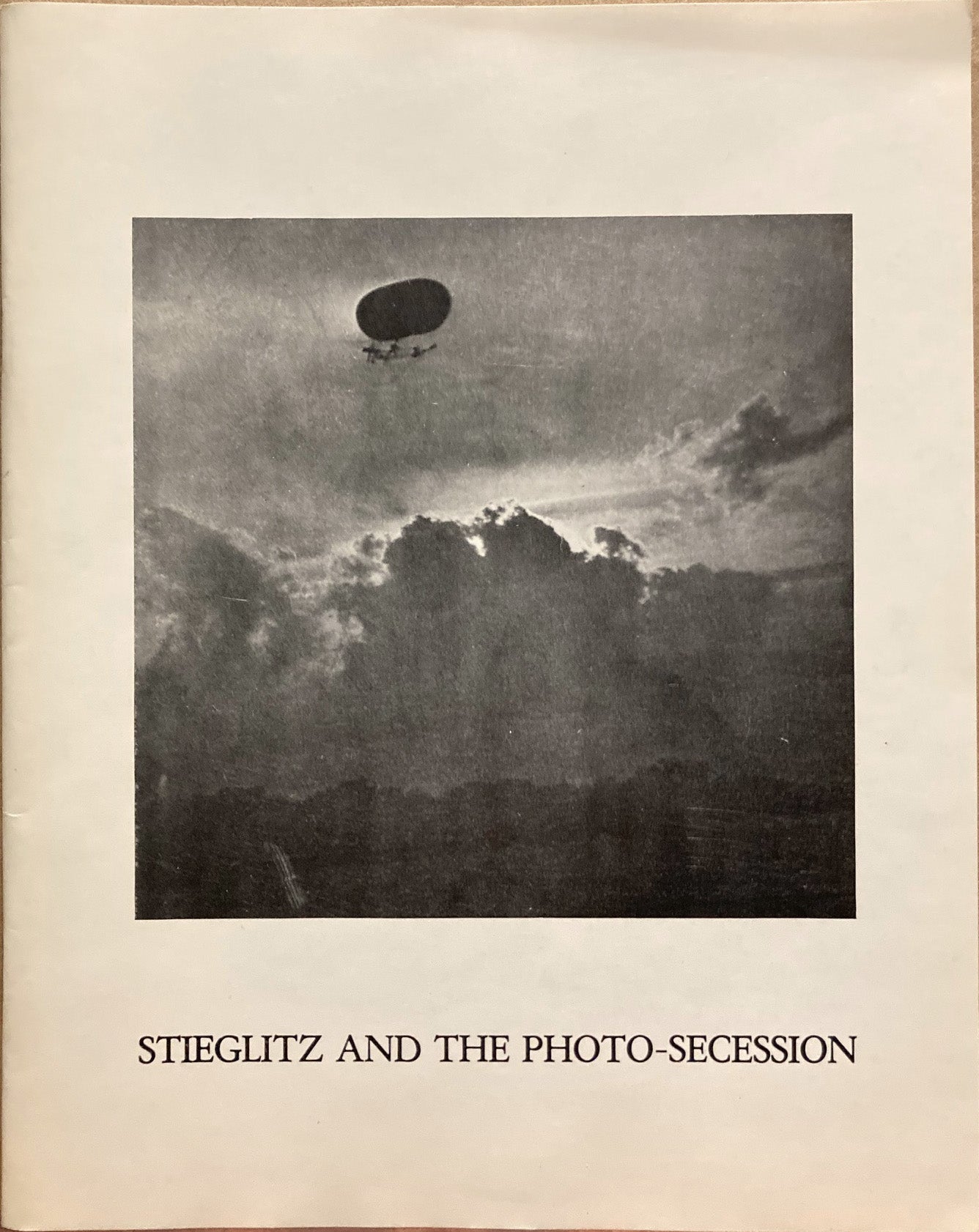
Stieglitz, Alfred. Stieglitz and the Photo-Secession. Pictorialism to Modernism 1902-1917. January 14-March 26, 1978.
Stieglitz, Alfred. Stieglitz and the Photo-Secession. Pictorialism to Modernism 1902-1917. January 14-March 26, 1978.
Couldn't load pickup availability
New Jersey State Museum, 1978. Curated and with text by Helen Gee. Wraps, 54 pages, 31 illustrations. Includes checklist and bibliography. Photographers illustrated include J. Craig Annan, Alice Boughton, Annie Brigman, John G. Bullock, Alvin Langdon Coburn, George Davison, Robert Demachy, Baron De Meyer, Frank Eugene, Frederick H. Evans, Gertrude Kasebier, Joseph T. Keiley, Heinrich Kuehn, Charles Puyo, George H. Seeley, Edward Steichen, Alfred Stieglitz, Paul Strand, Karl Struss, Eva Watson-Schütze, Clarence H. White. Fine.
Alfred Stieglitz (1864–1946) was a pioneering American photographer, publisher, and gallery director who was instrumental in establishing photography as a recognized fine art in the United States and introducing European modernism to the American public. Born in Hoboken, New Jersey, Stieglitz studied photochemistry in Berlin under Hermann Wilhelm Vogel, where he developed a rigorous command of photographic chemistry alongside a commitment to artistic expression. Returning to New York, he spearheaded the Photo-Secession movement, advocating for Pictorialism before championing straight, unmanipulated photography that embraced sharp focus, tone, and structural clarity—exemplified by his iconic 1907 masterpiece, The Steerage. Through his landmark journal Camera Work (1903–1917) and his avant-garde galleries, including 291 and An American Place, Stieglitz introduced American audiences to European modernists like Auguste Rodin, Henri Matisse, and Pablo Picasso alongside groundbreaking American photographers. His personal practice extended to expressive series such as Equivalents—abstract cloud studies exploring photography’s capacity to evoke emotional states—and a multi-decade photographic portrait study of painter Georgia O'Keeffe, his artistic partner and wife, solidifying his position as the central patriarch of 20th-century American art photography.
Stieglitz and the Photo-Secession: Pictorialism to Modernism 1902–1917 (1978) is an exhibition catalog published by the New Jersey State Museum to document a comprehensive historical survey held from January 14 to March 26, 1978. The publication serves as an important scholarly record tracing the foundational years of American art photography and the institutional avant-garde.
Key Elements of the Work
-
The Chronological Narrative: The catalog focuses on a critical fifteen-year period, mapping the dramatic aesthetic evolution from the atmospheric, painterly soft-focus styles of early Pictorialism to the sharp, geometric, and unmanipulated principles of Straight Modernism.
-
The Photo-Secession Circle: The volume chronicles the impact of the Photo-Secession, a progressive group founded by Alfred Stieglitz in 1902. It documents work by a legendary roster of core members who challenged academic conventions, including Edward Steichen, Gertrude Käsebier, Clarence H. White, Alvin Langdon Coburn, Paul Strand, and Frank Eugene.
-
The Gallery and Journal Record: The publication details the primary vehicles used by Stieglitz to promote the movement. It features a historical checklist and analysis of the groundbreaking quarterly journal Camera Work(1903–1917) and the physical exhibitions held at his iconic Little Galleries of the Photo-Secession (better known as 291) in New York City.
Narrative Intent
The catalog functions as an art-historical retrospective aimed at contextualizing the institutional roots of modern American photography. By archiving this definitive 1902–1917 timeline, the New Jersey State Museum illustrated how a tight-knit circle of American practitioners successfully shifted the camera from a tool of mechanical replication to a respected medium of subjective, high-art expression.
