Gary Saretzky Photo Books
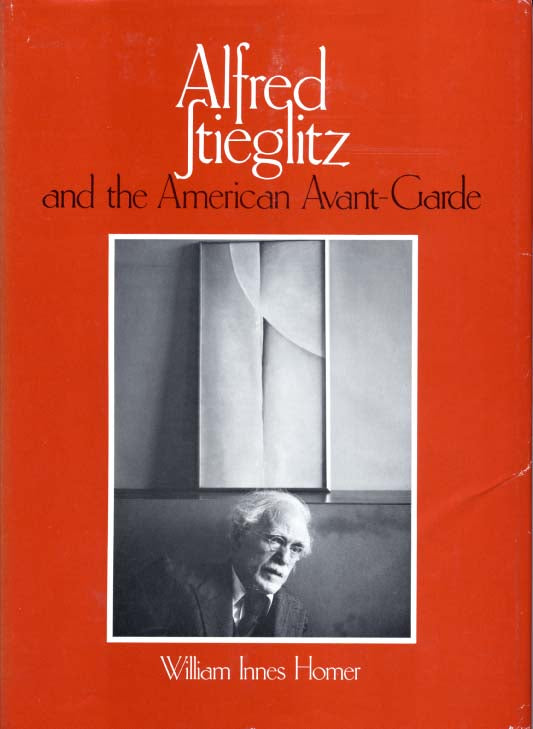
Stieglitz, Alfred. Alfred Stieglitz and the American Avant-Garde by William Innes Homer..
Stieglitz, Alfred. Alfred Stieglitz and the American Avant-Garde by William Innes Homer..
Couldn't load pickup availability
New York Graphic Society, 1977. 1st edition. Illustrated. 335 pages. Not to be confused with later reprints. Certainly one of the essential references on Stieglitz and the photographers and artists in his circle. Covers the Photo-Secession (e.g. Edward Steichen and Paul Strand) and the other artists like Marin, Dove, Weber, Walkowitz, Hartley, O'Keeffe, de Zayas, et al. Fine hardcover with very good protected jacket that is price clipped, worn at extremities, and has spots on the inside (not visible with protector on). Summary:
Alfred Stieglitz and the American Avant-Garde (published in 1977 by New York Graphic Society / Little, Brown and Company) is a seminal art-historical study written by William Innes Homer, a preeminent scholar of American modernism. The book provides a comprehensive, structured examination of how Alfred Stieglitz functioned as the primary catalyst, patron, and intellectual anchor for the first wave of modern art in the United States during the early 20th century.
Key Elements of the Work
-
The Impresario of Modernism: Homer shifts the primary focus away from Stieglitz’s personal photography to meticulously analyze his role as an institutional revolutionary. The text details how Stieglitz utilized his landmark publication, Camera Work, and his avant-garde galleries—most notably the Little Galleries of the Photo-Secession (291)—to wage war against academic conservatism.
-
The European Pipeline: The book chronicles how Stieglitz, alongside his close collaborator Edward Steichen, introduced a resistant American public to radical European modernists long before the historic 1913 Armory Show. Homer tracks the groundbreaking American debuts of Auguste Rodin, Henri Matisse, Pablo Picasso, and Constantin Brâncuși within Stieglitz's spaces.
-
Nurturing Native Avant-Garde Artists: A core strength of the volume is Homer’s deep-dive into the "Stieglitz Circle"—the tight-knit group of pioneering American painters and abstractionists whom Stieglitz fiercely protected, financially supported, and promoted. The text charts the development of key figures including Georgia O'Keeffe, John Marin, Arthur Dove, Marsden Hartley, and Charles Demuth.
-
A Cultural and Social History: Homer contextualizes the movement within the broader social fabric of New York City between 1900 and 1917. He explores the philosophical currents, internal rivalries, and the psychological atmosphere of 291, framing it not just as a commercial gallery, but as a quasi-religious laboratory for creative freedom.
Narrative Intent
The monograph functions as a definitive historical mapping of the roots of American modern art. By systematically documenting the networks, exhibitions, and publications masterminded by Stieglitz, Homer demonstrates that the emergence of a distinct, native avant-garde was not an accident of history, but the calculated result of one man's uncompromising vision and tireless cultural crusade.
