Gary Saretzky Photo Books
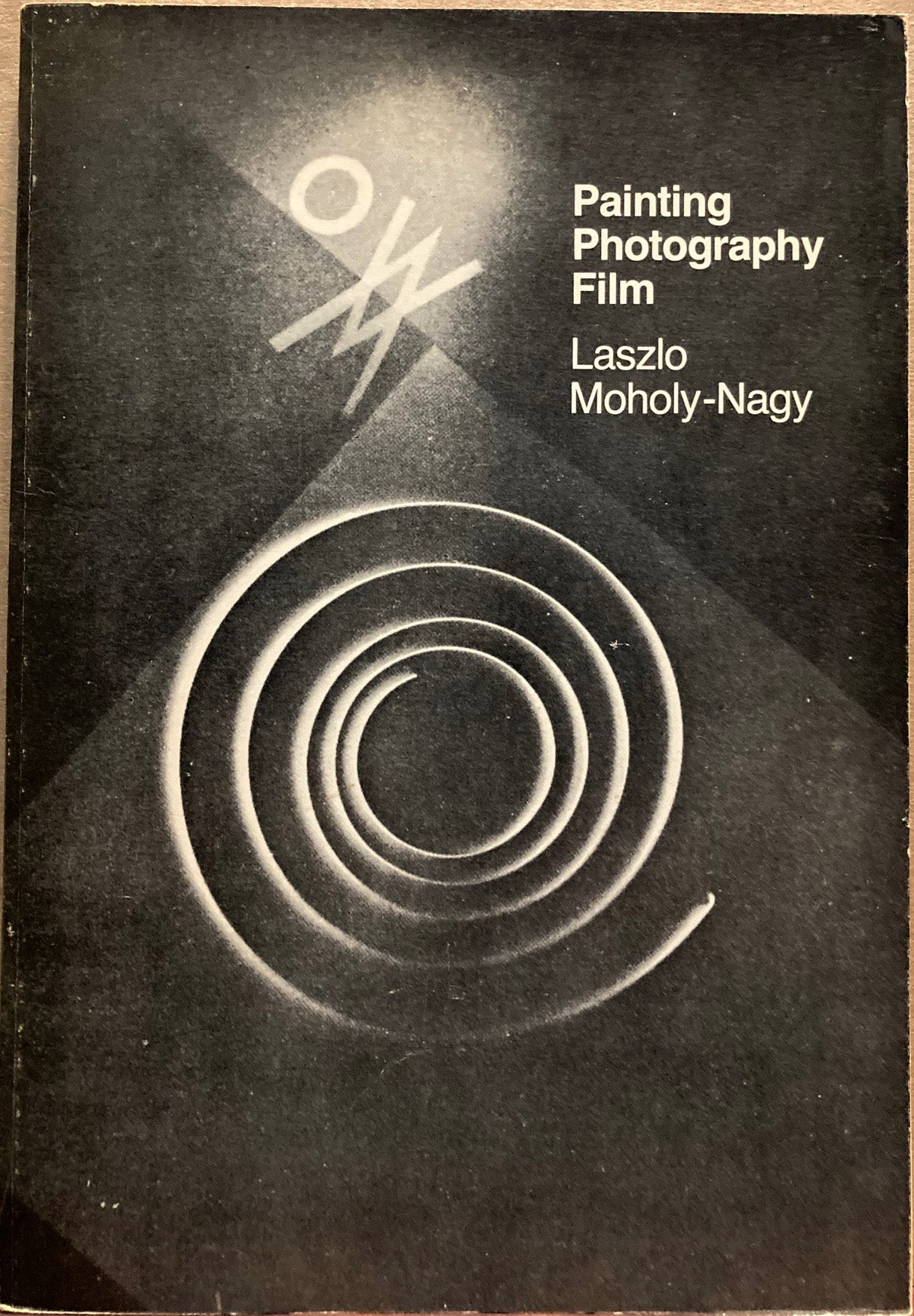
Moholy-Nagy, Laszlo. Painting Photography Film by Laszlo Moholy-Nagy.
Moholy-Nagy, Laszlo. Painting Photography Film by Laszlo Moholy-Nagy.
Couldn't load pickup availability
MIT, 1973. Wraps, 150 pages, reprint of 1925 edition, very good with crimp on front cover. [A classic by one of the 20th century's most influential artists, photographers, and teachers who taught at the Bauhaus.] Wraps, 150 pages, very good with crimps on covers, light spots on fore edge. Summary:
Painting, Photography, Film is a 150-page translated edition of the groundbreaking avant-garde text by Hungarian artist and visionary educator László Moholy-Nagy. First published in English by Lund Humphries in 1969 and issued as a defining paperback by The MIT Press in 1973, the book is a translation by Janet Seligman of the author's original 1925 Bauhausbook (Malerei, Fotografie, Film). It includes a contextual note by Hans M. Wingler and a postscript by Otto Stelzer, serving as a pillar of modern media theory.
Overview of the Book
-
The Author: László Moholy-Nagy (1895–1946) was an influential master at the Bauhaus in Germany, where he co-edited the Bauhausbücher (Bauhaus Books) series with Walter Gropius and pioneered radical new approaches to design, typography, and visual media.
-
Structure: The volume combines dense, manifesto-style theoretical essays with 100 pages of integrated black-and-white visual plates. These illustrations serve as a deliberate narrative sequence rather than mere back-ups to the text, juxtaposing scientific imaging with fine art.
-
The Premise: Moholy-Nagy argues that traditional easel painting has reached its limits in a mechanized world. He asserts that light itself, captured and manipulated through technology, is the ultimate modern creative medium.
Core Concepts and Themes
The book operates as a radical conceptual map predicting how mass media and technological reproduction would transform human perception.
-
The New Vision: Moholy-Nagy challenges the idea that photography should merely replicate human sight or copy classical painting styles. Instead, he outlines a "New Vision," advocating for extreme angles, bird's-eye views, worm's-eye perspectives, and macro-imaging to reveal patterns hidden to the naked human eye.
-
Production vs. Reproduction: A central philosophical argument distinguishes between using technology to simply copy existing art (reproduction) and using it to uncover entirely new visual experiences (production). To illustrate production, he champions camera-less photography like "photograms" (or rayographs), where objects are placed directly onto light-sensitive paper to capture pure, abstract interactions of shadow and light.
-
Typophoto and Kinetic Art: The book serves as a manifesto for "typophoto"—the integration of typography and photographic image into a single visual language for modern communication. Additionally, the final section looks forward to the future of cinema, laying out ideas for abstract, kinetic "light-displays" and synchronized sound film that would bridge static visual art and temporal performance.
