Gary Saretzky Photo Books
Stereographs. American Stereoviews.
Stereographs. American Stereoviews.
Couldn't load pickup availability
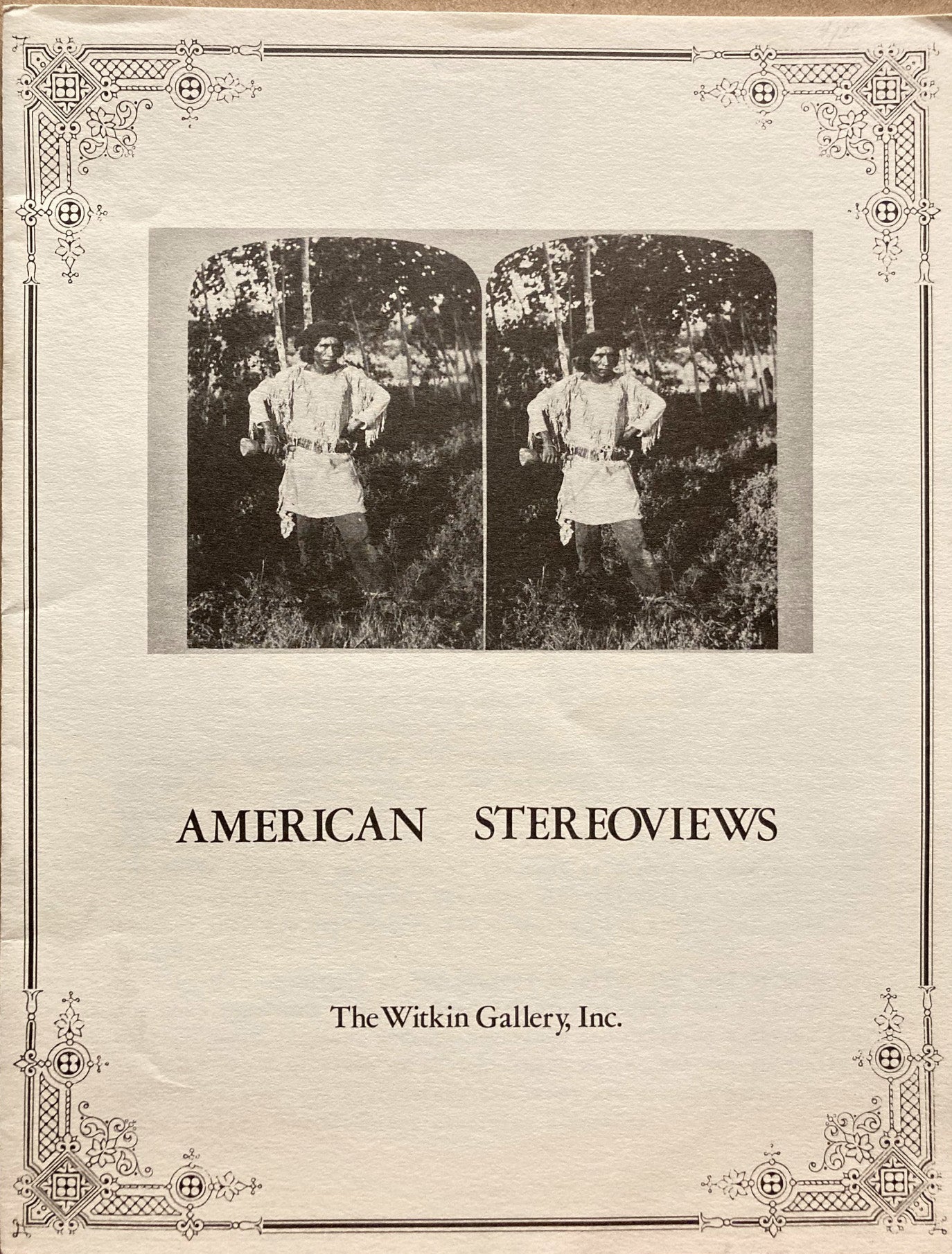
Witkin Gallery, 1979. Sales catalog with stereograph views by George Barker; Bell & Brother; H.H. Bennett; Jeremiah Gurney and son; Jack Hillers; Thomas Houseworth; William Henry Jackson; W.S. Jones; J. Robert Moore; S.J. Morrow; Eadweard Muybridge; F.A. Rinehart; Charles Roscoe Savage and George Martin Ottinger; Seneca Ray Stoddard; Carleton Watkins; et al. Stapled wraps, 16 pages, 24 illustrated lots, list of 25 views not illustrated, and list of three reference books. Like new. Very uncommon. Summary:
American Stereoviews (1979) is a specialized exhibition catalog published by the legendary Witkin Gallery in New York City to document a comprehensive historical survey and commercial sale of late 19th- and early 20th-century stereoscopic photography. Under the direction of pioneering gallerist Lee Witkin, this publication marks a significant moment in the late-19th-century photography revival, treating dual-image stereoview cards as highly collectible fine art and vital historical documents rather than mere antique parlor novelties.
Key Elements of the Work
-
The Curatorial Survey: The catalog acts as a structured archive for hundreds of original vintage stereoviews. It categorizes the cards into distinct historical and cultural themes, providing an expansive cross-section of American life captured through the illusion of three-dimensional depth.
-
Geographical and Industrial Expansion: A major portion of the publication documents the raw, expanding landscape of the post-Civil War United States. This includes iconic stereoview series focusing on Western exploration, the construction of the transcontinental railroad, early industrial mining operations, and surveys of Native American territories.
-
Social and Domestic Chronicles: The volume balances monumental landscapes with intimate glimpses into Victorian-era American society. It catalogs stereoviews depicting everyday urban street scenes, domestic parlor rooms, natural disasters, and the widely popular staged comic narratives that served as early visual sitcoms for the 19th-century public.
-
Market Canonization: True to the Witkin Gallery's role as a market-maker for photographic history, the catalog functions as an official sales reference, assigning rarity, condition criteria, and tangible art-market value to ephemeral objects produced by major stereographic publishers like Underwood & Underwood, the Keystone View Company, and Anthony & Co.
Narrative Intent
The publication functions as an institutional effort to validate vernacular photography. By housing mass-produced consumer objects of the 1800s within a formal gallery catalog, the Witkin Gallery successfully elevated the humble American stereoview into the realm of serious art-historical scholarship, demonstrating its value as a foundational building block of modern American visual culture.
