Gary Saretzky Photo Books
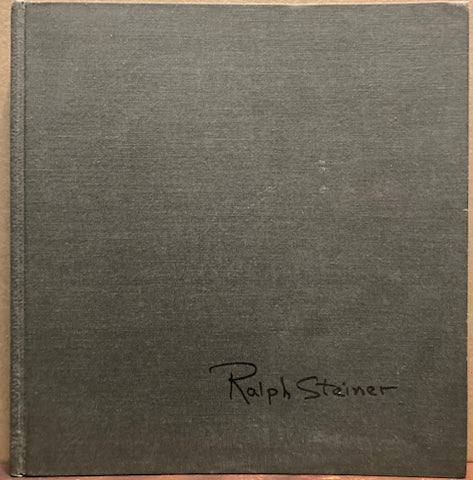
Steiner, Ralph. A Point of View by Ralph Steiner.
Steiner, Ralph. A Point of View by Ralph Steiner.
Couldn't load pickup availability
Wesleyan University, 1978. Introduction by Willard Van Dyke. Autobiographical essays by Ralph Steiner with a retrospective of more than 50 years of photographs. 1st ed., 1st printing. [Ralph Steiner (1899–1986) was a photographer and film maker who became a leader in avant garde photography and film in the 1920s and 1930s. Steiner produced A Point of View in Vermont after he retired from commercial work in 1962.] Cloth bound, VG+ without dust jacket. Custom made 4-mil polyester jacket. Summary:
A Point of View (1978), published by Wesleyan University Press, is a definitive retrospective monograph and artistic memoir by Ralph Steiner, a seminal figure in American modern photography and avant-garde filmmaking. Over its 144 pages, the book brings together over 100 meticulously reproduced plates spanning more than a half-century of Steiner's creative output, framed directly by his own witty, highly independent, and iconoclastic commentary.
Key Elements of the Work
-
A Half-Century Retrospective: The book tracks Steiner’s career from the 1920s through the late 1970s. It features his iconic early Clarence White School-influenced patterns, sharp-focus Manhattan architectural geometry, Madison Avenue advertising assignments, and his legendary documentation of American material culture (such as his famous Typewriter Keys and rural billboard photographs).
-
The Intersecting Eyes: The volume bridges the gap between Steiner’s achievements as a still photographer and his landmark work as a progressive filmmaker (celebrated for H2O and his collaboration on The City). The images emphasize a highly dynamic, cinematic approach to framing and light, showcasing how his moving-image sensibilities infused his static compositions.
-
Candid Written Narrative: A cornerstone of the monograph is Steiner’s extensive introductory text and anecdotal captions. Rejecting the dry, overly theoretical jargon of traditional art criticism, Steiner writes with self-deprecating humor and sharp candor. He reflects openly on his creative failures, his technical shifts, and his struggles to balance commercial economic survival with pure artistic integrity.
-
The Philosophy of Looking: The title itself speaks to Steiner's core aesthetic ideology. The text rejects the solemn, rigid pretension often found in the early modernist circles of his contemporaries, arguing instead that photography should be an act of joyful, unforced looking—capturing the surrealism, irony, and unexpected beauty buried in everyday, vernacular environments.
Narrative Intent
The monograph functions as an intimate, humanized look at the evolution of modern American vision. By pairing a lifetimes' worth of brilliant master prints with his raw, unfiltered personal philosophy, Steiner constructs a book that is part historical record and part masterclass, proving that a photographer's ultimate tool is not a complex piece of equipment, but a uniquely curious and uncompromising "point of view."
Note: Born in Cleveland, photographer and film maker Ralph Steiner. studied chemistry at Dartmouth, then in 1921 entered the Clarence H. White School of Modern Photography in New York. His photographs with a strong sense of abstraction led to advertising assignments for magazines like the Ladies' Home Journal. In the 1930s, Steiner was a cinematographer with Leo Hurwitz in the Nikino production company, which transitioned into Frontier Films, for which he worked with director Pare Lorentz on The Plow That Broke the Plains. With Willard Van Dyke, Steiner co-directed The City, with music by Aaron Copland, that opened at the New York World’s Fair in 1939. After a few years in Hollywood, where he photographed “Gypsy Rose Lee and Her Entourage” (1944), Steiner’s later career in New York was largely in magazine assignments before he retired to Vermont in 1962. Bill Jay, who photographed Steiner for his book, Photographers Photographed (1983), described him as “a contentious, feisty little man. His opinions are delivered with such fiery, goggle-eyed vehemence that the audience is verbally bludgeoned into acquiescence.”
