Gary Saretzky Photo Books
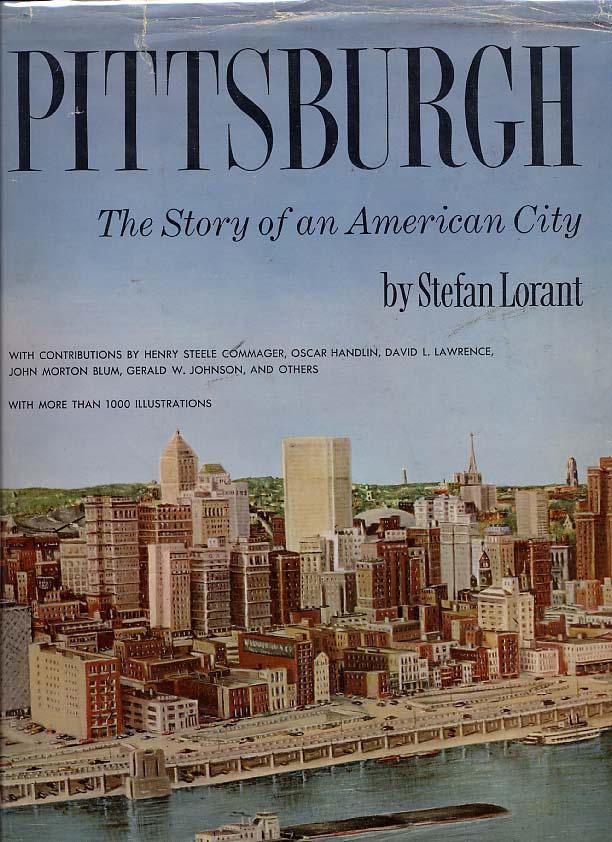
Smith, W. Eugene. Pittsburgh: The Story of an American City by Stefan Lorant. Photographs by W. Eugene Smith, et al.
Smith, W. Eugene. Pittsburgh: The Story of an American City by Stefan Lorant. Photographs by W. Eugene Smith, et al.
Couldn't load pickup availability
Doubleday, 1964. 1st edition. With contributions by Henry Steele Commager, Oscar Handlin, David L. Lawrence, John Morton Blum, Gerald W. Johnson, and others, with more than 1,000 illustrations. This huge book is especially notable for the many photographs by one of the great photographers of the 20th century, W. Eugene Smith. Lorant hired Smith to come to Pittsburgh for a relatively short time to fill in some gaps and Smith ended up living with Lorant for an extended time and exposing about 10,000 negatives. Smith became totally engrossed in trying to produce a photographic portrait of the city in all its facets and was never able to complete his own book on the subject, although there have been several publications that include his Pittsburgh photographs, including Lorant's book offered here. In addition to its importance in the literature of photography, Lorant's book is a wonderful resource on the history of Pittsburgh. It reproduces documents and paintings from 200 years of the city's history, with chapters by Pittsburgh's leading historians. Reproductions by artists include paintings by David Blythe, William C. Wall, Russell Smith, John Kane, Samuel Rosenberg, William Libby, Roy Hilton, Edwin Anderson, Marty Cornelius, and Idabell Kleinhans. Aside from about 50 photographs by Smith, the book includes work by many other fine photographers including about a dozen by Margaret Bourke-White, as well as by Arthur Rothstein, Luke Swank, John Vachon, Frank E. Bingaman, and others. Near fine with dust jacket that has wear along top edge and a chip along top edge of spine extending to back cover. Another copy, very good without dust jacket, short tear at base of spine, otherwise fine. Heavy book, requires more postage than most items in my store. Summary:
First published in 1964, Pittsburgh: The Story of an American City is a comprehensive pictorial history that chronicles the evolution of Pittsburgh from its 18th-century origins as a frontier outpost into a global industrial capital, concluding with its mid-20th-century urban modernization.
Core Content and Narrative
The book utilizes a chronological approach to tell the city's story, weaving historical text together with over 1,100 illustrations, paintings, maps, and photographs. The narrative spans several distinct eras:
-
The Frontier Foundation: Explores the strategic military and geopolitical importance of the "Three Rivers" fork, detailing early forts and conflicts during the French and Indian War.
-
The Steel Empire: Charts the dramatic industrial boom driven by the rise of massive manufacturing operations, mapping the growth of the prosperous city that fueled America's Gilded Age.
-
The Renaissance: Highlights the post-WWII civic collaborations that aimed to clean up industrial smog, implement flood control, and modernize the urban infrastructure.
Photographers
W. Eugene Smith: The book famously features a significant selection of images from Smith’s legendary, obsessive Pittsburgh project. Originally hired by Lorant in 1955 for a short three-week assignment to provide a few dozen photos for the book, Smith became consumed by the city. He stayed for months and took thousands of photographs, capturing the raw, dramatic, and poetic essence of steelworkers, smoky neighborhoods, and towering blast furnaces.
Margaret Bourke-White: Features striking, industrial photographs that emphasize the architectural scale and power of Pittsburgh's heavy manufacturing infrastructure.
Additional Visuals: Includes documentary photographs by Norman W. Schumm, historical etchings, and images taken by Lorant himself, resulting in an unparalleled visual archive of a quintessential American city.
Visual Composition
The publication is highly regarded for its extensive visual documentation. It relies on extensive photojournalism to capture the atmosphere of the city, utilizing historical etchings alongside striking documentary photography. The imagery heavily emphasizes the architectural scale of heavy manufacturing, the daily lives of local residents, and the intense environments of the steel mills, creating a definitive visual archive of the city's history.
