Gary Saretzky Photo Books
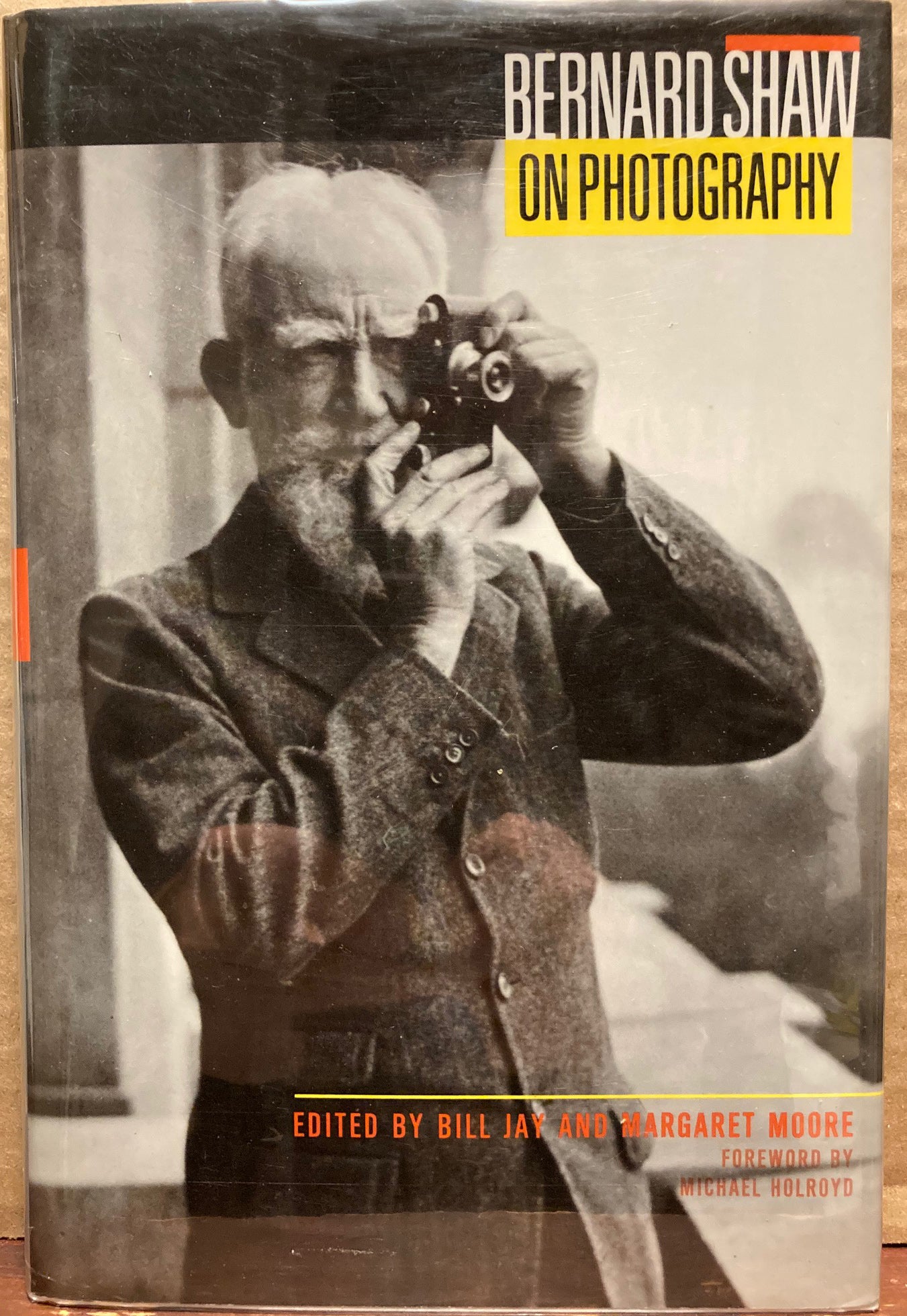
Shaw, Bernard. Bernard Shaw on Photography.
Shaw, Bernard. Bernard Shaw on Photography.
Couldn't load pickup availability
Peregrine Smith, 1989, 1st edition, 1st printing. Edited by Bill Jay and Margaret Moore. Foreword by Michael Holroyd. [Shaw was an avid amateur photographer and wrote many essays and exhibition reviews on the subject, the most important collected here. Subjects include Frederick Evans, Alvin Langdon Coburn, relation of photography to art, etc.] Fine with fine, protected dust jacket. Like new with very minor shelf wear on bottom edge. (Note: picture of dust jacket shows reflections, not stains.) Summary:
Bernard Shaw on Photography is a fascinating, comprehensive compilation of essays, reviews, and photographs by the legendary Irish playwright George Bernard Shaw. While widely celebrated for his contributions to theatre and literature, Shaw was also a prolific photography critic and an avid practitioner who took thousands of photographs over a fifty-year period. This book brings together his sharp-witted, often polemical writings on the medium alongside a selection of his own images.
Key Elements of the Book
-
The Argument for "Unmechanical" Art: A core thesis running through Shaw’s photographic essays is his defense of photography as a legitimate, high art form. Paradoxically, he argued that photography was actually less mechanical than traditional painting or drawing, claiming that while a painter relied on manual dexterity and conventional stylistic tricks, a photographer captured a pure, direct, and unmanipulated truth about the physical world.
-
Photography as a Tool for Social Reform: Deeply rooted in his Fabian socialist beliefs, Shaw saw the camera as an activist medium. He believed the brutal, unvarnished visual truths captured by photographs could act as catalysts for spiritual evolution and social change, shattering the romanticized illusions often peddled by traditional academic painters.
-
Critiques of Contemporary Movements: The collection highlights Shaw's active involvement in turn-of-the-century aesthetic debates. He heavily critiqued the Royal Photographic Society's rigid, old-fashioned standards and became a champion of the Linked Ring Brotherhood and Pictorialism, which fought to establish photography as a fine art.
-
Shaw behind the Lens: In addition to his essays, the book reproduces numerous black-and-white plates of Shaw’s own photographic work. These include intimate portraits of cultural figures, landscapes, and striking, playful self-portraits, such as his famous photograph replicating Auguste Rodin's sculpture The Thinker.
Summary
Bernard Shaw on Photography provides an invaluable look into an underappreciated facet of one of the 20th century's greatest minds. It encapsulates Shaw’s unique ability to blend art criticism, technical processes, and social politics, proving that he viewed the camera not as a hobbyist's toy, but as a revolutionary artistic instrument.
