Gary Saretzky Photo Books
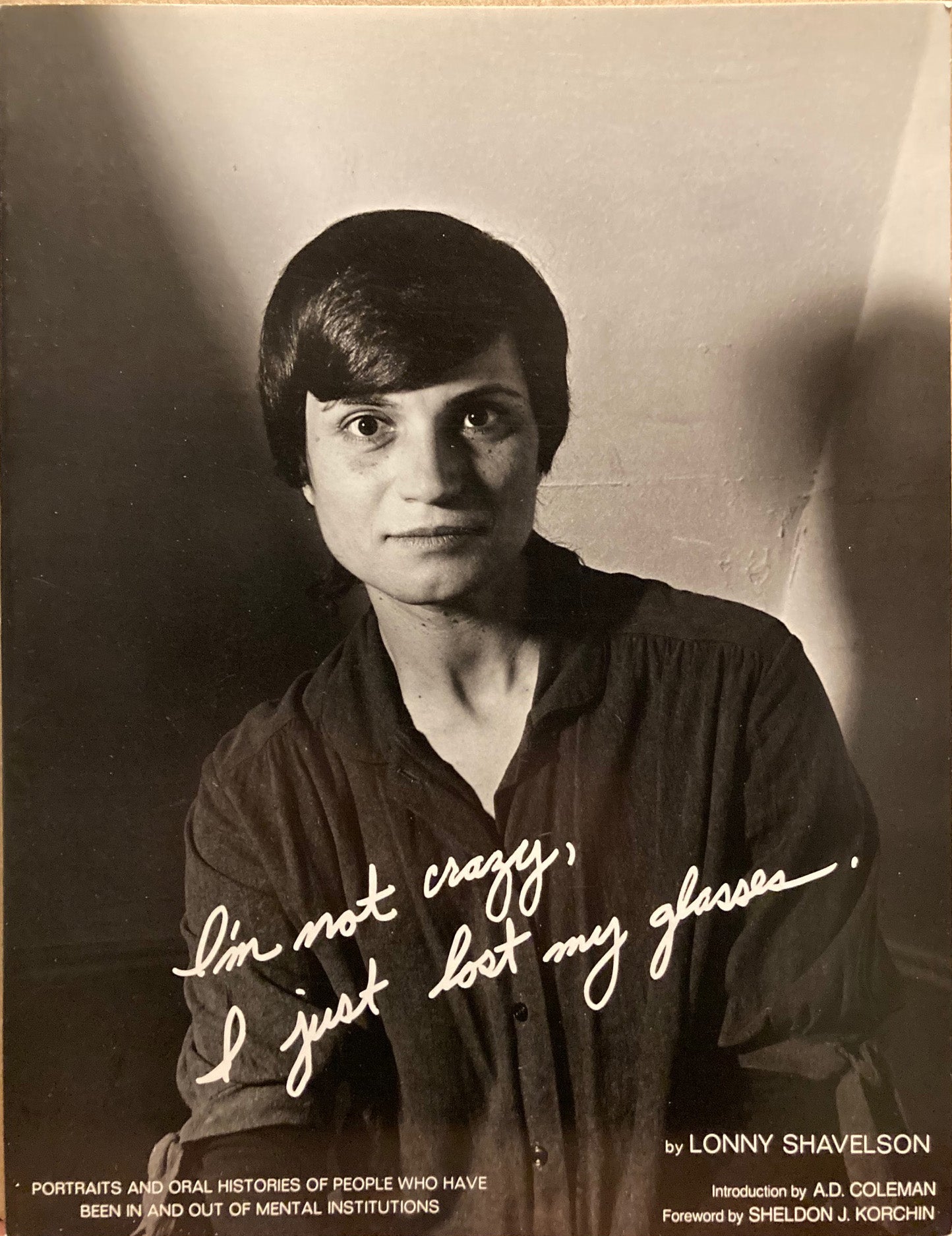
Shavelson, Lonny. I'm Not Crazy, I Just Lost My Glasses by Lonny Shavelson.
Shavelson, Lonny. I'm Not Crazy, I Just Lost My Glasses by Lonny Shavelson.
Couldn't load pickup availability
Portraits and Oral Histories of People Who Have Been In and Out of Mental Institutions by Lonny Shavelson. De Novo, 1986. Introduction by A.D. Coleman. Foreword by Sheldon J. Korchin. Full page black-and-white portraits by Shavelson with text on facing pages. Images of people with mental disabilities. Stiff illustrated wraps, unpaginated (about 92 pages). Like new. Summary:
hank you! Here is the revised summary with a cleaner, more streamlined flow:
I'm Not Crazy, I Just Lost My Glasses is a powerful, groundbreaking photo-documentary book by photojournalist and author Lonny Shavelson. Subtitled Portraits and Oral Histories of People Who Have Been In and Out of Mental Institutions, the book explores the raw, lived experiences of individuals navigating the American mental health system, featuring an introduction by prominent photography critic A.D. Coleman and a foreword by psychologist Sheldon J. Korchin.
Key Elements of the Book
-
The Intersection of Portraiture and Oral History: The book utilizes a deliberate, alternating layout where full-page black-and-white portraits face raw, unedited first-person testimonies from the subjects. This formatting ensures that the individuals are not merely observed, but actively heard, letting them control their own narratives.
-
Challenging Stigma and Stereotypes: The provocative title underscores a central theme: the terrifying ease with which the actions of those labeled "mentally ill" are pathologized by society. A simple moment of distress or confusion—like misplacing one's glasses—can be weaponized by onlookers or authorities as proof of madness.
-
A Critique of Institutionalization: Shavelson's work provides an intimate look at the revolving-door nature of mental institutions. The oral histories expose systemic failures, the trauma of forced confinement, the heavy reliance on over-medication, and the profound isolation people face both inside institutions and after being released into an unsupportive society.
-
Humanizing the Invisible: Influenced by his background as both a photojournalist and a medical professional, Shavelson avoids sensationalism. His portraits are intimate, respectful, and intensely human, capturing a spectrum of emotion—including vulnerability, anger, humor, and resilience—that strips away the clinical detachment often found in medical or sociological studies.
Summary
I'm Not Crazy, I Just Lost My Glasses serves as an empathetic and critical bridge between documentary art and mental health advocacy. By combining dignified visual portraiture with unfiltered personal testimonies, Lonny Shavelson confronts societal discomfort with mental illness and forces the reader to acknowledge the fundamental humanity and agency of a deeply marginalized population.
