Gary Saretzky Photo Books
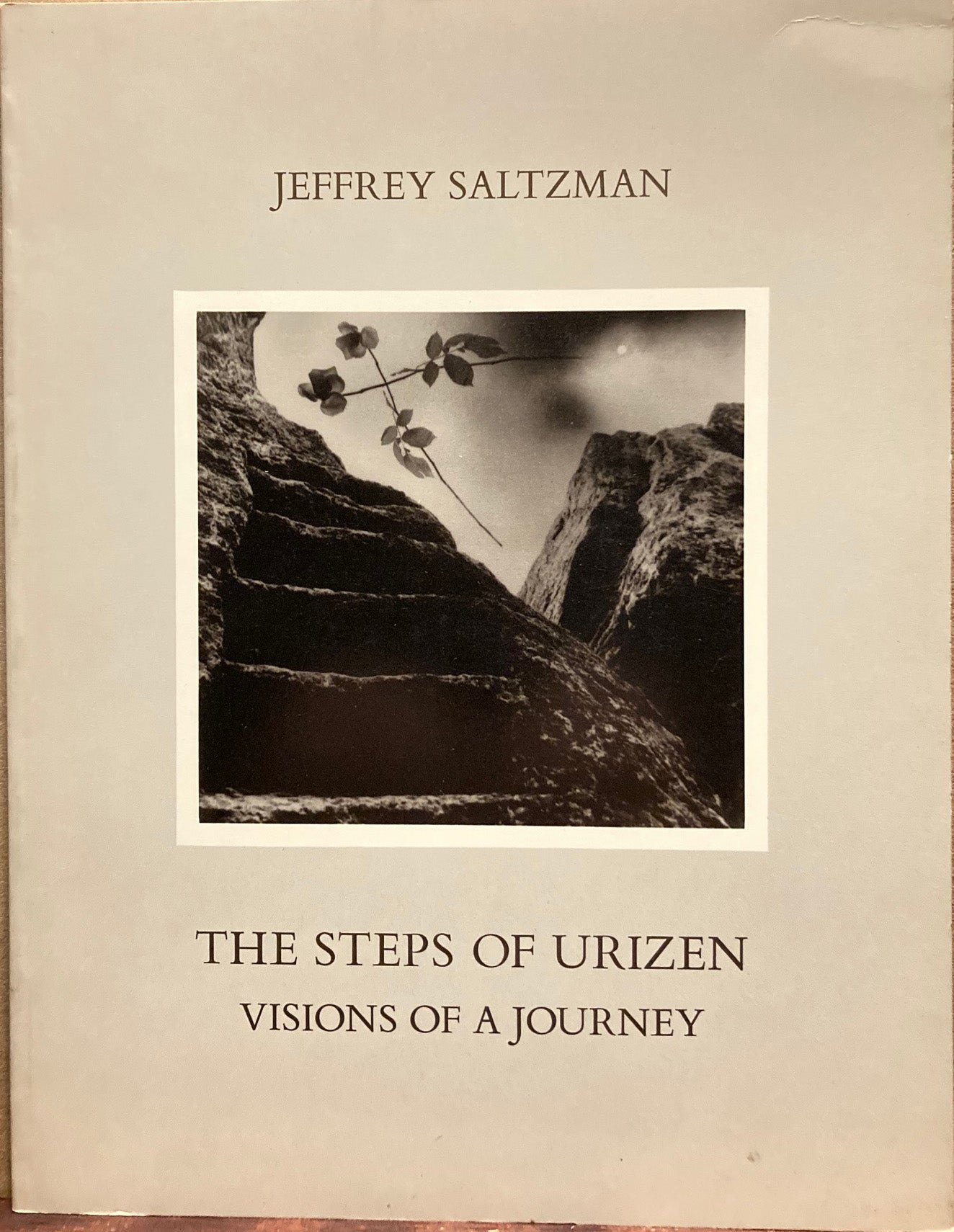
Saltzman, Jeffrey. The Steps of Urizen: Visions of a Journey by Jeffrey Saltzman.
Saltzman, Jeffrey. The Steps of Urizen: Visions of a Journey by Jeffrey Saltzman.
Couldn't load pickup availability
Alan Wofsey Fine Arts, 1975. [Photomontages portraying a personal journey through the world created by Urizen in the mythology of William Blake. 23 plates. Predominantly landscapes, sometimes including a woman.] Crimp in back cover, otherwise fine, wraps as issued. Summary:
The Steps of Urizen: Visions of a Journey is an evocative, highly conceptual fine-art photography monograph by American photographer Jeffrey Saltzman, published in 1980 by Alan Wofsey Fine Arts. Following the stylistic blueprint of his previous work, this volume uses a sequence of dramatic, high-contrast duotone black-and-white plates to construct a deeply psychological, visual narrative loosely inspired by the complex mythology of the visionary English poet and artist William Blake.
Key Overview and Objectives
-
A Visual Adaptation of Blake: The primary objective of the book is to translate the spirit of William Blake’s prophetic texts—specifically The Book of Urizen—into a modern photographic landscape. In Blake's mythology, Urizen represents cold reason, law, and architecture, often trapped in a dark world of his own creation.
-
The Concept of the Journey: Saltzman uses the monograph format to map out a dark, symbolic pilgrimage. The "steps" imply a descent or progress through an internal, labyrinthine environment where the human soul grapples with structure, confinement, and existential isolation.
Core Themes and Visual Style
-
Monolithic and Oppressive Architecture: Reflecting the nature of Urizen, the imagery is dominated by imposing, classical, and neoclassical architectural forms. Massive stone steps, sweeping staircases, dark archways, and looming columns create a sense of overwhelming weight, scale, and cold, mathematical order.
-
The Anonymous Figure: Shadowy, often nude human figures are meticulously placed within these monolithic spaces. Rather than traditional portrait subjects, these figures act as universal archetypes or lost souls. They are frequently seen climbing, descending, or collapsing against the stone, illustrating the friction between vulnerable humanity and rigid, oppressive structures.
-
Chiaroscuro and Pictorialist Atmosphere: Saltzman utilizes an extreme chiaroscuro style, defined by a dramatic interplay of deep, pitch-black shadows and piercing highlights. Combined with a signature soft-focus technique, the images possess a grainy, dreamlike, and timeless quality that feels more akin to dark surrealist etchings than straight documentary photography.
Significance
The Steps of Urizen remains an exceptional example of post-modern, narrative-driven fine-art photography from the early 1980s. By boldly bridging the gap between romantic 19th-century literature and contemporary analog manipulation, Saltzman’s book stands as a highly cohesive, atmospheric masterpiece that treats the camera not as a tool for recording objective reality, but as a portal into the human subconscious.
