Gary Saretzky Photo Books
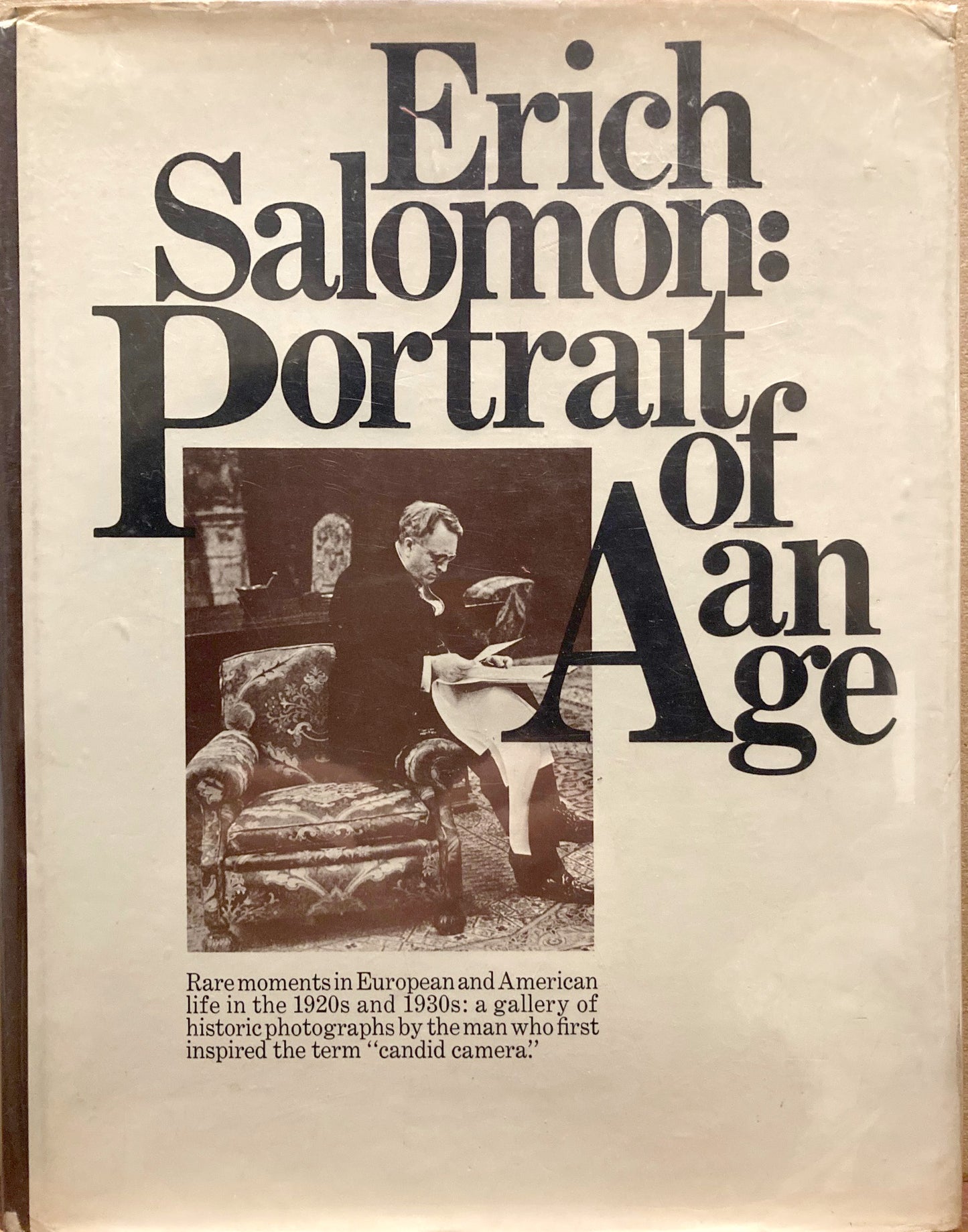
Salomon, Erich. Erich Salomon: Portrait of an Age.
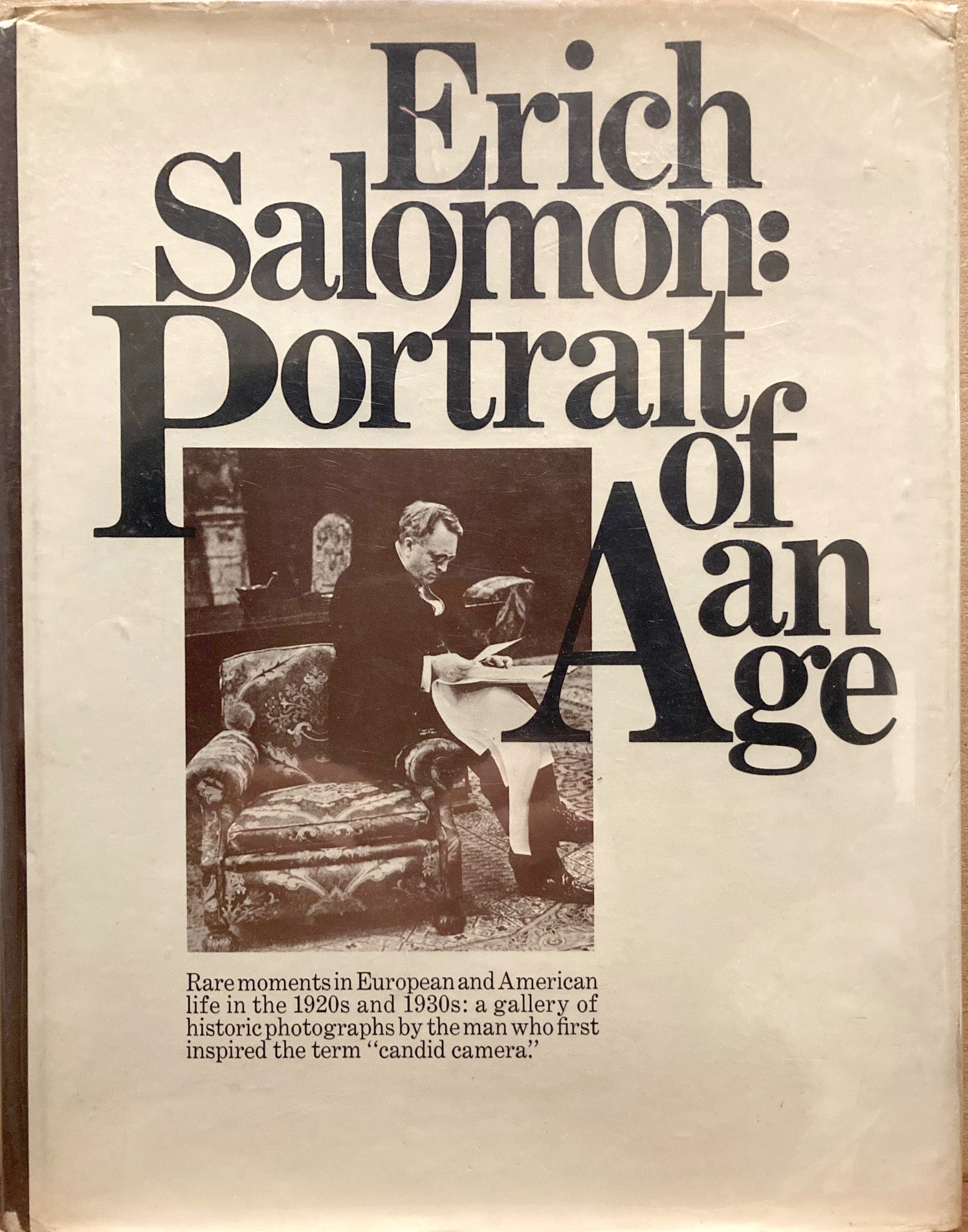
Salomon, Erich. Erich Salomon: Portrait of an Age.
Couldn't load pickup availability
Macmillan, 1967. Essay by Peter Hunter-Salomon. Hardcover with protected dust jacket. 1st American edition. A VG+ copy with VG dust jacket that has a few small chips at extremities. [Salomon was the first "candid camera" photographer. With remarkable chutzpah, he gained access to high level political meetings and even the U.S. Supreme Court and took pictures without his subjects' knowledge. Some of the people who appear in this book include Vilma Banky, French Premier Leon Blum, Senator William E. Borah, Prussian Prime Minister Otto Braun, French Foreign Minister, Aristide Briand, British Prime Minister Neville Chamberlain, Winston Churchill, Marion Davies, Marlene Dietrich, Albert Einstein, King Fuad of Egypt, Dr. Joseph Goebbels, Emperor Haile Selassie, William Randolph Hearst, Princess Juliana (later Queen) of the Netherlands, French Premier Pierre Laval, Max Liebermann, Soviet Foreign Minister Maxim Litvinov, English Prime Minister David Lloyd George, President of Reichstag Paul Lobe, English Prime Minister Ramsay MacDonald, Thomas Mann, Heinrich Mann, Dr. Otto Meissner, Benito Mussolini, Fritjof Nansen, Count Oberndorff, Cardinal Eugenio Pacelli (later Pope), German Chancellor Franz von Papen, Auguste Piccard, French Premier Raymond Poincare, Dolores del Rio, Owen J. Roberts, Eleanor Roosevelt, Franklin Delano Roosevelt, Max Schmeling, Upton Sinclair, Governor Alfred E. Smith, Richard Strauss, Igor Stravinsky, Arturo Toscanini, Bruno Walter, ex-Queen Wilhelmina of Netherlands, Klara Zetkin, et al. Declining an invitation to stay in America, Salomon returned to Europe and died at Auschwitz in 1944.]
Erich Salomon (1886–1944) was a German news photographer widely recognized as a pioneer of modern photojournalism and candid photography. Holding a doctorate in law from the University of Munich, he initially pursued careers in engineering, law, and promotion before turning to photography in his mid-40s. Utilizing compact, unobtrusive cameras equipped with fast lenses—such as the Ermanox and early Leica models—Salomon specialized in capturing unposed, intimate photographs of world leaders, diplomats, and cultural figures in high-profile, guarded environments, earning him the nickname "King of Indiscretion". His groundbreaking approach revolutionized picture journalism, culminating in his celebrated 1931 photobook Berühmte Zeitgenossen in unbewachten Augenblicken (Celebrated Contemporaries in Unguarded Moments). Today, his legacy as a photojournalistic innovator is honored by the German Society for Photography through the prestigious Dr. Erich Salomon Award.
Erich Salomon: Portrait of an Age
Edited by Han de Vries and Peter Hunter-Salomon, 1967
Erich Salomon: Portrait of an Age is a monumental, posthumous photographic monograph published by Macmillan. The book compiles the pioneering work of German-born photojournalist Dr. Erich Salomon, who was tragically killed at Auschwitz in 1944. The volume serves as a historical record of the shifting geopolitical, cultural, and social landscapes of Europe and the United States between the two World Wars.
Key Overview and Objectives
-
The Father of Modern Photojournalism: The primary objective of the publication is to cement Salomon’s status as a revolutionary figure in media history. He was the man for whom the term "candid camera" was originally coined, fundamentally changing how the public viewed people of power.
-
A Witness to History: The book functions as an insider's look at the fragile Weimar Republic, the League of Nations, and the high-stakes international diplomacy of the late 1920s and 1930s that preceded the outbreak of World War II.
Core Themes and Visual Style
-
The Unguarded Moment: Salomon’s defining signature was catching his prominent subjects completely off-guard. By rejecting the stiff, staged portraiture of the era, the book displays world leaders, royalty, and celebrities yawning, arguing, laughing, and slumped in exhaustion during late-night political debates or lavish banquets.
-
Technological Stealth: The text explores how Salomon utilized cutting-edge technology—primarily the small, lightweight Ermanox camera and later the Leica—equipped with exceptionally fast lenses. This allowed him to shoot in ultra-low, indoor ambient light without a disruptive flash, enabling him to blend into the background of high-profile events unnoticed.
-
Elite Geographies: The collection maps out the epicenter of interwar power and culture. Images flow through the political halls of Berlin, Paris, Geneva, London, and Washington, DC, before transitioning to the glamour of Hollywood and the cultural elite, featuring iconic figures like Marlene Dietrich, Albert Einstein, and Winston Churchill.
Significance
Erich Salomon: Portrait of an Age is an indispensable text in the history of photography. It documents the transition of the medium into a vital tool for news reporting and social commentary, demonstrating how one photographer with a hidden camera could pull back the curtain on the world's most powerful institutions to humanize history in real time.