Gary Saretzky Photo Books
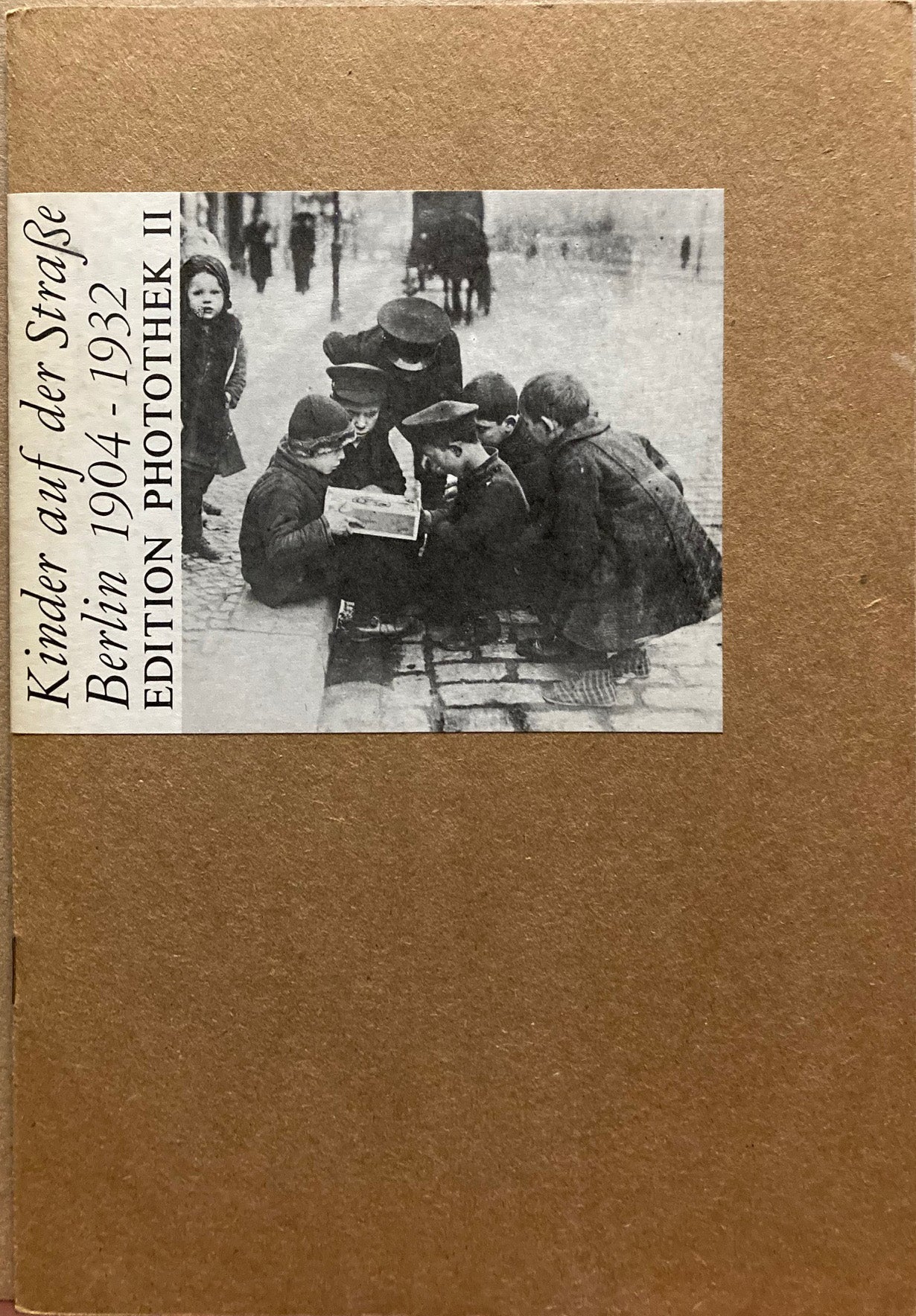
Römer, Willy. Willy Römer: Kinder auf der Strasse. Berlin 1904-1932.
Römer, Willy. Willy Römer: Kinder auf der Strasse. Berlin 1904-1932.
Couldn't load pickup availability
Edition Photothek II. Dirk Nishen Verlag in Kreuzberg. Dirk Nishen, 1983. Text by Diethart Kerbs in German. Street photography of children in Berlin, Germany, in black-and-white. Willy Römer (1887–1979) was a Berlin photojournalist who covered numerous events of the German Revolution, including the Spartakist rising of January 1919.] Wraps, 32 pages, fine with price label on back cover. Summary:
Willy Römer: Kinder auf der Straße. Berlin 1904–1932 is a significant historical photobook that compiles the street photography of pioneering German photojournalist Willy Römer. Published by Edition Dirk Nishen, the volume serves as a profound visual archive of working-class childhood in Berlin during a period of intense geopolitical transformation.
Historical Context and Core Narrative
The book covers nearly three decades of Berlin's history, spanning the late Wilhelmine Empire, the devastation of World War I, and the turbulent years of the Weimar Republic. Throughout these shifting political eras, Römer focused his lens on the backyards, alleyways, and cobblestone streets of Berlin’s poorest neighborhoods, such as Wedding and Kreuzberg.
The central narrative documents how children reclaimed the harsh urban environment as their personal playground, finding joy, community, and autonomy despite widespread poverty, political unrest, and economic depression.
Key Visual Themes
-
Improvised Play: The photographs vividly illustrate the creativity of working-class youth, showing children inventing games with minimal resources—playing with hoops, marbles, homemade carts, and treating street gutters or construction sites as playgrounds.
-
Child Labor and Responsibility: Beyond play, Römer documents the stark realities of the era, capturing young children carrying out domestic chores, watching over younger siblings, or working as street vendors to help support their families.
-
Urban Social Spaces: The imagery acts as a detailed architectural and social study of old Berlin, showcasing the daily life that unfolded outside the cramped, dark tenement blocks (Mietskasernen) and directly on the public pavement.
Documentary Value and Impact
-
Candid Photojournalism: Römer was a master of the early, lightweight hand-held camera, allowing him to capture completely unposed, spontaneous interactions without the stiff formality common in early 20th-century studio portraiture.
-
An Eraser of Nostalgia: The book balances a sense of youthful resilience with unvarnished historical realism, preserving an authentic look at a generation of Berliners whose childhoods were shaped by societal upheaval just prior to the rise of the Nazi regime.
