Gary Saretzky Photo Books
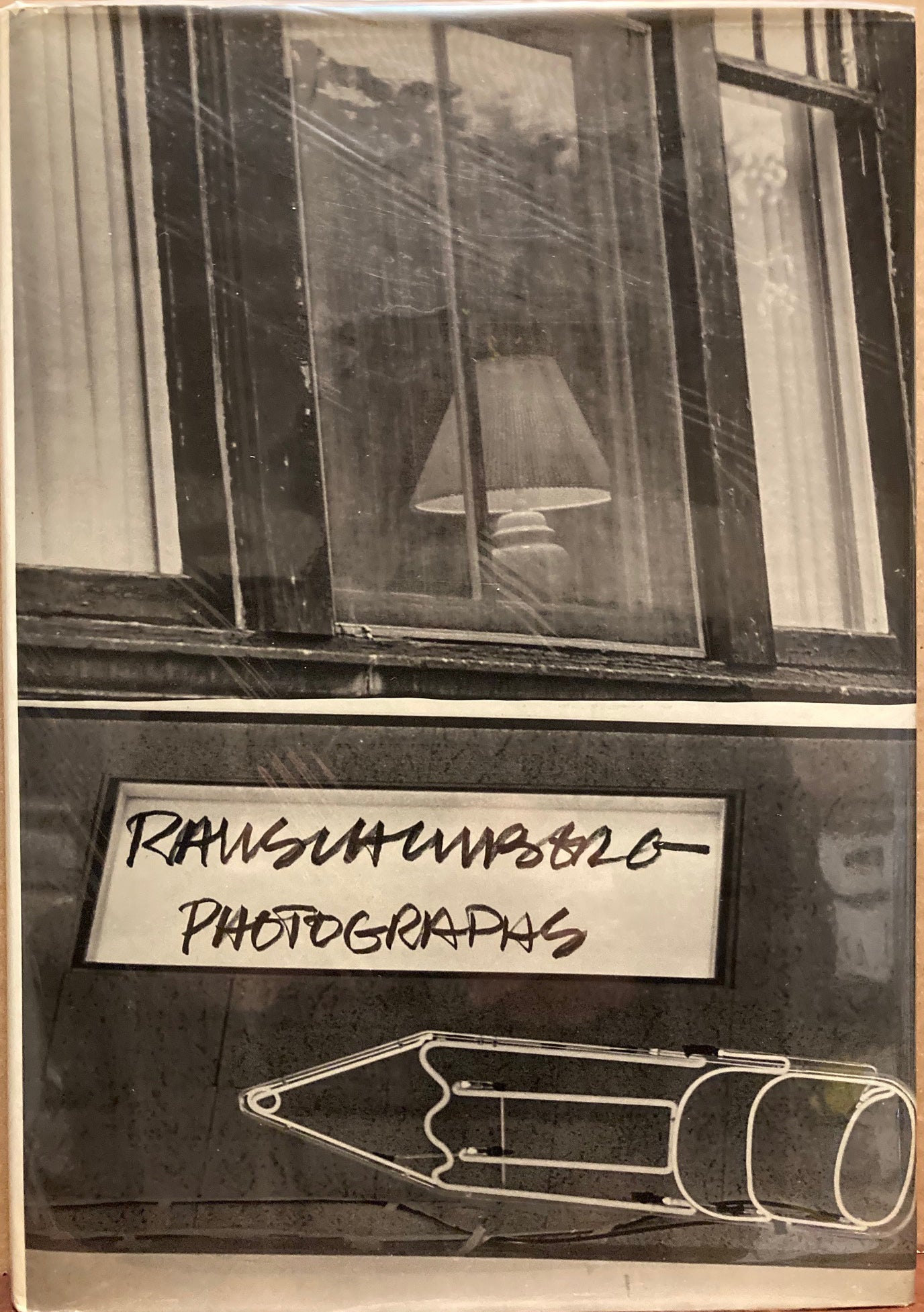
Rauschenberg, Robert. Rauschenberg Photographs by Robert Rauschenberg.
Rauschenberg, Robert. Rauschenberg Photographs by Robert Rauschenberg.
Couldn't load pickup availability
Pantheon, 1981. 1st U.S. edition, also published in France, for which this publication was issued in connection with an exhibition at the Centre Beaubourg in Paris. Very good, with trace of foxing on preliminary title page, in very good protected dust jacket that has two minuscule closed tears on top edge and a crimp on inside of front flap. [A copy of this book sold at the #1971 Swann auction in 2003 for $175, plus buyer's premium.] Summary:
Rauschenberg Photographs (published by Pantheon Books in 1981) is a seminal monograph that establishes photography not merely as a reference tool for Robert Rauschenberg’s celebrated multi-media combines and prints, but as an independent, foundational element of his artistic identity.
The book collects over 120 of his black-and-white photographs taken between 1949 and 1980, tracking his visual excursions across the United States, Europe, and Asia.
Core Themes & Artistic Insights
1. Photography as an Independent Medium
While Rauschenberg is famous for transferring found photographic media into his collages and paintings, this volume frames his straight photography as a distinct, creative practice. The collection demonstrates his sharp eye for composition, texture, and spontaneous geometry in the physical world—proving that his lens work was an active way of "thinking" visually rather than just collecting source material.
2. The Poetry of the Everyday
True to his famous desire to operate "in the gap between art and life," Rauschenberg’s photographs capture quiet, overlooked urban landscapes and domestic details. His imagery focuses heavily on:
-
Decontextualized city signage, storefronts, and architectural fragments.
-
Casual, intimate portraits of close artistic contemporaries, including Cy Twombly, Jasper Johns, Merce Cunningham, and John Cage.
-
The interplay of shadows, reflections in windows, and discarded everyday objects that echo the found-object aesthetic of his sculptures.
3. Early Foundations and Travel Logs
The monograph spans several decades, offering a chronological look at his evolution. It features early, foundational work from his time at Black Mountain College in the late 1940s and early 1950s, alongside expansive visual travelogues from his later journeys through Italy, France, and various regions of the American South.
Rauschenberg Photographs acts as a crucial autobiography of the artist's eye. It reveals that the chaotic, layered energy of his mixed-media masterpieces was rooted in a disciplined, elegant appreciation for the unedited, raw visual moments of daily life.
