Gary Saretzky Photo Books
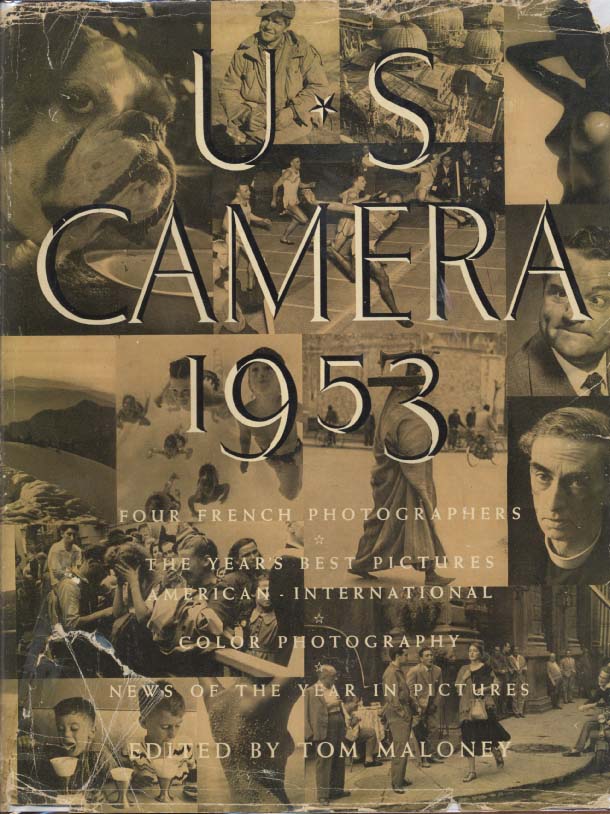
Annuals. U.S. Camera 1953 (annual).
Annuals. U.S. Camera 1953 (annual).
Couldn't load pickup availability
U.S. Camera Publishing Co., 1952. Edited by Tom Maloney. (Feature on Four French Photographers: Brassai, Robert Doisneau, Izis, and Willy Ronis, with portfolios, biographies, and portraits of the photographers. Also Alred Eisenstaedt portfolio of portraits of famous Britons, inc. Augustus John, Joyce Carey, Viscount Moore, Sir Alexander Fleming, Bertrand Russell, Gilbert Murray, et al. Also photos in The Christmas Show at the Museum of Modern Art, New York, by Ansel Adams, Harry Callahan, Robert Frank, Arthur Leipzig, Lisette Model, Arnold Newman, Charles Sheeler, Frederick Sommer, et al. Also other photos by Erwin Blumenfeld, Dmitri Kessel, Roman Vishniac, Ferenc Berko, Eliot Elisofon, Rosalie Gwathmey, Wayne Miller, W. Eugene Smith, Charles Kerlee, Dorothea Lange, Brett Weston, Minor White, and many others.) Summary:
U.S. Camera 1953, edited by Tom Maloney, is a landmark edition that celebrates the high-water mark of post-war humanism. The volume is structured around the growing dialogue between the established American documentary tradition and the lyrical, romantic "street" photography emerging from Europe.
The French Humanists
A major highlight of this edition is the extensive feature on Four French Photographers, which helped solidify the "Humanist" movement in the American consciousness:
-
Brassaï, Robert Doisneau, Izis, and Willy Ronis: Each is presented with a dedicated portfolio, biography, and a portrait of the artist.
-
This section captures the "poetic realism" of Paris—from Doisneau’s whimsical street scenes to Brassaï’s nocturnal mysteries—emphasizing a gentler, more observational approach to life following the trauma of World War II.
Eisenstaedt’s "Famous Britons"
Alfred Eisenstaedt, the master of the candid portrait, contributes a sophisticated portfolio of influential British figures.
-
Using his signature 35mm Leica, Eisenstaedt strips away the stiffness of traditional formal portraiture to capture the "inner life" of intellectuals and artists such as Sir Alexander Fleming, Bertrand Russell, and Augustus John.
MoMA: The Christmas Show
The annual provides a rare look at the Museum of Modern Art’s "Christmas Show" in New York, curated by Edward Steichen. This section serves as a preview of the "New York School" and the future of art photography:
-
Robert Frank & Harry Callahan: Features early, experimental work that challenged traditional composition.
-
Lisette Model & Arthur Leipzig: Showcases the raw, high-contrast energy of New York City street life.
-
Frederick Sommer & Charles Sheeler: Highlights the intersection of photography with surrealism and precisionist painting.
A Survey of Global Masters
The 1953 volume is exceptionally dense with work from the era's most significant practitioners:
-
The Concerned Lens: Includes W. Eugene Smith, Dorothea Lange, and Wayne Miller, who continued to push the boundaries of social documentation.
-
Formalism and Landscape: Ansel Adams, Brett Weston, and Minor White provide a counterpoint of technical perfection and natural abstraction.
-
Visionary Perspectives: Roman Vishniac (documenting Jewish life), Erwin Blumenfeld (avant-garde fashion), and Eliot Elisofon (monumental travel/color) showcase the medium's expanding reach.
Significance
The 1953 Annual is characterized by its editorial balance. By placing the "Four Frenchmen" alongside the starker visions found in the MoMA Christmas Show, Tom Maloney illustrated the diverging paths of the medium: one toward the lyrical and sentimental, the other toward the abstract and psychological. It remains a definitive record of the year photography truly became a global, high-art conversation.
Available Conditions:
- 1: Very good except worn spots on bottom edge near spine, with good, chipped, mylar protected dust jacket.
- 2: Protected good edge-worn dust jacket generally better than above but has a piece of tape on verso.
- 3: Protected good edge-worn jacket, largely intact with some short edge tears closed with archival repair tape on inside. Book very good with a few small spots on fore edge.