Gary Saretzky Photo Books
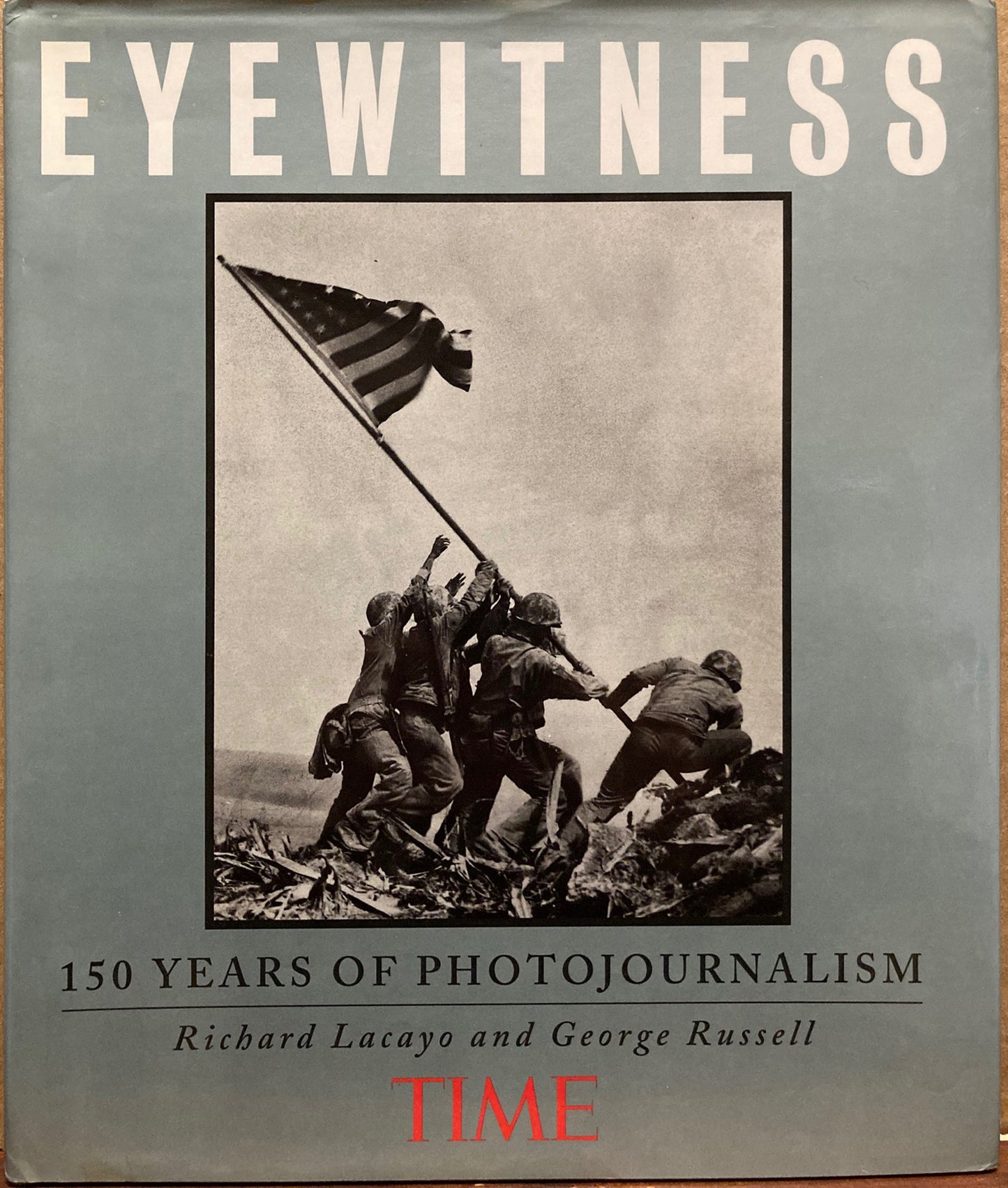
Photojournalism. Eyewitness: 150 Years of Photojournalism by Richard Lacayo and George Russell.
Photojournalism. Eyewitness: 150 Years of Photojournalism by Richard Lacayo and George Russell.
Couldn't load pickup availability
2nd revised edition. Time, 1995. Includes photos from 1990-1995 not in 1st edition. Different dust jacket than first edition features Joe Rosenthal's raising the flag at Iwo Jima. More recent photos include color. Photographers include George Barnard, Margaret Bourke-White, Robert Capa, Henri Cartier-Bresson, Bruce Davidson, Alfred Eisenstaedt, Walker Evans, Roger Fenton, Leonard Freed, Tim Gidal, Dorothea Lange, Jacob Riis, Arthur Rothstein, W. Eugene Smith, and many others. Includes detailed subject and name index. VG+ with VG+ dust jacket. Summary:
Eyewitness: 150 Years of Photojournalism (published by Time Inc. Books in 1990) is an expansive, 192-page historical survey authored by TIME magazine writers Richard Lacayo and George Russell. Released shortly after the 150th anniversary of the invention of photography, the heavily illustrated volume chronicles the global history of news photography, analyzing how the camera transformed from an experimental laboratory novelty into the world's most powerful medium for documenting current events and shaping public opinion.
Core Content & Chronological Structure
1. The Direct Witness: 1839–1880
The opening section traces the rugged origins of the medium, focusing on the technical challenges and monumental achievements of early pioneering photographers. The historical narrative details how figures like Roger Fenton during the Crimean War and Mathew Brady's studio during the American Civil War first brought the grim realities of distant battlefields to home audiences. The text analyzes how these early, static glass-plate images fundamentally altered society's relationship with historical truth, replacing idealized artistic illustrations with unyielding, mechanical records.
2. The Era of Social Conscience and Mass Media: 1880–1930
The midsection examines the rapid technological evolution that allowed cameras to enter daily street life. The analysis highlights the introduction of half-tone printing and flash powder, which enabled newspapers to mass-reproduce candid indoor photography. Special emphasis is placed on social reformers like Jacob Riis and Lewis Hine, who utilized the camera as an instrument for legislative change by exposing urban poverty and child labor, followed by the birth of modern tabloid sensationalism and the competitive news agencies of the early 20th century.
3. The Golden Age and the Television Era: 1930–1990
The final chapters survey the height of the printed picture magazine culture and its subsequent battle for relevance against broadcast television. The authors map the influence of elite photojournalists—such as Robert Capa, Margaret Bourke-White, and W. Eugene Smith—whose work in publications like LIFE and Picture Post defined the visual history of World War II and the rise of post-war consumer culture. The text finishes with a critical assessment of late-20th-century photojournalism, examining how photographers adapted to modern global conflicts and television's immediate news delivery by capturing deeply personal, highly conceptual, and enduring iconic imagery.
Eyewitness: 150 Years of Photojournalism stands as an essential reference work that synthesizes a century and a half of human struggle, triumph, and cultural transformation through the lens of the camera eye. By combining authoritative journalistic commentary with a museum-grade gallery of historic news frames, Lacayo and Russell successfully preserve the structural legacy of the physical print press and validate the photojournalist as humanity's primary historical recorder.