Gary Saretzky Photo Books
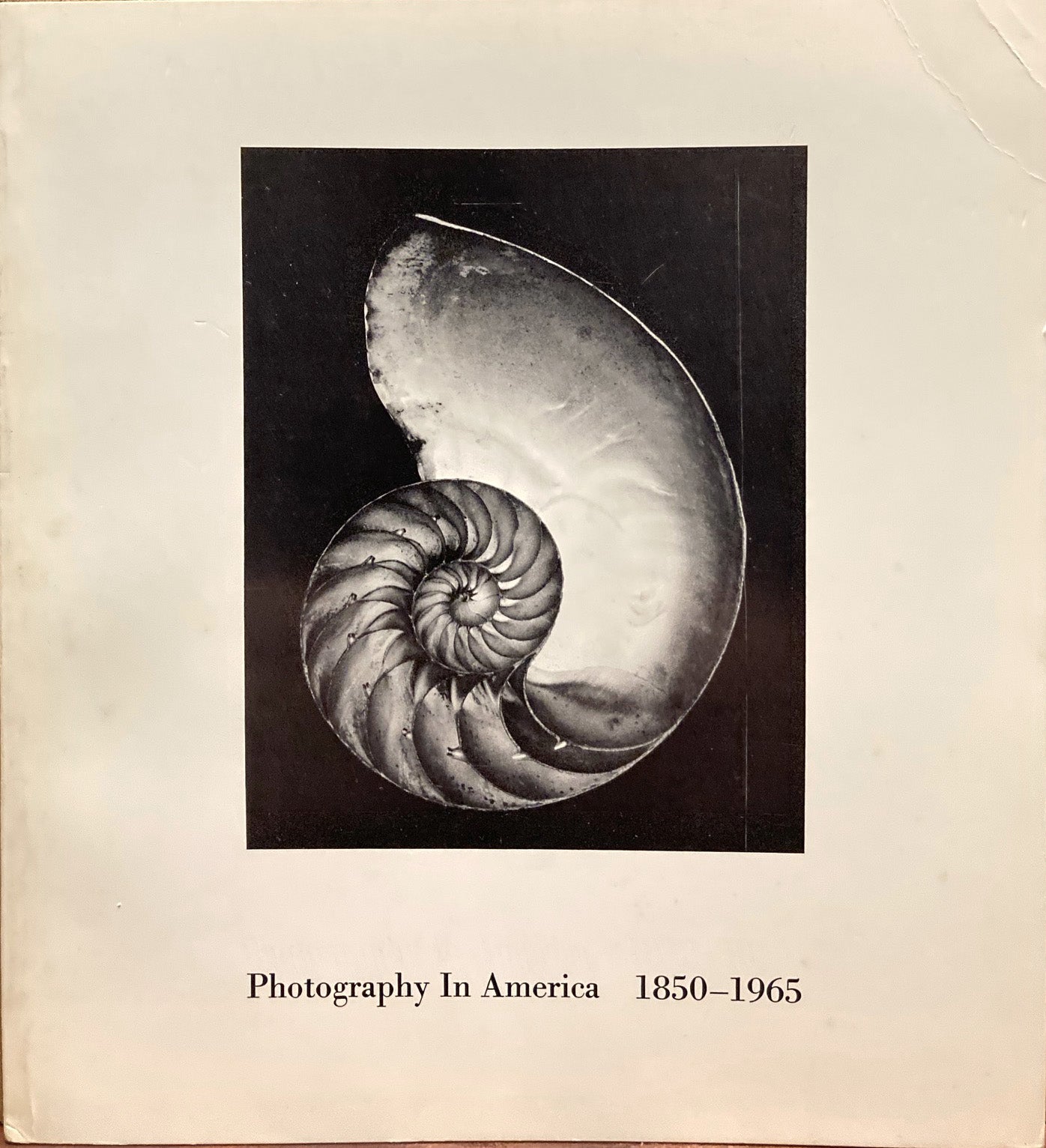
Photography in America, 1850–1965. October 13–November 28, 1965.
Photography in America, 1850–1965. October 13–November 28, 1965.
Couldn't load pickup availability
Yale University Art Gallery, 1965. Edited with an Introduction by Robert M. Doty. Includes exhibit checklist with 160 works. 42 one-to-a-page illustrations. Photographers in the exhibit (most with illustrations in this exhibition catalog): Ansel Adams; George N. Barnard; Francis Bruguiere; Wynn Bullock; Harry Callahan; F. Holland Day; Walker Evans; Robert Frank; Lee Friedlander; Alexander Gardner; Charles Harbutt; Erich Hartmann; Dave Heath; Lewis Hine; Scott Hyde; William Henry Jackson; Simpson Kalisher; Gertrude Kasebier; Joseph T. Keily; David Knox; George Krause; Dorothea Lange; Russell Lee; Helen Levitt; Man Ray; Wright Morris; Lisette Model; Timothy O’Sullivan; Henry S. Peck; Eliot Porter; Jacob Riis; Arthur Rothstein; George H. Seeley; Charles Sheeler; Aaron Siskind; W. Eugene Smith; Frederick Sommer; Southworth & Hawes; Edward Steichen; Alfred Stieglitz; Dennis Stock; Paul Strand; Isaiah West Taber; Jerry Uelsmann; Carleton E. Watkins; Brett Weston; Edward Weston; Clarence H. White; Minor White; and D.B. Woodbury. Very good in wraps with shallow indentations and two crimps on front cover. Summary:
Photography in America, 1850–1965 (published by the Yale University Art Gallery in 1965) is a specialized exhibition catalog documenting a major historical survey of American photography held from October 13 through November 28, 1965. Organized by the Yale University Art Gallery in New Haven, Connecticut, the publication serves as an essential institutional record of one of the earliest comprehensive university-level exhibitions designed to evaluate the medium's evolutionary trajectory as an independent fine art.
Core Content & Curatorial Framework
1. Curatorial Vision and Academic Context
The publication functions as a critical bridge between early photographic history and mid-20th-century academic validation. The prefatory essays examine how the photographic medium developed a distinct American identity over a 115-year span. Rather than treating the camera as a purely mechanical recording tool, the catalog positions the selected works within the broader context of American art history, mapping how photographers evolved unique visual strategies to interpret the rapidly changing social, industrial, and natural landscapes of the nation.
2. Chronological Trajectory and Master Photographers
The core of the catalog consists of an authoritative checklist and selected plates that trace the historical progression of American image-making across three distinct eras:
-
The Nineteenth-Century Foundations: Documents the early pioneers of the medium, tracking the rise of detailed daguerreotypes, Civil War documentary work, and the monumental Western expeditionary landscapes captured on large glass plates.
-
The Photo-Secession and Modernism: Charts the crucial turn-of-the-century transition spearheaded by Alfred Stieglitz and his circle, highlighting the painterly approach of Pictorialism and the subsequent shift toward "straight" photography, sharp-focus modernism, and formal abstraction.
-
The Mid-Century Masters: Showcases the mature development of American documentary, journalistic, and fine-art photography, featuring original prints by defining figures of the 1930s through the 1960s, including Farm Security Administration (FSA) photographers and post-war gallery innovators.
3. The Physical Print as Historical Record
The catalog commentary emphasizes a shared philosophy of unmediated print quality and technical craftsmanship. The text details the importance of the physical print medium—ranging from fragile early chemical emulsions to pristine silver gelatin tones—as a permanent cultural monument. The technical and biographical indexing reinforces how precise darkroom mastery allowed these artists to achieve complete creative control over their physical output, establishing a powerful baseline for the serious scholarly study of photography within an Ivy League museum setting.
Photography in America, 1850–1965 stands as a vital record from a transitional era when major academic art galleries were first establishing permanent photography collections and curricula. By combining rigorous historical framing with a curated registry of vintage masterworks, the Yale University Art Gallery successfully validated the medium not as an ephemeral, commercial curiosity, but as a living, highly expressive discipline central to the American artistic canon.
