Gary Saretzky Photo Books
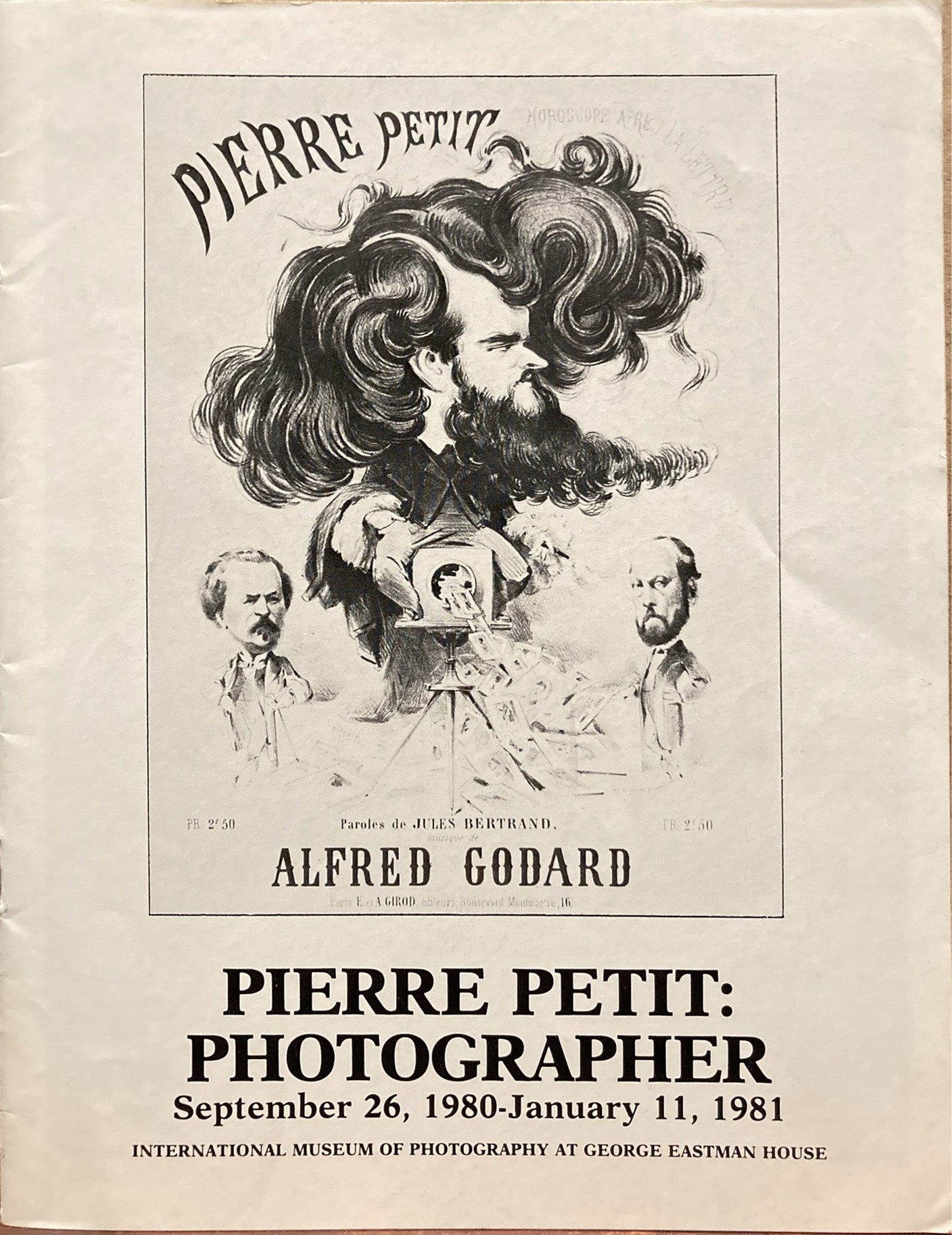
Petit, Pierre. Pierre Petit: Photographer, September 26, 1980-January 11, 1981.
Petit, Pierre. Pierre Petit: Photographer, September 26, 1980-January 11, 1981.
Couldn't load pickup availability
George Eastman House, 1980. Wraps, exhibition catalog, 20 pages, with mailing label, very good with some crimps. Biography by Janet E. Buerger. Includes portraits of Emile Littre, Jean-Baptiste Faure, Pierre Joseph Proudhon, Ernest Rehan, August Nelaton, Pierre Antoine Berryer, Charles Francois Daubigny, Robert-Fleury, Ambroise-Firmin Didot, Eugene Delacroix, Thomas Couture, Jean-Baptiste Camille Corot, Gustave Courbet, Francis Wey, Gustave Dore, Adele Hugo, Victor Hugo, et al. List of 75 exhibit items, including biographies of sitters.
Pierre Lanith Petit (1831/1832–1909) was a French photographer and pioneer of early studio portraiture, renowned for documenting prominent cultural figures and monumental engineering projects in 19th-century France. Born in Aups, France, Petit began practicing daguerreotypy in 1849 before working in the studio of André-Adolphe-Eugène Disdéri, pioneer of the carte-de-visite format, later establishing his own highly successful Paris studio. Over a prolific multi-decade career, Petit photographed thousands of notable figures—including Hector Berlioz, Eugène Delacroix, and Camille Saint-Saëns—published extensive portrait series like Galerie des hommes du jour, and became one of the first studio photographers to successfully utilize electric light in portraiture. Appointed the official photographer for the Paris International Exposition of 1867, he also undertook major documentary assignments, recording the Siege of Paris (1870–71), the construction of the Statue of Liberty in New York, and the early foundational work of the Eiffel Tower. Known also for early experiments in underwater photography during the late 1890s, Petit built a commercial empire with studios in Marseille and Baden-Baden, leaving a major visual record of Second Empire and Third Republic France now preserved in institutions such as the Bibliothèque nationale de France, the Musée d'Orsay, and the J. Paul Getty Museum.
Pierre Petit: Photographer, September 26, 1980–January 11, 1981 (published by the International Museum of Photography at George Eastman House in 1980) is a specialized exhibition catalog documenting the first major American retrospective dedicated to the prominent 19th-century French master. The publication captures a landmark gallery installation that explored Petit's vast contributions to early commercial portraiture, institutional photojournalism, and international expositions during the golden age of the collodion process.
Core Content & Historical Framework
1. The Architecture of Celebrated Portraiture
The monograph examines Petit’s rise as one of the most commercially successful studio photographers in Paris during the Second Empire. It highlights his famous series, Les Contemporains, which featured striking, intimate portraits of the era's leading writers, artists, politicians, and ecclesiastics. The historical text outlines how Petit's classical framing, mastery of natural lighting, and ability to capture psychological depth distinguished his work from the rigid, assembly-line portrait studios of his contemporaries.
2. Official Documentation and Public Infrastructure
A primary focus of the exhibition is Petit’s work as the official photographer for major state and cultural entities. The catalog details his extensive commissions, tracking how his camera recorded monumental shifts in French infrastructure and technology:
-
The 1867 Paris Universal Exposition: His role as the exclusive documentarian of the fair, capturing the grand pavilions and global innovations.
-
The Construction of the Statue of Liberty: Rare, historic images documenting the step-by-step fabrication of Frédéric-Auguste Bartholdi’s masterpiece in its Parisian workshop before its shipment to America.
-
Institutional Reports: His extensive work for the French Ministry of Public Works, recording the expansion of early railroad networks and civic structures.
3. Technical Mastery and Technological Transition
The catalog provides deep insight into Petit's technical adaptability as the medium evolved. It charts his sophisticated handling of the volatile wet-plate collodion process, his mastery of large-format albumen printing, and his early adoption of carbon printing to ensure the permanence of his historical records. The curation emphasizes how his technical precision allowed him to maintain an expansive, multi-branch studio operation while upholding the highest aesthetic and material standards of the period.
This 1980 George Eastman House publication remains a vital scholarly resource for the study of 19th-century European photography. By unifying Pierre Petit's artistic portraits with his monumental industrial documentation, the catalog validates his dual legacy as an elite visual tastemaker and an indispensable archivist of France's imperial modernization.
