Gary Saretzky Photo Books
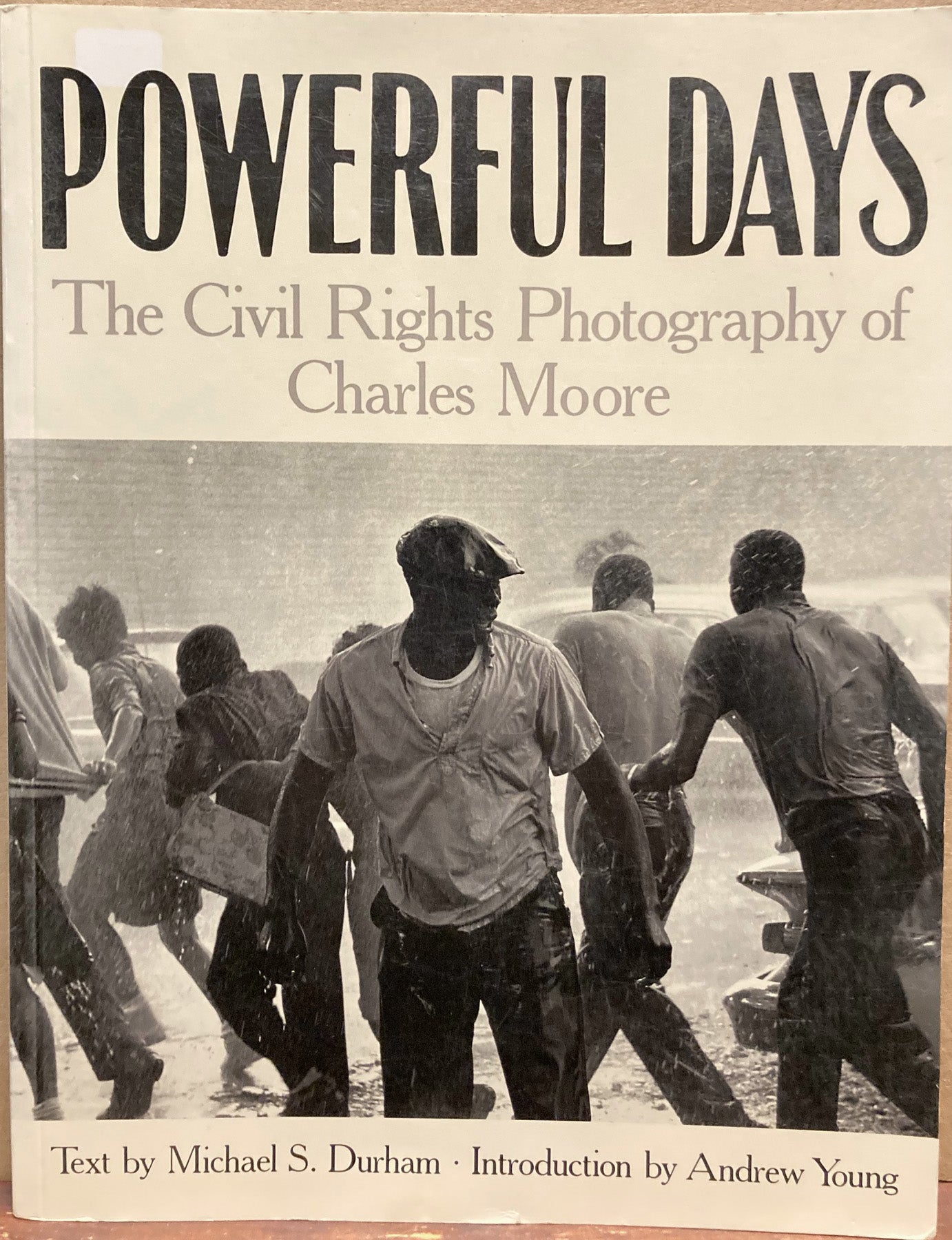
Moore, Charles. Powerful Days: The Civil Rights Photography of Charles Moore by Michael S. Durham.
Moore, Charles. Powerful Days: The Civil Rights Photography of Charles Moore by Michael S. Durham.
Couldn't load pickup availability
Stewart, Tabori, and Chang, 1st edition, 1st printing, 1991. Introduction by Andrew Young. [Dramatic photographs of Martin Luther King, Ralph Abernathy, and other African Americans in action during the 1960s Civil Rights Movement. Moore's most famous photo is of Martin Luther King Jr.'s arrest on September 3, 1958.] 207 pages. Stiff wraps, near fine. Not to be confused with the later reprint.
On March 8, 1931, in Hackleburg, Alabama, a gifted photographer was born, Charles Moore, whose photographs of the Civil Rights movement between 1958 and the mid-1960s became memorable through Life magazine and other media. Among other iconic images, the white Southerner captured Martin Luther King, Jr.’s arrest for loitering at the Montgomery courthouse in 1958; demonstrators being attacked by firemen using high pressure hoses; the march in Selma; and the riot when James Meredith integrated the University of Mississippi. Moore began his career working for newspapers, then Life, but became a freelancer in 1962 for the Black Star agency, which sold many of his photos back to Life. His work also appeared in photography annuals, including U.S. Camera 1955, Photography of the World ’64, and Popular Photography Annual 1965. Later books about the history the Civil Rights movement featured his work, including Selma 1965: The March that Changed the South (1974) and Powerful Days... (1991). Moore died March 11, 2010, in Palm Beach Gardens, Florida. Summary of book:
Powerful Days: The Civil Rights Photography of Charles Moore is a profound 208-page photojournalistic retrospective written by journalist Michael S. Durham, featuring an introduction by civil rights leader Andrew Young and photographs by Charles Moore. The book serves as a vital historical chronicle of the American Civil Rights Movement in the South between 1958 and 1965.
Overview of the Book
-
The Photographer: Charles Moore was an Alabama native and freelance photojournalist whose work for Lifemagazine fundamentally shaped national public perception of Jim Crow segregation and the fight for racial equality. He received the first Kodak Crystal Eagle Award for Impact Photojournalism for this body of work.
-
The Author: Michael S. Durham, who drafted the biographical and contextual narrative, was a Life reporter and editor who traveled and collaborated directly with Moore on several of his most significant, high-stakes southern assignments during the 1960s.
-
Structure: The book is organized chronologically across distinct geographical flashpoints of the movement. It pairs Durham's insider commentary with over 100 raw, black-and-white photographs, including iconic full-page spreads.
Thematic Sections and Core Focus
The volume is arranged by major historical milestones, illustrating how the localized struggle evolved into a national legislative catalyst.
-
Montgomery (1958–1960): Documents the early years of the movement, highlighted by Moore's famous, jarring image of a young Dr. Martin Luther King Jr. being forcibly pinned against a police precinct counter with his arm twisted behind his back.
-
Oxford, Mississippi (1962): Chronicles the violent rioting and federal integration crisis surrounding James Meredith’s enrollment as the first Black student at the University of Mississippi.
-
Birmingham and the Freedom March (1963): Contains Moore's most globally recognized and influential imagery, capturing the brutal tactics authorized by Police Commissioner Bull Connor. These include searing frames of Black demonstrators huddled in doorways to withstand high-pressure fire hoses and police dogs tearing at the clothes and legs of peaceful protesters.
-
Mississippi Voter Registration and the KKK (1963–1965): Covers the systemic terrors faced by voter registration drives and offers rare, intimate documentations of localized Ku Klux Klan rallies.
-
The Selma March (1965): Captures the brutal realities and historical gravity of the "Bloody Sunday" march on the Edmund Pettus Bridge, alongside portraits of both prominent celebrity activists and the anonymous everyday participants who carried the movement forward.