Gary Saretzky Photo Books
Magic Lanterns. Magic Lanterns. Shire Album No. 169 by Derek Greenacre.
Magic Lanterns. Magic Lanterns. Shire Album No. 169 by Derek Greenacre.
Couldn't load pickup availability
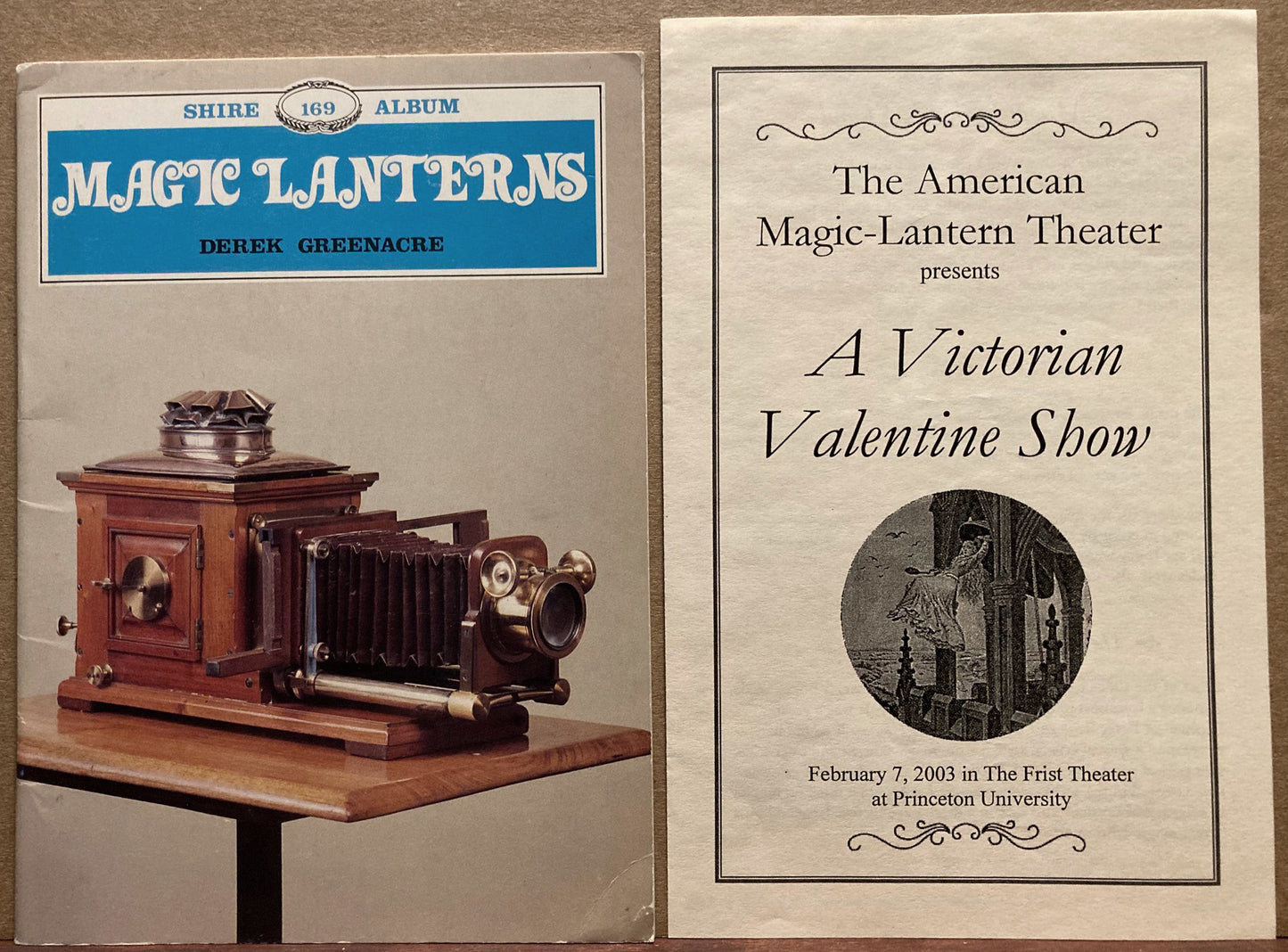
Shire Publications, 1986. Wraps, 32 pages, very good with crimp on one corner. With public program booklet and ticket stub, American Magic-Lantern Theater, Victorian Valentine Show, Princeton University, February 7, 2003, laid in. Summary:
Magic Lanterns (Shire Album No. 169), written by Derek Greenacre and published by Shire Publications in 1986, is a concise, illustrated monograph detailing the history and cultural impact of the magic lantern—the precursor to the modern slide and movie projector.
The booklet provides an accessible overview of the optical device's evolution, focusing on:
-
Historical Evolution: The text traces the development of early projection technology from its 17th-century origins through its peak popularity during the Victorian and Edwardian eras.
-
Techniques of the Lanternists: It describes the showmanship and specialized techniques pioneered by "lanternists," who combined painted glass slides, mechanical moving parts, and dual-lens systems to create dissolving views and early illusions of motion.
-
Cultural Impact and Decline: The book examines how magic lanterns served as vital tools for entertainment, education, and religious instruction across Britain before experiencing a swift decline in popularity with the arrival of cinema.
nvented in 1659 by the Dutch scientist Christiaan Huygens, the magic lantern was the earliest precursor to the modern slide projector and motion picture, utilizing a light source—initially candles or oil lamps—and a combination of optical lenses to project images painted on glass slides onto walls or screens. Originally regarded as a scientific novelty or a tool for traveling showmen to thrill audiences with "phantasmagoria" ghost shows, the device evolved dramatically over the next two centuries. By the Victorian era, technical advancements like the introduction of brilliant "limelight," mechanized slides that simulated movement, and the application of photographic slides transformed the laterna magica into a ubiquitous global phenomenon. It became an essential tool for public education, religious instruction, and mass entertainment in theaters, churches, and homes, establishing a widespread screen culture that laid the technological and narrative foundations for the birth of cinema.