Gary Saretzky Photo Books
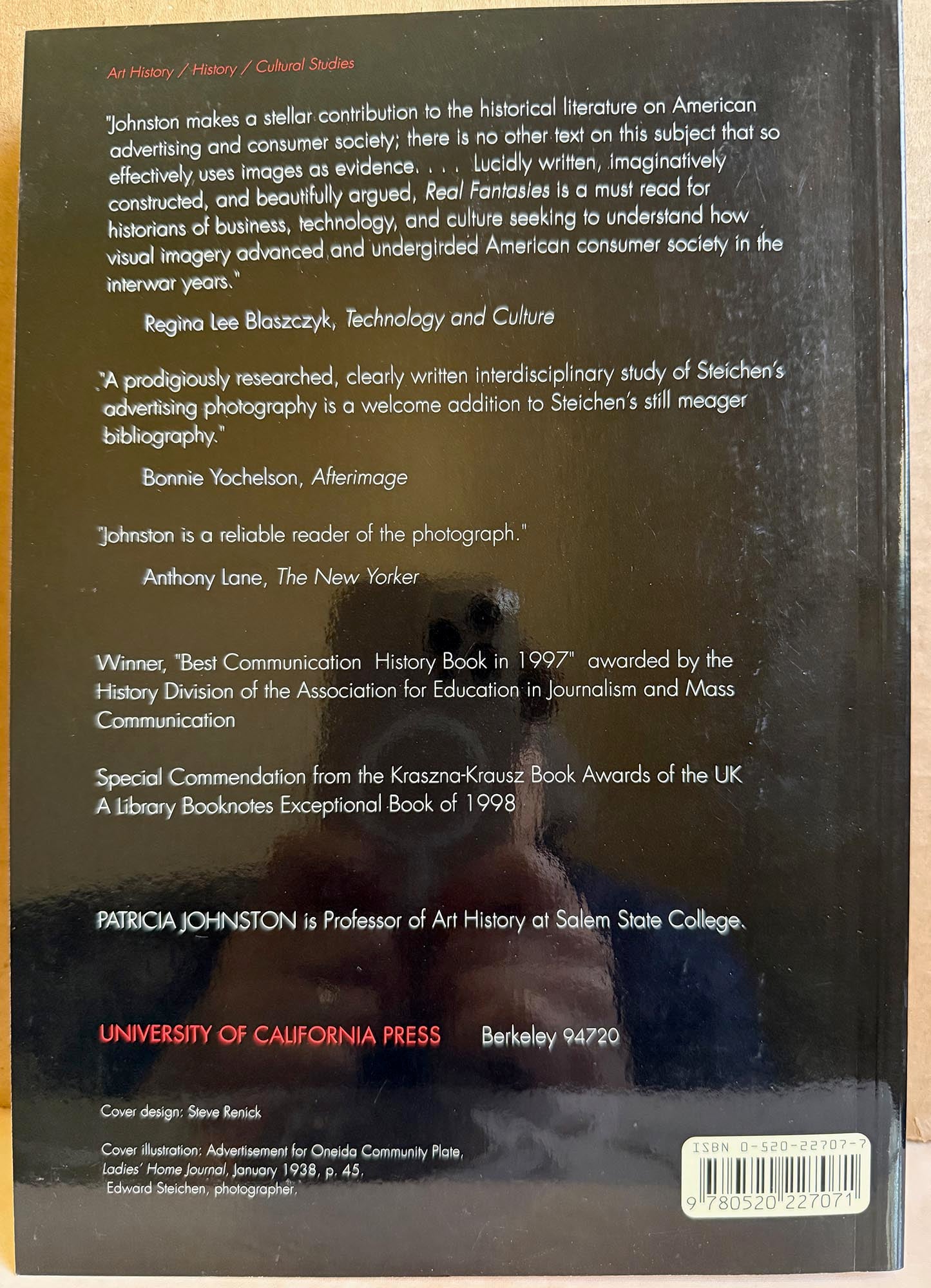
Real Fantasies: Edward Steichen’s Advertising Photography (1997) by Patricia Johnston.
Real Fantasies: Edward Steichen’s Advertising Photography (1997) by Patricia Johnston.
受取状況を読み込めませんでした
University of California, 1997, 2000. First trade paperback edition, fine, like new. xxii, 351 pages. Profusely illustrated. About the book: During the 1920s and 1930s, Edward Steichen was the most successful photographer in the advertising industry. Although much has been said about Steichen's fine-art photography, his commercial work—which appeared regularly in Vanity Fair, Vogue, Ladies Home Journal, and almost every other popular magazine published in the United States—has not received the attention it deserves. Summary:
Real Fantasies: Edward Steichen’s Advertising Photography (1997) by Patricia Johnston is a seminal critical study of how one of the 20th century’s greatest fine-art photographers transitioned into the most influential commercial photographer of the interwar period. The book examines Steichen’s work for the J. Walter Thompson agency and Vogue/House & Garden between 1923 and 1938, a period that redefined the American consumer's "dream life."
Core Themes and Cultural Impact
The High-Art Sell: Johnston explores how Steichen took the techniques of Modernism—stark lighting, bold diagonals, and sharp focus—and applied them to consumer goods. He transformed everyday objects like soaps, cigarettes, and silverware into "aspirational icons."
Constructing the Modern Woman: A major focus of the book is Steichen's role in creating the "New Woman" of the 1920s and 30s. His fashion and advertising photography didn't just sell clothes; it sold a lifestyle of independence, sophistication, and "manufactured glamour."
Realism vs. Fantasy: The "Real Fantasies" of the title refers to Steichen’s ability to use the inherent "truth" of photography to sell a fictional social status. He made the unattainable feel tangibly real through technical perfection.
Visual and Technical Style
The "Steichen Style": Moving away from his early Pictorialist (blurry/painterly) roots, Steichen embraced a hard-edged, "Precisionist" aesthetic. His commercial work is characterized by a "metallic" clarity and an obsessive attention to surface textures.
The Theater of the Studio: Johnston deconstructs Steichen’s elaborate studio setups, showing how he used artificial lighting to create a sense of drama and luxury that rivaled the cinematography of Old Hollywood.
Edward Steichen (1879–1973) was a towering figure in 20th-century photography whose multifaceted career spanned pictorialism, commercial fashion, military photojournalism, and museum curation. Born in Luxembourg and raised in the United States, Steichen co-founded the Photo-Secession movement alongside Alfred Stieglitz in 1902 and helped establish the influential gallery Little Galleries of the Photo-Secession (291). Transitioning from painterly pictorialism to sharp modernist realism after World War I—during which he commanded the photographic division of the U.S. Army Air Service—he became the chief photographer for Condé Nast from 1923 to 1937, virtually inventing modern fashion and celebrity portraiture for Vogue and Vanity Fair. During World War II, Steichen directed the U.S. Navy Naval Aviation Photographic Unit, earning an Academy Award for the documentary The Fighting Lady (1944). He later served as the Director of the Department of Photography at the Museum of Modern Art from 1947 to 1962, where he curated the landmark 1955 international exhibition The Family of Man, solidifying his position as one of the most influential figures in the history of photographic art.