Gary Saretzky Photo Books
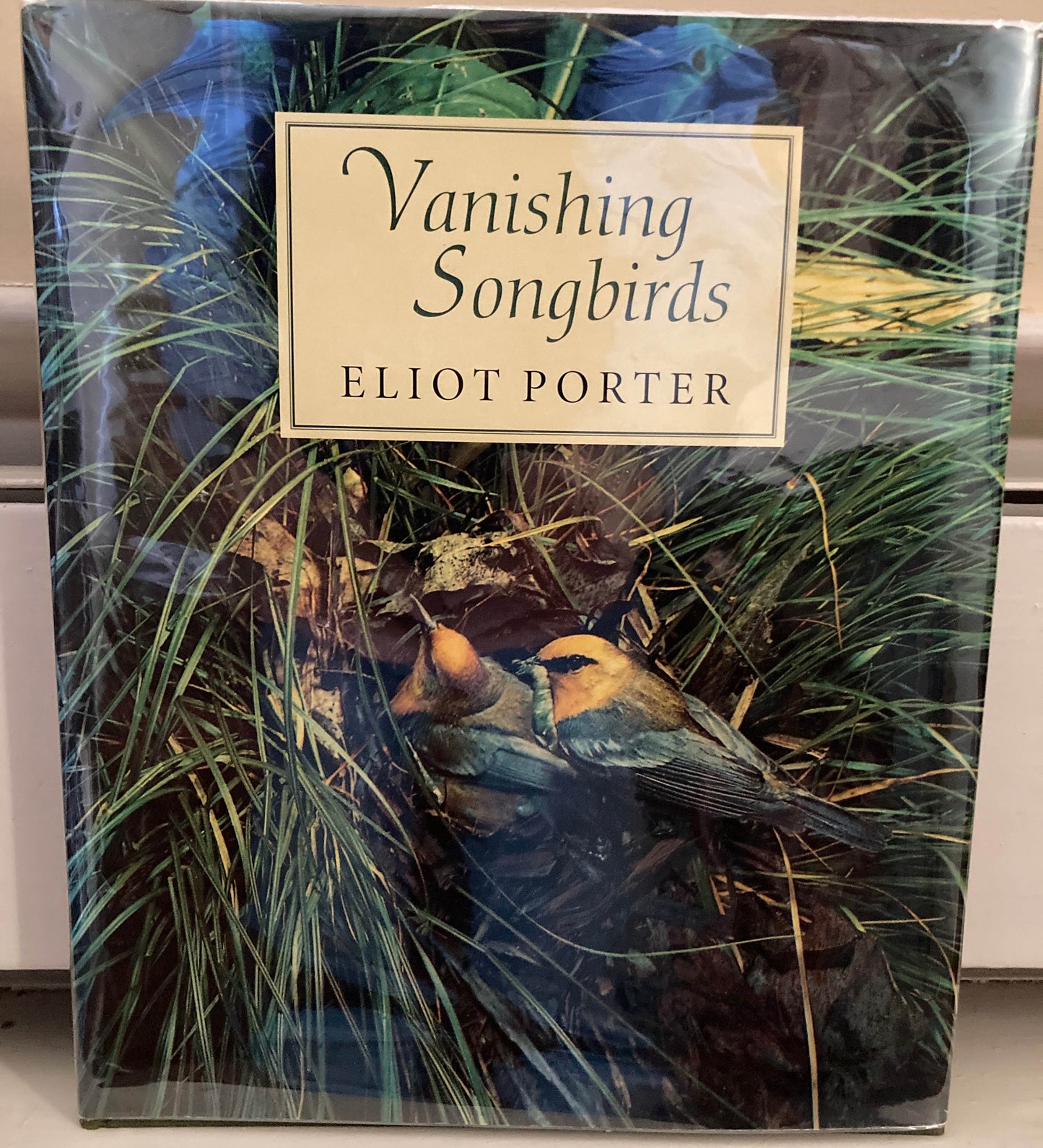
Porter, Eliot. Vanishing Songbirds: The Sixth Order. Wood Warblers and Other Passerine Birds with added texts by Kenn Kaufman.
Porter, Eliot. Vanishing Songbirds: The Sixth Order. Wood Warblers and Other Passerine Birds with added texts by Kenn Kaufman.
受取状況を読み込めませんでした
Bulfinch, 1996. First edition, fine with very good protected dust jacket that has a bit of wear at top of spine and fading on spine and rear panel next to spine. 159 pages. Porter's amazing color photos of birds in and near their nests with informative texts about their appearance, songs, behavior, and where they live. He planned this book before he died in 1990. Issued at $37.50. Summary:
Vanishing Songbirds: The Sixth Order (2000), featuring the photographs of Eliot Porter and added commentary by renowned ornithologist Kenn Kaufman, is a poignant intersection of nature photography, avian science, and environmental advocacy. The book serves as a late-career tribute to the beauty of North American wood warblers and other passerine birds, many of which are facing drastic population declines.
Core Themes and Ecological Narrative
-
The "Sixth Order": The title refers to the taxonomic order Passeriformes (perching birds). The book highlights the fragility of these small, migratory songbirds, framing them as "canaries in the coal mine" for the health of our global ecosystems.
-
The Migratory Struggle: Kenn Kaufman’s text provides a scientific backbone to the imagery, detailing the incredible physical feats of migration and the modern "gauntlet" of habitat loss, climate change, and window collisions that these birds must navigate.
-
A Call to Conservation: The book is overtly political in its environmentalism, arguing that the loss of these birds' "songs" represents a fundamental silencing of the natural world.
Visual and Technical Mastery
-
The Porter Aesthetic: As a pioneer of color nature photography, Eliot Porter used his signature "Dye-Transfer" process to capture the vibrant, jewel-like plumage of warblers. For Porter, the bird is not a specimen in a void but a vibrant part of an intricate, tangled thicket.
-
Technique: Porter was famous for his patience and technical precision. He often used high-speed flashes to "stop" the motion of these birds, revealing details in their feathers and eyes that were previously invisible to the casual observer.
- Eliot Porter (1901–1990) was an acclaimed American photographer, trained biomedical researcher, and conservationist widely celebrated for establishing fine-art color landscape photography and pioneering the use of dye-transfer printing. Born in Winnetka, Illinois, Porter earned degrees in chemical engineering and medicine from Harvard University, working as a researcher and instructor in bacteriology before encouragement from Alfred Stieglitz and Ansel Adams led him to abandon medicine in 1939 to pursue photography full-time. Recognizing the expressive potential of color work when most fine art photographers favored black-and-white, Porter mastered the complex dye-transfer process, capturing the subtle hues, intricate textures, and intimate details of natural ecosystems—from birds in flight to lichen-covered rocks and vibrant autumn foliage. His landmark 1962 Sierra Club monograph, In Wildness Is the Preservation of the World, combining his vivid color photographs with the writings of Henry David Thoreau, became a massive bestseller and a powerful political tool that helped catalyze the modern American environmental movement.