Gary Saretzky Photo Books
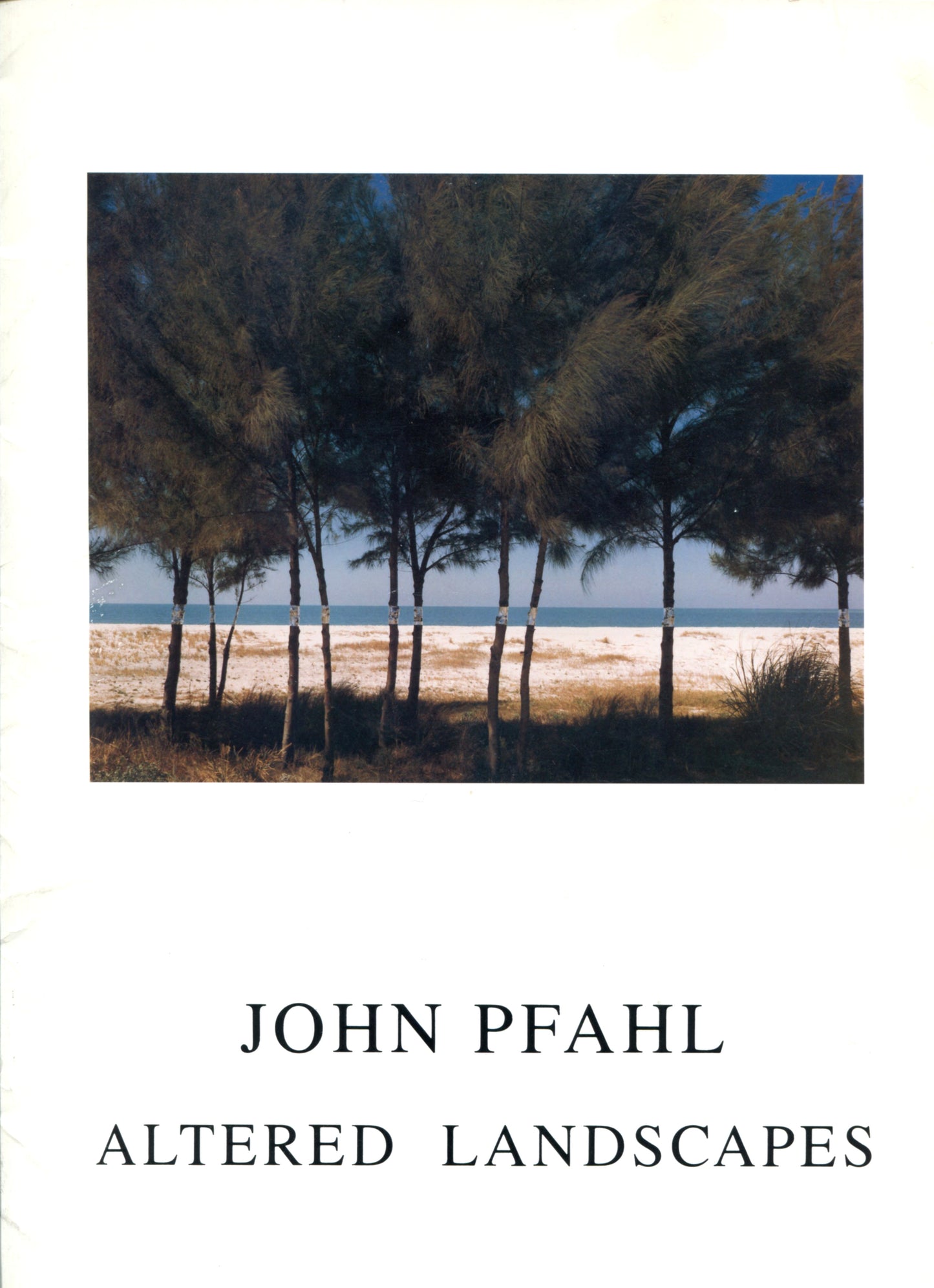
Pfahl, John. Altered Landscapes by John Pfahl.
Pfahl, John. Altered Landscapes by John Pfahl.
受取状況を読み込めませんでした
Friends of Photography, 1981. Issued as Untitled 26. [For this well known series in color, John Pfahl (1939-2020) added geometric elements to his unmanipulated landscape views, photographed the scene, and then returned the land to its natural state. This project was conducted from 1974 to 1978. He subsequently became an early adopter of digital photographic technology. He taught at R.I.T., the University of New Mexico, and SUNY-Buffalo.] Very good plus in illustrated wraps as issued with trace of rubber stamp on bottom of text block, internally fine. Summary:
Altered Landscapes (first published in 1981) is the definitive collection of John Pfahl’s pioneering "Assignments" and "Altered Landscapes" series. The book documents his playful yet profound interventions in the natural world, where he temporarily introduced physical objects into a scene to challenge the viewer’s perception of photographic space.
The Concept of the "Intervention"
Unlike traditional landscape photographers who sought to capture "untouched" nature, Pfahl explicitly marked the landscape. Using tape, string, foil, or lace, he created geometric shapes and lines that—when viewed through the camera’s specific vantage point—aligned perfectly with the horizon, trees, or topography.
Core Themes
-
Anamorphosis and Illusion: Pfahl utilized the camera's monocular vision to create optical illusions. For example, he might lay a string on a distant hillside so that it appears as a perfect, flat line cutting across the foreground of the photograph.
-
The "Window" vs. the "Surface": The work forces the viewer to acknowledge the photograph as both a window into a three-dimensional world and a two-dimensional flat surface.
-
Nature vs. Artifice: By placing man-made materials (like neon-colored tape) into pristine environments, Pfahl comments on the human urge to organize, measure, and dominate the natural world.
Artistic Context
-
The 1970s Shift: The book is a cornerstone of the "Post-New Topographics" era. It moved away from the objective documentation of human impact toward a more conceptual, humorous, and self-reflexive style.
-
Visual Puns: Pfahl often engaged in "visual puns," such as creating a "dotted line" across a wave or using lace to mimic the foam of the sea, blending the domestic with the sublime.
Significance
Altered Landscapes is credited with expanding the boundaries of landscape photography. It proved that the landscape could be a stage for conceptual art and that the photographer could be an active participant in the creation of a scene rather than just a passive observer. It remains a vital text for those studying the intersection of land art, geometry, and the inherent "lies" of the photographic lens.
Note: John Pfahl was born in Manhattan on February 17, 1939. Raised in Wanaque, New Jersey, he grew up hiking local wilderness trails and developed a love of nature. After graduating with a B.A. in fine arts from Syracuse University School of Art and two years in the army, he began a photography career. Returning to Syracuse to obtain an M.A. in color photography in 1968, he then taught at R.I.T. until 1985. According to his obit in the New York Times, “In the 1970s, Mr. Pfahl traveled around the United States asking strangers to let him shoot landscapes from inside their homes. Many accommodated him, intrigued by his idiosyncratic vision. He would then take down their curtains, wash their windows and move their furniture for a series that he called “Picture Windows.” He also is renowned for his “Altered Landscapes” series in which he added geometric elements to nature, then removed them after making the photograph. Pfahl died on April 15, 2020, in Buffalo, from the Covid-19 coronavirus with contributing other health issues.