Gary Saretzky Photo Books
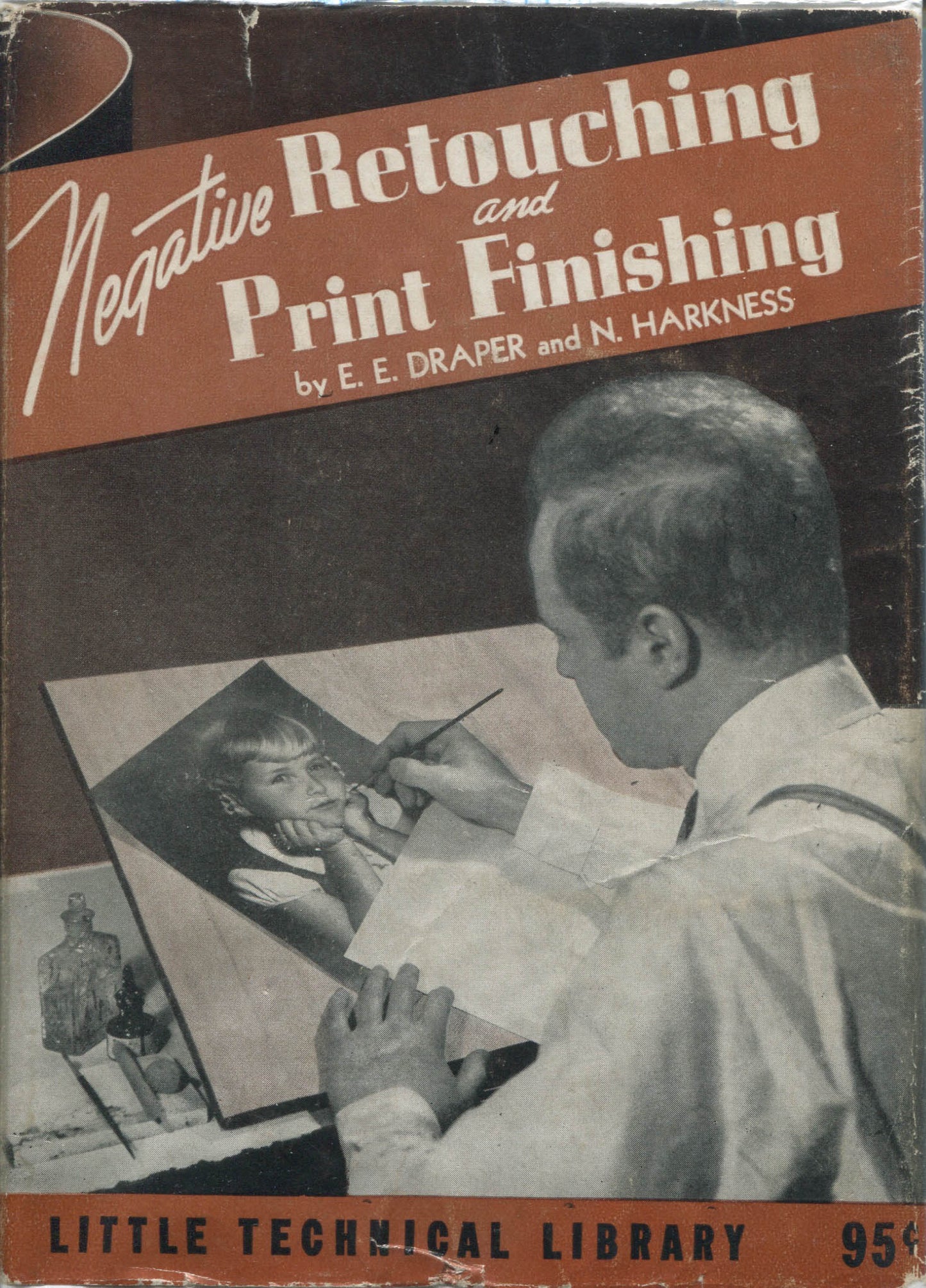
Little Technical Library No. 29. Negative Retouching and Print Finishing by E.E. Draper and N. Harkness.
Little Technical Library No. 29. Negative Retouching and Print Finishing by E.E. Draper and N. Harkness.
受取状況を読み込めませんでした
Ziff-Davis, 1941. 9th printing. Hardcover in cloth, fine with very good dust jacket with small tears and edge chips. Contains outdated recommendation to use rubber cement to mount photos. Uncommon to find a largely intact dust jacket for this book. Inside back flap of dust jacket lists titles in the series up to No. 30. Summary:
Published in 1941 as part of the Little Technical Library series by Ziff-Davis, Negative Retouching and Print Finishing (Volume No. 29) is a practical manual by Ernest E. Draper and Norris Harkness. It was written during an era when manual "handwork" was an essential skill for any photographer aiming for professional or salon-quality results.
Core Focus & Objective
The book addresses the "after-work" of photography—the corrective and enhancing steps taken once a negative has been developed and a print made. It advocates for the idea that the camera often captures "too much truth" (such as skin blemishes or distracting background elements) and that the artist's role is to refine the image through manual intervention.
Key Technical Sections
The book is divided into two primary areas of expertise:
1. Negative Retouching:
-
Tools of the Trade: A guide to using retouching desks (easels that back-light the negative), specialized pencils, etching knives, and "dope" (a resinous medium applied to the film to give it "tooth" for the pencil).
-
Additive Tecniques: The use of sharp blades or abrasive pastes to physically scrape away silver density from the negative to darken specific areas of the print.
2. Print Finishing:
-
Spotting: The delicate art of using a fine brush and India ink or dyes to hide white dust spots or scratches on the final paper print.
-
Chemical Reduction: Using Farmer’s Reducer to selectively brighten highlights or clear up "muddy" areas after the print has been developed.
-
Mounting and Presentation: Practical advice on dry-mounting prints, selecting mats, and the proper way to sign and title work for exhibition.
-
Hand-Coloring: A brief look at using oils or watercolors to add color to black-and-white images.
Style and Approach
-
The "Master-Apprentice" Tone: Like other books in the Little Technical Library, it is written in an accessible, conversational style intended for the dedicated amateur.
-
Step-by-Step Illustrations: It features "before and after" examples and close-up photographs of a retoucher's hands at work, making complex manual tasks appear achievable.
Historical Significance
In the 1940s, before the advent of digital "healing brushes" or airbrushing, these techniques were the only way to achieve the "glamour" look popularized by Hollywood. Today, the book serves as a vital historical record of the physicality of photography, documenting the meticulous hand-eye coordination required to master the medium in its analog prime.