Gary Saretzky Photo Books
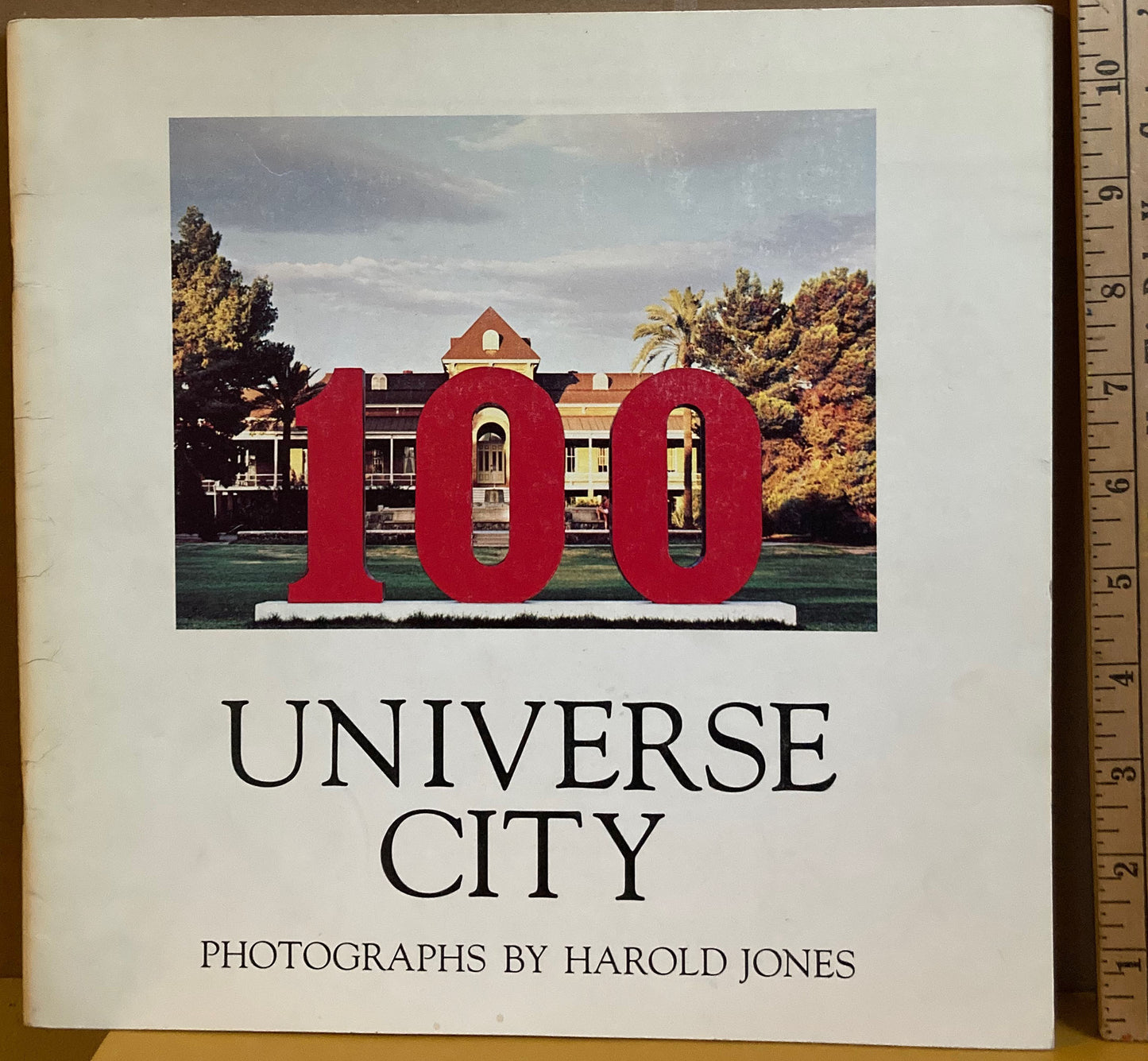
Jones, Harold. Universe City. Photographs by Harold Jones of Arizona State University. Signed.
Jones, Harold. Universe City. Photographs by Harold Jones of Arizona State University. Signed.
受取状況を読み込めませんでした
University of Arizona Art Museum, 1985. Soft cover catalog issued to accompany an exhibit of 100 photos of the university by Harold Jones, September 8–25, 1985, with a Prologue by Robert Heinecken. 35 black and white plates, 40 pages. Very good with slight crimp on back cover. SIGNED and inscribed on back of title page by Harold Jones, July 17, 1986. Issued to accompany an exhibition of Jones’ photographs, September 8-25, 1985. Uncommon, particularly if signed. Summary:
Universe City is a photographic volume documenting a body of work by Harold Jones, issued in conjunction with an exhibition of his photographs at the University of Arizona Art Museum in 1985. The book presents around 100 black-and-white images made by Jones that explore the architectural and urban environment of Arizona State University and its surroundings, reflecting the visual character of campus life and the built landscape.
Rather than a straightforward documentary record, Jones’s photographs emphasize form, structure, and spatial relationships, often isolating architectural elements or framing campus scenes in ways that reveal surprising abstract patterns and rhythms. This connects to Jones’s broader photographic interests in visual perception and the interplay between everyday subjects and deeper compositional concerns. The catalogue includes a prologue by fellow photographer and critic Robert Heinecken, which situates the project within Jones’s artistic approach and the context of contemporary photography.
The work Universe City also relates to a larger project Jones pursued in the mid-1980s under the title University: A Photographic Inquiry (or “Universe City”), a two-volume photographic inquiry that comprises numerous gelatin silver prints and colour works, reflecting his sustained engagement with photographic exploration of place and environment.
Overall, the book functions as both an exhibition record and an aesthetic statement, inviting viewers to consider how familiar built spaces can be transformed through photographic vision into resonant, almost poetic visual experiences.
Harold Jones (b. 1940) is an American photographer, curator, arts administrator, and educator who played a foundational role in shaping the institutional infrastructure of contemporary photography in the United States. Born in Morristown, New Jersey, Jones studied painting and photography at the Maryland Institute College of Art before earning an MFA in art history and photography from the University of New Mexico. He began his career as an assistant curator at the George Eastman House before moving to New York City in 1971 to serve as the inaugural director of LIGHT Gallery—the landmark venue dedicated exclusively to representing contemporary fine-art photographers such as Harry Callahan, Aaron Siskind, and Frederick Sommer. In 1975, Jones was recruited as the founding director of the Center for Creative Photography (CCP) at the University of Arizona, where he subsequently established the university's renowned photography degree program and taught as a professor for three decades. As a fine-art photographer, Jones is celebrated for his "photodrawings"—unique, mixed-media gelatin silver prints hand-altered with ink, oil paint, food coloring, or spray paint—as well as his wry, observational studies of everyday landscapes and objects. Honored as a professor emeritus, Jones holds an enduring legacy as both an influential visual practitioner and a pioneering builder of photographic institutions, archives, and academic programs.