Gary Saretzky Photo Books
Easterly, Thomas. "The View from Fourth and Olive," by Carla Davidson in American Heritage, December 1979, 76-93.
Easterly, Thomas. "The View from Fourth and Olive," by Carla Davidson in American Heritage, December 1979, 76-93.
受取状況を読み込めませんでした
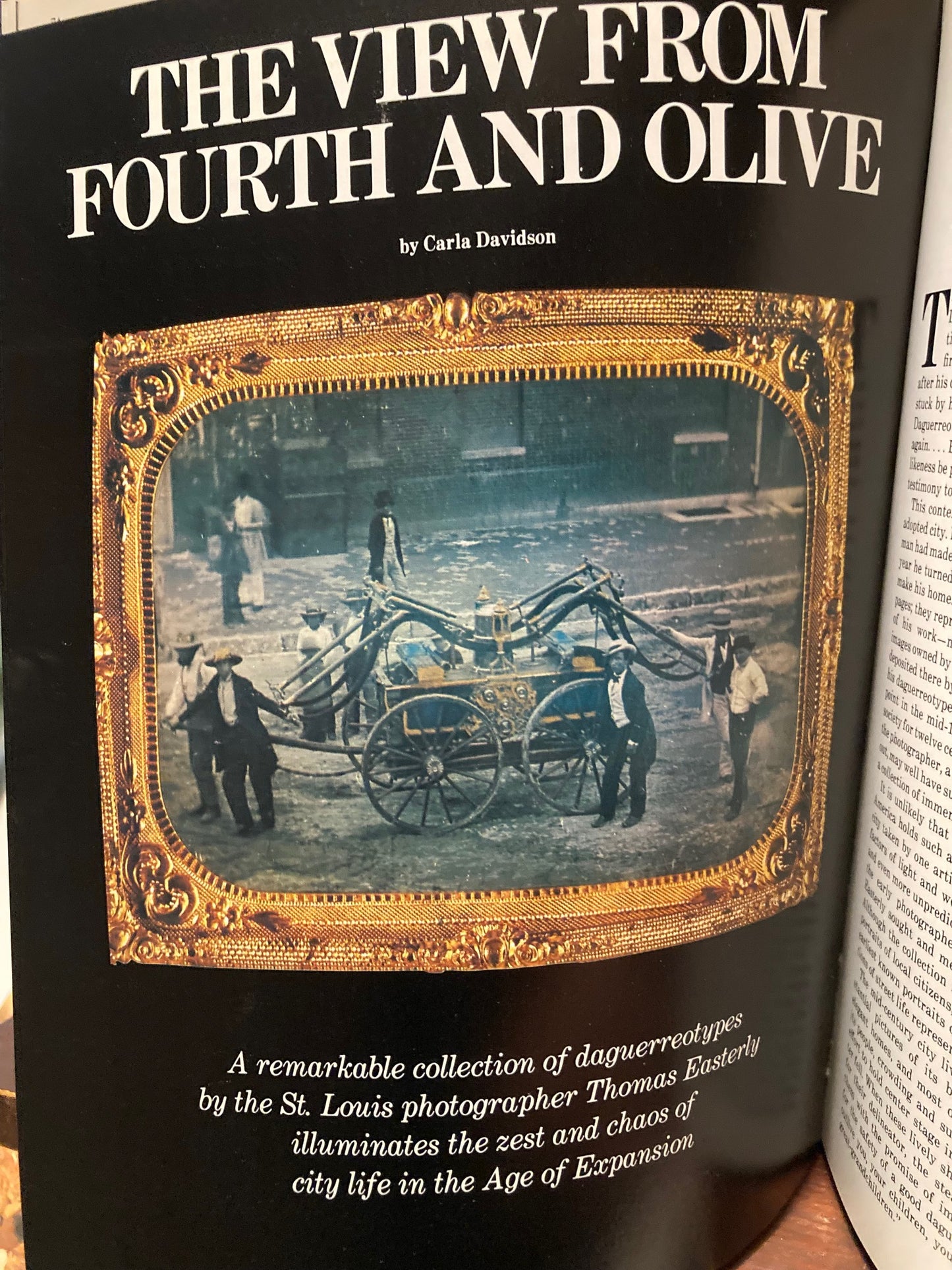
The outstanding St. Louis daguerreotypist Thomas Easterly's indoor portraits and outdoor scenes, including what is perhaps the earliest photograph of a construction worker at work, a large Indian burial mound at different stages of its destruction, locomotive, wreck of steamboat Calypso on the Mississippi River, the rapping Fox sisters, William Greenleaf Eliot, self-portrait, fire company with hand pumper, et al. Entire issue, hardcover, illustrated boards, not issued with dust jacket, fine.
Thomas Martin Easterly (1809–1881) was one of 19th-century America’s premier daguerreotypists, celebrated for his exceptional technical mastery, outdoor documentary views, and uncompromising commitment to the daguerreotype medium long after cheaper photographic processes surpassed it. Born in Guilford, Vermont, Easterly worked as a calligraphy teacher before learning daguerreotypy in the early 1840s and traveling throughout Vermont, New York, and Iowa. In 1848, he permanently established a studio in St. Louis, Missouri, where he built a nationwide reputation for taking candid, expressive portraits of prominent figures—including Native American leaders such as Keokuk and Red Wing—as well as prominent politicians and visiting celebrities. Unusually for daguerreotypists of his era, who mostly remained in indoor studios, Easterly ventured outside to systematically document St. Louis’s rapid urban expansion, capturing riverboats, construction sites, architectural landmarks, and even meteor showers and lightning strikes. Refusing to adopt wet-plate collodion or paper print technologies, he operated his gallery until his health declined in the late 1870s, leaving behind a monumental collection of mirror-like silver plates preserved today at the Missouri Historical Society as a vital visual record of antebellum America and the American frontier.