Gary Saretzky Photo Books
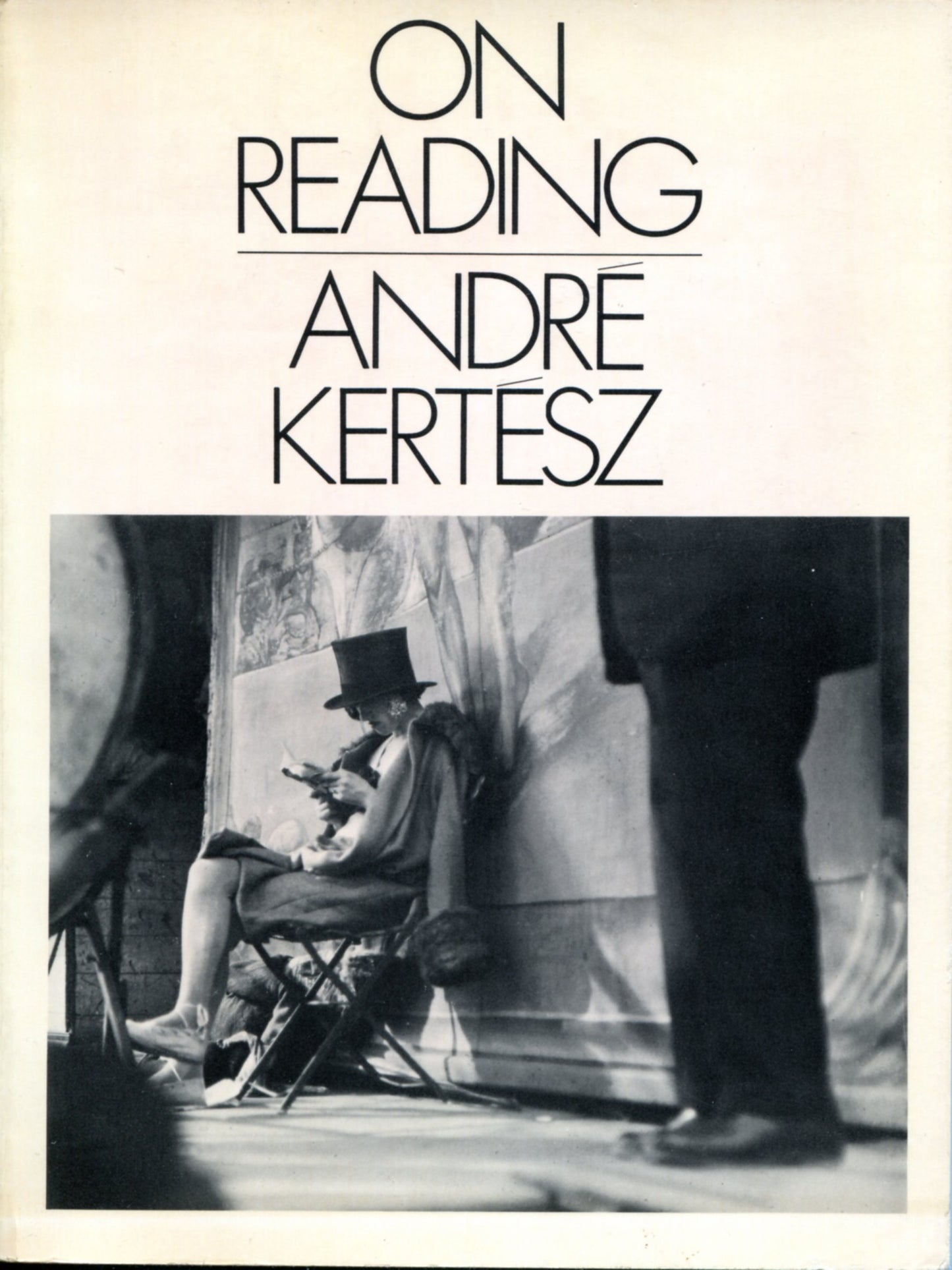
Kertesz, Andre. On Reading by Andre Kertesz.
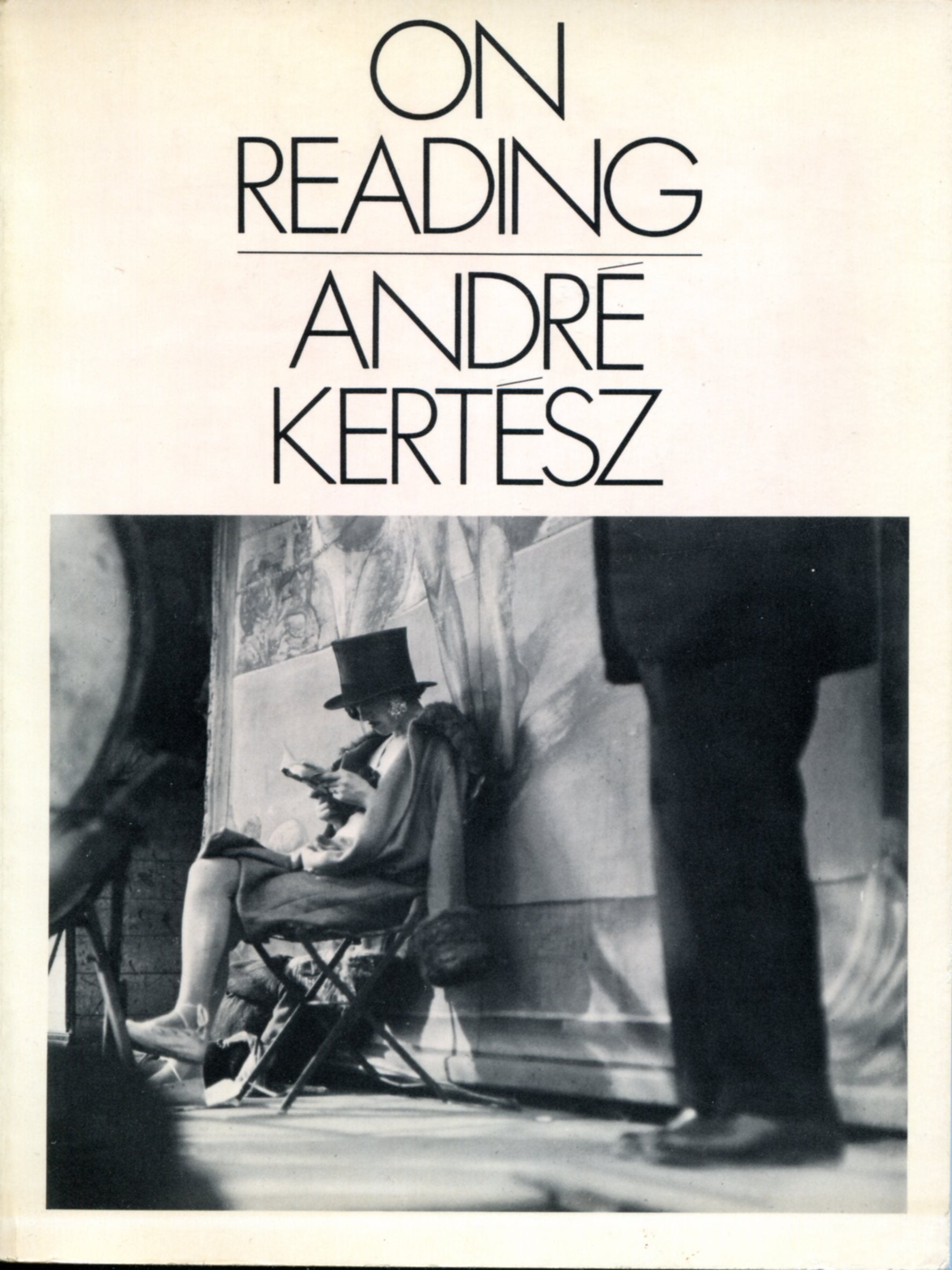
Kertesz, Andre. On Reading by Andre Kertesz.
受取状況を読み込めませんでした
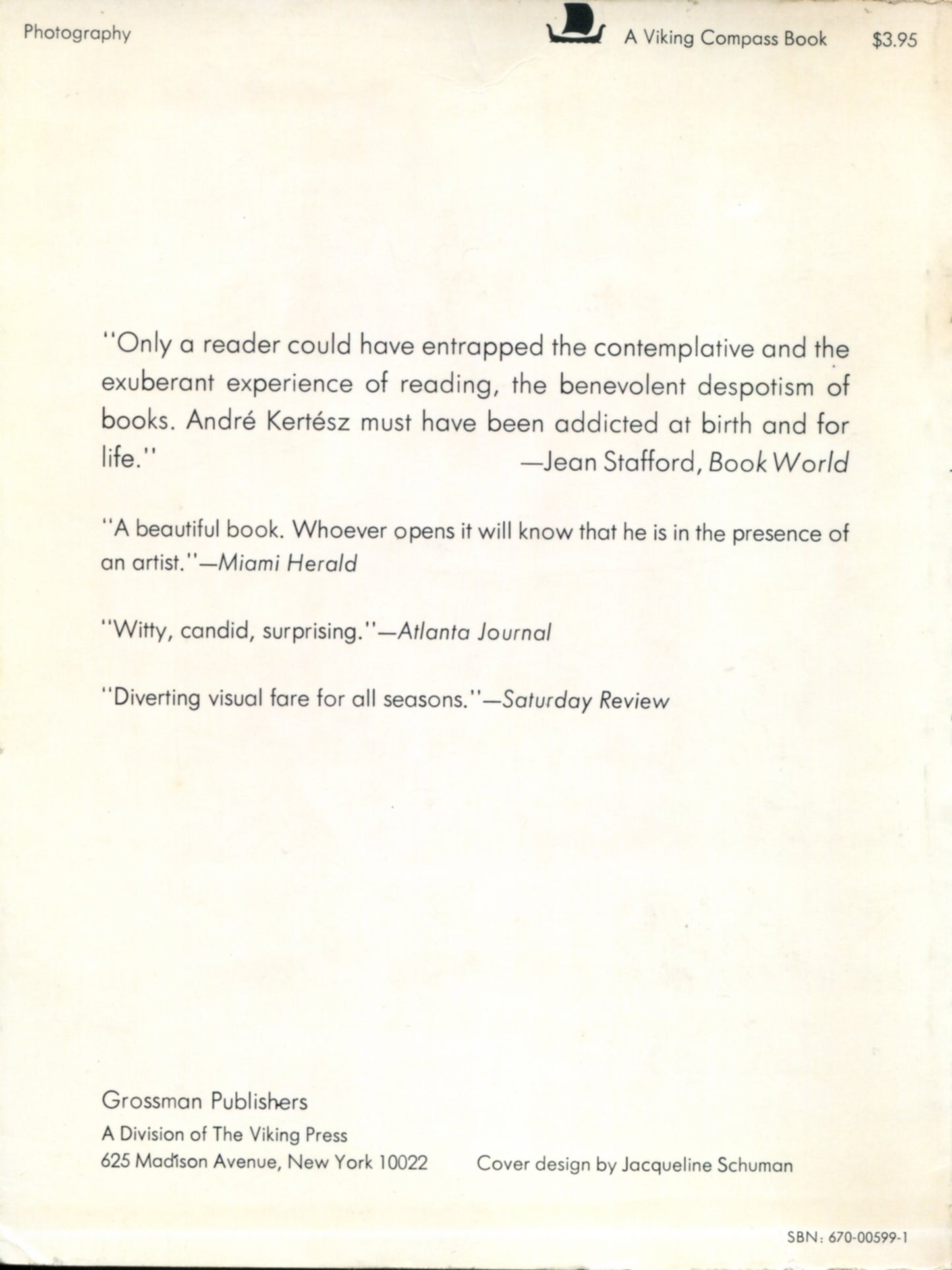
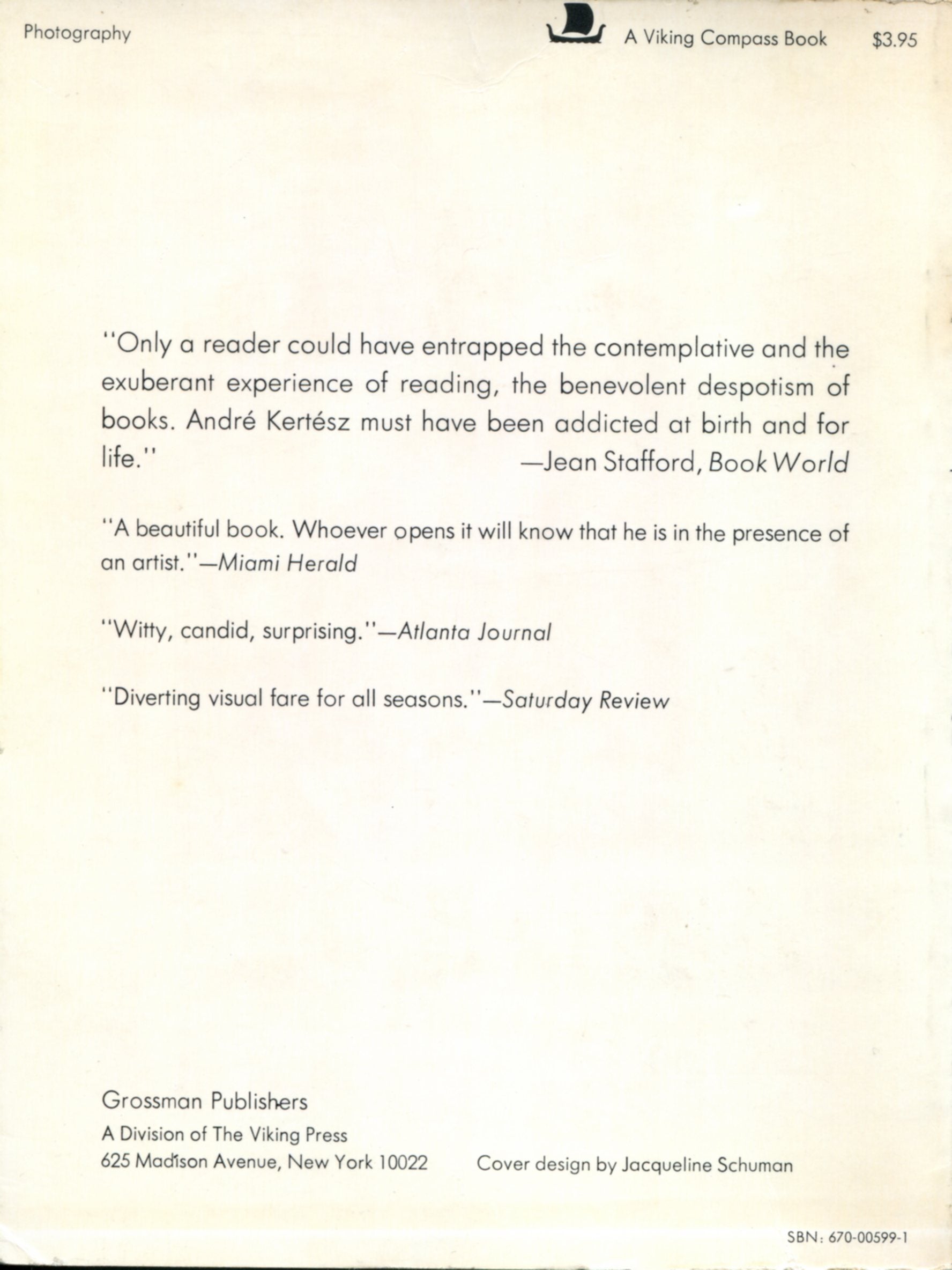
Grossman, 1975. 1st edition in wraps. Photographs by Kertesz of people reading. Grossman published the 1st edition in hardcover in 1971. This paperback is not to be confused with later reprints. A clean copy with covers slightly curling at outside edges and small crimp bottom outside corner of back cover. No marks, tears, odors or other defects. 64 photographs of readers mostly taken in New York, Paris, and Buenos Aires. Summary:
On Reading (originally published in 1971 by Grossman Publishers) is a classic, unpaginated photographic book by legendary Hungarian-born American photographer André Kertész. Comprising over 60 candid black-and-white images taken between 1915 and 1970, this slim, deeply poetic volume functions as a profound visual essay celebrating the universal, transformative act of reading across different cultures, generations, and social strata.
Core Themes and Content
-
The Universal Sanctuary of Literacy: The book’s primary theme is the democratic nature of reading. Kertész captures a vast array of individuals—from homeless men scanning newspapers on urban park benches and children huddled over comic books on New York stoops, to affluent elites browsing rare volumes in private libraries—illustrating how reading serves as an accessible sanctuary that transcends economic and social divisions.
-
The Psychology of Absorbed Isolation: A master of capturing quiet, intimate moments, Kertész focuses on the intense psychological absorption of his subjects. The photographs depict readers so completely lost in the written word that they become entirely oblivious to their immediate environments, highlighting how literature allows a person to mentally escape physical reality while remaining rooted in a public space.
-
A Journey Through Global Contexts: Structurally, the book acts as a sweeping retrospective of Kertész’s nomadic career. The chronological and geographical reach of the images spans over five decades, moving fluidly from his early days in rural Hungary and his avant-garde period in Paris, to his later life in New York City, demonstrating that the human craving for narrative is globally uniform.
-
Geometric Harmony and Wit: Visually, the monograph showcases Kertész's signature ability to find geometric order and subtle humor in everyday life. He frequently frames his readers within complex architectural compositions—juxtaposing the organic form of a reading person against rigid metal fire escapes, stacks of paper, or towering cityscapes—to emphasize the quiet stillness of the reader amidst the chaos of the modern world.
By stripping away any explanatory text or captions, On Reading allows the images to speak for themselves, standing as one of the most enduring, gentle, and affectionate tributes to the enduring bond between the human mind and the printed page.
André Kertész (1894–1985) was a pioneering Hungarian-born American photographer celebrated for his lyrical, unmanipulated imagery and his groundbreaking contributions to photographic composition, street photography, and the photo essay. Born Andor Kertész in Budapest, he initially worked as a clerk at the local stock exchange while teaching himself photography, creating intimate depictions of daily life and moving portraits of soldiers while serving in the Austro-Hungarian army during World War I. Seeking greater artistic opportunities, Kertész moved to Paris in 1925, where he became a cornerstone of the interwar avant-garde scene, making portraits of icons like Piet Mondrian and Colette while serving as a lead photographer for the trailblazing illustrated magazine Vu. In 1928, he became one of the first major artists to adopt the handheld 35mm Leica camera, using its mobility to capture unexpected street juxtapositions, shadows, and reflections that proved photography could be considered a fine art. Fleeing the rise of Nazism, Kertész emigrated to New York City in 1936, where his poetic sensibility initially clashed with the commercial demands of American magazines, leading to a long, frustrating period shooting architecture for Condé Nast's House & Garden. His career was dramatically reawakened in 1964 with a major solo retrospective at the Museum of Modern Art (MoMA), cementing his legacy as a mentor to masters like Henri Cartier-Bresson and Brassaï, and securing his status as one of the most influential and poetic visual voices of the 20th century.