Gary Saretzky Photo Books
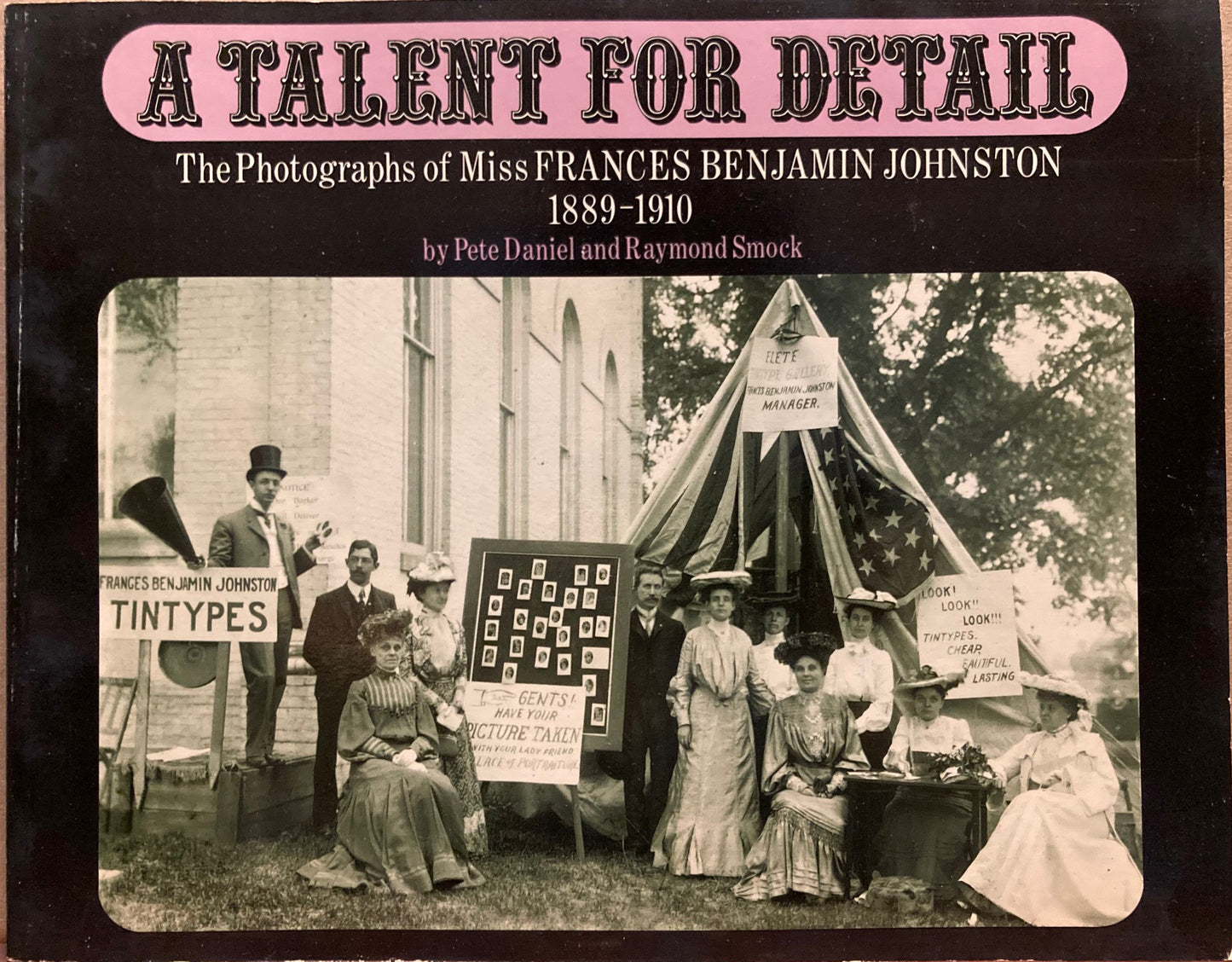
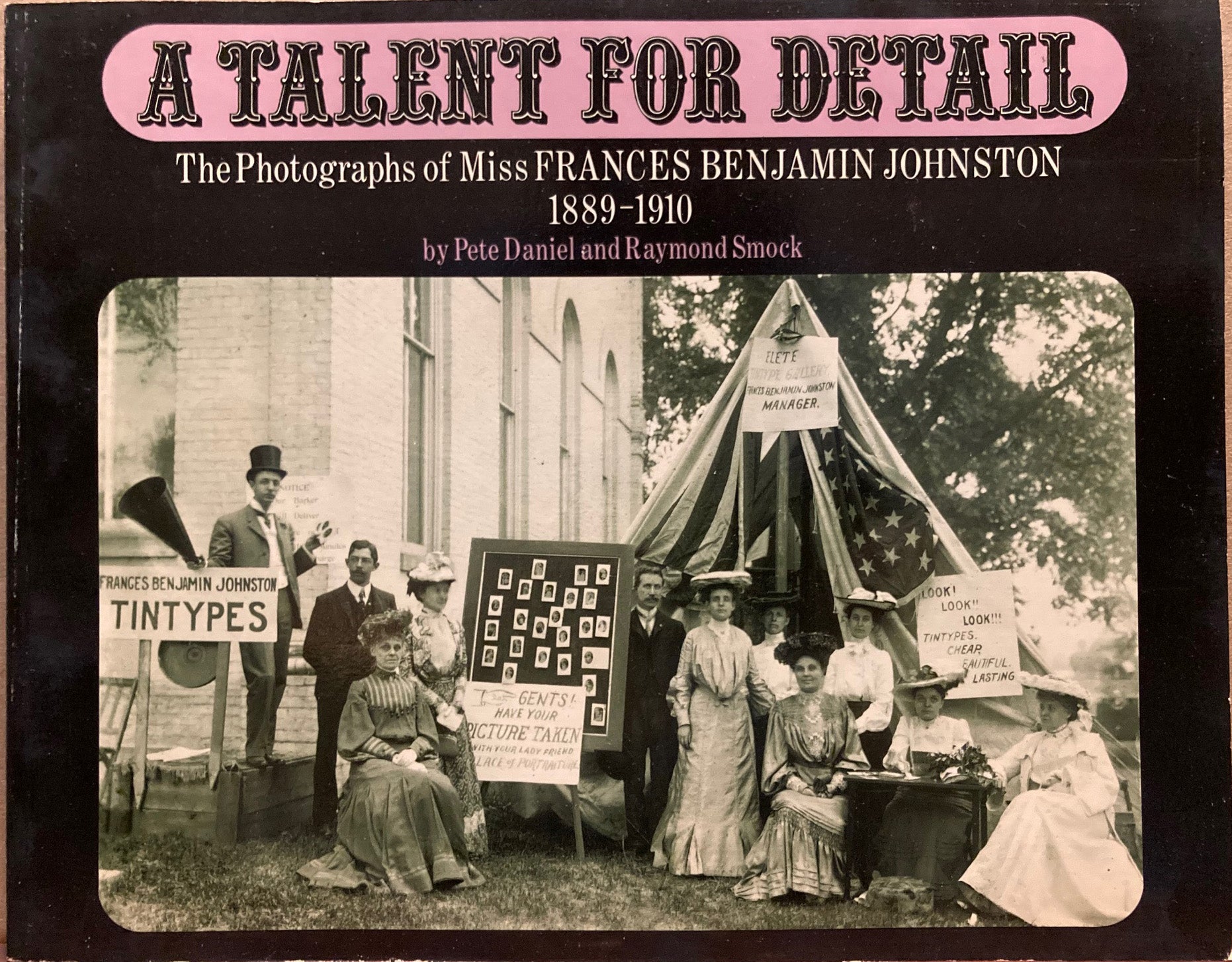
Johnston, Frances Benjamin. A Talent for Detail: The Photographs of Miss Frances Benjamin Johnston, 1889-1910 by Pete Daniel and Raymond Smock.
Johnston, Frances Benjamin. A Talent for Detail: The Photographs of Miss Frances Benjamin Johnston, 1889-1910 by Pete Daniel and Raymond Smock.
受取状況を読み込めませんでした
Harmony, 1974. [Johnston was one of the most famous photographers in the United States circa 1900. In addition to photographing, Johnston organized important exhibitions of women photographers and profiled them in articles.] Stiff illustrated wraps, near fine. Summary:
A Talent for Detail: The Photographs of Miss Frances Benjamin Johnston, 1889-1910 (published in 1974 by Harmony Books) is a pioneering 182-page photobiography and historical monograph edited and written by historians Pete Daniel and Raymond Smock. Featuring an extensive collection of monochrome plates drawn primarily from the Library of Congress, this volume serves as the definitive mid-20th-century resurrection of Frances Benjamin Johnston's legacy, establishing her as one of America’s first significant female photojournalists and an unparalleled documentarian of the Gilded Age.
Core Themes and Content
-
A Comprehensive Mosaic of the Gilded Age: The primary theme of the book is its panoramic capture of American society pivoting from the late Victorian era into the 20th century. Daniel and Smock curate the layout to show the vast economic and social divides of the period, juxtaposing the immense privilege of industrial barons against the raw, gritty realities of coal miners, iron workers, and underpaid female laborers.
-
Photographer of the American Court: A significant biographical section documents Johnston's unique status as the unofficial photographer of the Washington, D.C., political elite. The text charts how her personal charm, sharp wit, and upper-class connections granted her unprecedented access to the White House across multiple administrations. The volume features her definitive portraits of historic figures, including Susan B. Anthony, Mark Twain, Alexander Graham Bell, Booker T. Washington, and the Roosevelt family.
-
The Documentary Eye and Progressive Education: The monograph highlights Johnston’s groundbreaking photo-essays, most notably her historic commissions at the turn of the century. Daniel and Smock dedicate substantial space to her meticulous 1899 Washington, D.C., public school series—commissioned to show American educational progress at the Paris Universal Exposition of 1900—alongside her profoundly respectful documentary portraits of minority students at the Hampton Institute and the Carlisle Indian Industrial School.
-
The Unconventional Independent Woman: Beyond her subjects, the authors analyze Johnston herself as a symbol of the "New Woman" of the 19th century. Through personal writings and her famous bohemian self-portraits (such as holding a beer stein and cigarette in a low-cut dress), the book traces her trajectory as a self-made, financially independent professional woman who navigated a male-dominated field, actively encouraging other women to take up photography as both a profitable trade and a fine art.
By organizing decades of scattered glass-plate negatives into a structured visual narrative, A Talent for Detail functions as both a crucial post-Victorian historical record and a triumphant tribute to a fiercely independent artist whose compositional genius captured the precise operational details of a changing nation.
Frances Benjamin Johnston (1864–1952) was a trailblazing American photographer and photojournalist whose prolific six-decade career shattered gender barriers and provided an unparalleled visual record of the Gilded Age and the changing American landscape. Born into a well-connected family in West Virginia and raised in Washington, D.C., she studied fine art at the Académie Julian in Paris before turning to photography in the late 1880s, opening her own professional studio down the street from the White House. Leveraging her immense wit and elite social standing, she became the unofficial photographer of the American political court, gaining unprecedented behind-the-scenes access to capture intimate portraits of five sitting U.S. presidents, their families, and historical icons like Susan B. Anthony, Mark Twain, and Booker T. Washington. As one of the country's first female press photographers, Johnston pushed the boundaries of the medium with groundbreaking documentary photo-essays, including her masterfully composed turn-of-the-century series documenting progressive education at the Hampton Institute, Tuskegee Institute, and Washington's public schools, which she proudly exhibited at the Paris Exposition of 1900. A fiercely independent bohemian who famously photographed herself holding a beer stein and a cigarette to mock Victorian gender norms, she dedicated her later decades to architectural preservation, embarking on a monumental project to meticulously survey thousands of vernacular southern structures for the Library of Congress. Leaving behind a profound archival legacy of over 20,000 prints and negatives, Johnston is remembered as an unyielding pioneer who proved that photography could serve simultaneously as a fine art, a tool for social commentary, and a vital instrument for historical preservation.