Gary Saretzky Photo Books
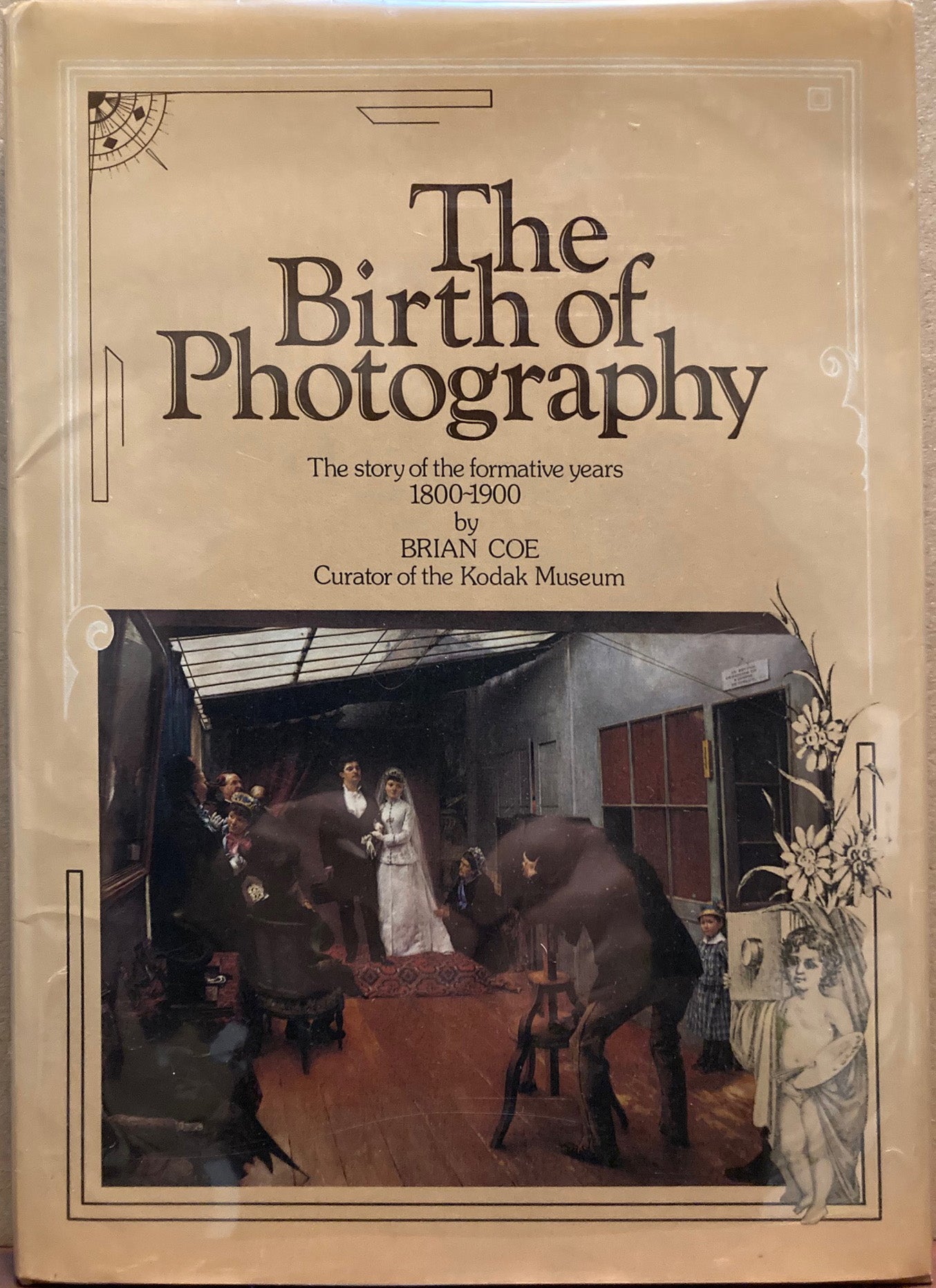
History of Photography. The Birth of Photography; The Story of the Formative Years, 1800-1900 by Brian Coe.
History of Photography. The Birth of Photography; The Story of the Formative Years, 1800-1900 by Brian Coe.
受取状況を読み込めませんでした
Taplinger, 1977. 1st U.S. Edition. By Brian Coe, Curator of the Kodak Museum. Fine with fine protected dust jacket. 144 pages, profusely illustrated including images not found in other histories. Summary:
Published in 1976, The Birth of Photography: The Story of the Formative Years, 1800-1900 by Brian Coe is an authoritative, accessible examination of photography's vital first century. Written while Coe served as the curator of the landmark Kodak Museum in London, the book blends meticulous technical breakdown with cultural history, tracing how the medium transformed from an exclusive, highly toxic laboratory science into a democratic hobby shared by millions.
Accompanied by over 200 historical illustrations, Coe’s history treats changes in chemistry, mechanics, and visual style as deeply interconnected steps.
1. Foundations of Chemical Mastery
The narrative begins with early 19th-century visual experiments, tracing how inventors learned to trap the image projected inside a camera obscura. Coe isolates three critical waves of chemical breakthroughs:
-
The Early Pioneers: The agonizingly long exposures of Nicéphore Niépce and the highly detailed, non-reproducible silver plates of Louis Daguerre's daguerreotype system.
-
The Paper Foundation: William Henry Fox Talbot's development of the calotype, which established the negative-to-positive workflow that allowed for multiple reproductions.
-
The Technical Shifts: The transition to Frederick Scott Archer’s crisp but cumbersome wet-plate collodionprocess, followed by the game-changing invention of the gelatin dry plate. Coe explains how eliminating the need for on-the-spot chemical mixing completely untethered photographers from their darkrooms.
2. Slicing Time: The Photography of Action
Coe dedicates significant real estate to the hardware developments that allowed cameras to capture split-second reality. The integration of highly sensitive gelatin chemistry alongside rapid mechanical shutters opened new analytical possibilities. Coe details the iconic motion studies of Eadweard Muybridge and Étienne-Jules Marey, demonstrating how high-speed photography permanently changed our understanding of animal and human mechanics.
3. Industrial Growth and the First Consumer Cameras
As a curator immersed in Kodak history, Coe tracks the precise industrial evolution of camera design. He marks the massive shift in the late 1880s when George Eastman introduced the first handheld Kodak camera. By replacing fragile glass plates with flexible roll film, Eastman successfully detached the camera from commercial studios and birthed "snapshot" culture, giving rise to the famous slogan, "You press the button, we do the rest."
4. Cultural Forms: Document, Depth, and Art
Beyond the gear, the volume tracks how Victorian society adopted and shaped this new visual language through various cultural trends:
-
Likenesses for Everyone: The commercial boom of cheap portraiture studios, making personal image collecting accessible across all social classes.
-
Depth and Decoration: The wild public obsession with stereoscopy (3D viewing devices) and the rapid growth of photography as an explicit medium for textbook illustration.
-
The Battle for Artistry: The ideological friction between pure, unvarnished documentation ("record and reality") and the highly orchestrated, soft-focus imagery of the Pictorialist art movement, where photographers fought to earn the camera a respected position alongside traditional painting.
The Birth of Photography stands out for its exceptional clarity regarding the engineering of early photography. Rather than treating technical history as a dry list of dates, Brian Coe presents a readable narrative that honors both the brilliant inventors who built the tools and the everyday users who forever transformed how the modern world documents itself.
