Gary Saretzky Photo Books
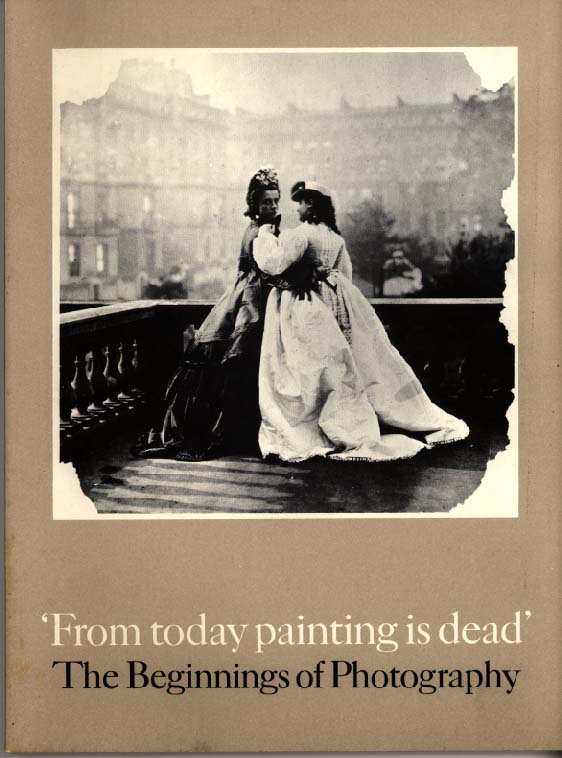
History of Photography. 'From Today Painting is Dead': The Beginnings of Photography.
History of Photography. 'From Today Painting is Dead': The Beginnings of Photography.
受取状況を読み込めませんでした
The Victoria & Albert Museum 16 March - 14 May 1972. The Arts Council of Great Britain. [Important exhibit with list of more than 900 items, essays on camera obscura, wet plate photography, etc., well illustrated with 50 plates.] Softcover, as issued, very good with moderate wear at bottom right corner, blind stamp of previous owner at bottom of title page. Summary:
Published by the Arts Council of Great Britain and the Victoria & Albert Museum to accompany a landmark 1972 exhibition, 'From Today Painting is Dead': The Beginnings of Photography is a foundational study of early photographic history. Featuring an introductory essay by the eminent cultural historian Asa Briggs, the catalog takes its title from the famous exclamation by French painter Paul Delaroche upon first seeing a daguerreotype in 1839. The volume examines the formative decades of the medium, exploring the deep aesthetic anxieties, technical hurdles, and societal shifts that occurred when mechanical imagery disrupted a world dominated by traditional painting.
1. Confronting the Academic Hierarchy
The core structure of the exhibition and catalog filters early photography through the rigid genre hierarchies established by European fine art academies. It maps how early practitioners navigated these traditional categories:
-
History Painting: While early cameras lacked the speed to capture complex, theatrical historical or biblical scenes, the text tracks how photographers eventually adapted by documenting real-world history and warfare as it happened.
-
Portraiture: The text details the explosive commercial demand for photographic likenesses, particularly among a rising middle class unable to afford painted miniatures. It highlights the transition from rigid, minutes-long daguerreotype exposures to more psychologically expressive portraits.
-
Genre and Everyday Life: It outlines how scenes of daily life were staged or captured, offering sentimental or realist imagery to consumers accustomed to engravings.
-
Landscape and Still Life: Positioned at the bottom of the academic art ladder, these static subjects were ironically the easiest for early photography to conquer due to long chemical exposure requirements, ultimately forcing a reassessment of their artistic value.
2. The Dialogue Between Camera and Canvas
Briggs and the curators analyze photography not as a sudden break from art history, but as an evolution deeply tied to Western pictorial traditions. The text demonstrates how early masters deliberately imitated painting compositions, lighting, and textures to gain institutional legitimacy, even as the camera's uncompromising mechanical accuracy simultaneously pushed painters away from realism and toward abstraction.
3. Showcasing the British and French Masters
The catalog acts as an important portfolio of early photographic pioneers, featuring high-quality plates from iconic figures such as:
-
William Henry Fox Talbot: The inventor of the paper-negative calotype process.
-
David Octavius Hill and Robert Adamson: Early Scottish masters of expressive, painterly portraiture.
-
Julia Margaret Cameron and Clementina, Viscountess Hawarden: Trailblazing amateurs who used the camera for theatrical tableaux, domestic portraiture, and complex light studies.
-
Roger Fenton: Documentarian of the Crimean War and early landscape master.
This museum volume is widely regarded as a watershed moment in curation. By treating early photographs with the same rigorous thematic, intellectual, and aesthetic scrutiny typically reserved for classical painting, 'From Today Painting is Dead' helped cement photography's status as a legitimate, distinct discipline within major art institutions.
