Gary Saretzky Photo Books
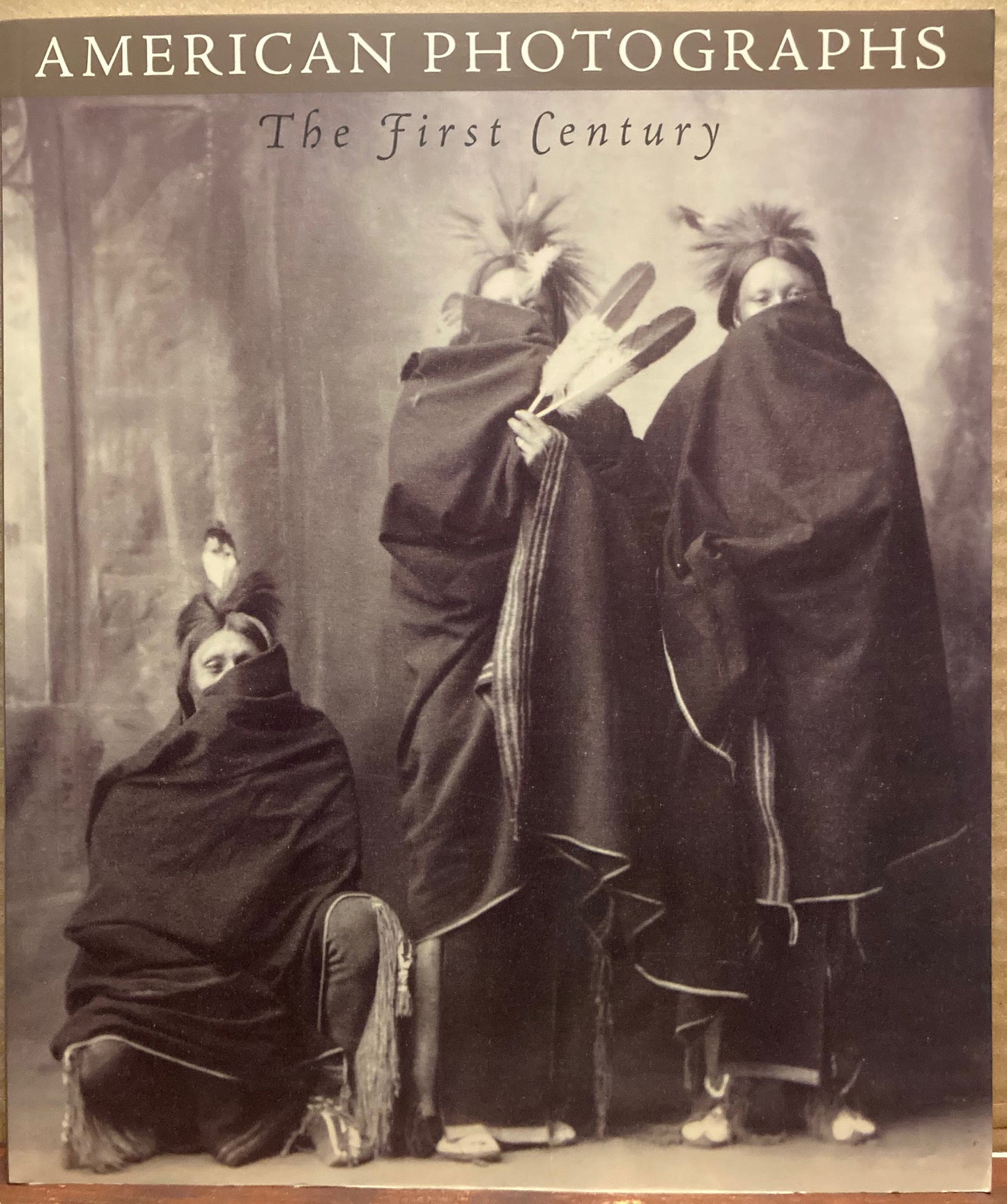
American Photographs: The First Century. From the Isaacs Collection in the National Museum of American Art.
American Photographs: The First Century. From the Isaacs Collection in the National Museum of American Art.
受取状況を読み込めませんでした
Edited by Merry A. Foresta. Smithsonian, 1996. Phenomenal photographs collected by Charles Isaacs, Jr., who provides an Afterword. 79 color plates plus more than 100 four-color images. George Barker, William Bell, Charles Bierstadt, Elias Bonine, Mathew Brady, Annie Brigman, Alexander Gardner, Laura Gilpin. O. Pierre Havens; William Rau, Paul Haviland, F. Jay Haynes, Alexander Hesler, Pach Brothers, Lejaren Hillers, Lewis Hine, William Henry Jackson, Gertrude Kasebier, Joseph Keiley, James E. McClees; John Moran; Eadweard Muybridge, Timothy O'Sullivan, John Bullock, John Chislett, Imogen Cunningham; Dwight Davis, Clara Sipprell, Rudolf Eickemeyer, Carleton Watkins, et al. Fine in stiff wraps. Summary:
American Photographs: The First Century (1987) is a seminal survey of 19th-century photography, showcasing the expansive collection of Charles Isaacs. The book, and the accompanying exhibition at the National Museum of American Art (now the Smithsonian American Art Museum), highlights the medium's evolution from its commercial birth in 1839 to its establishment as an expressive art form by the early 1900s.
Core Focus and Scope
The volume focuses on the "pre-modernist" era, emphasizing how photography documented the rapid transformation of the American landscape and identity. It covers three primary movements:
-
The Daguerreotype Era: Early portraiture and the democratic nature of "the mirror with a memory," making professional likenesses available to the middle class.
-
Expansion and Conflict: Breathtaking landscape photography from the American West (surveys) and the gritty, monumental documentation of the Civil War.
-
The Rise of Pictorialism: The shift toward the end of the century where photographers like Alfred Stieglitz began treating the camera as a tool for fine art, often mimicking painterly styles.
Key Themes
-
Technological Evolution: The transition from the unique silver plate of the Daguerreotype to the reproducible wet-plate collodion process and the eventual convenience of the dry plate.
-
National Narrative: How photography served as a tool for Manifest Destiny, capturing the "sublime" beauty of Yosemite and the Yellowstone region to inspire national pride and westward migration.
-
Social Documentation: The book highlights the work of both anonymous itinerant photographers and famous figures like Matthew Brady, Timothy O’Sullivan, and Carleton Watkins.
Significance of the Isaacs Collection
The collection is noted for its high "curatorial eye." Unlike collections that focus solely on historical record, the Isaacs Collection prioritizes the aesthetic quality and compositional strength of the prints. It argues that even early survey photographers were making conscious artistic choices regarding light, framing, and perspective.
Format and Presentation
The book is structured with scholarly essays that provide historical context for the plates, making it a critical reference for understanding how early photography shaped the American visual consciousness. It serves as a bridge between photography as a scientific curiosity and photography as a respected museum-grade art form.