Gary Saretzky Photo Books
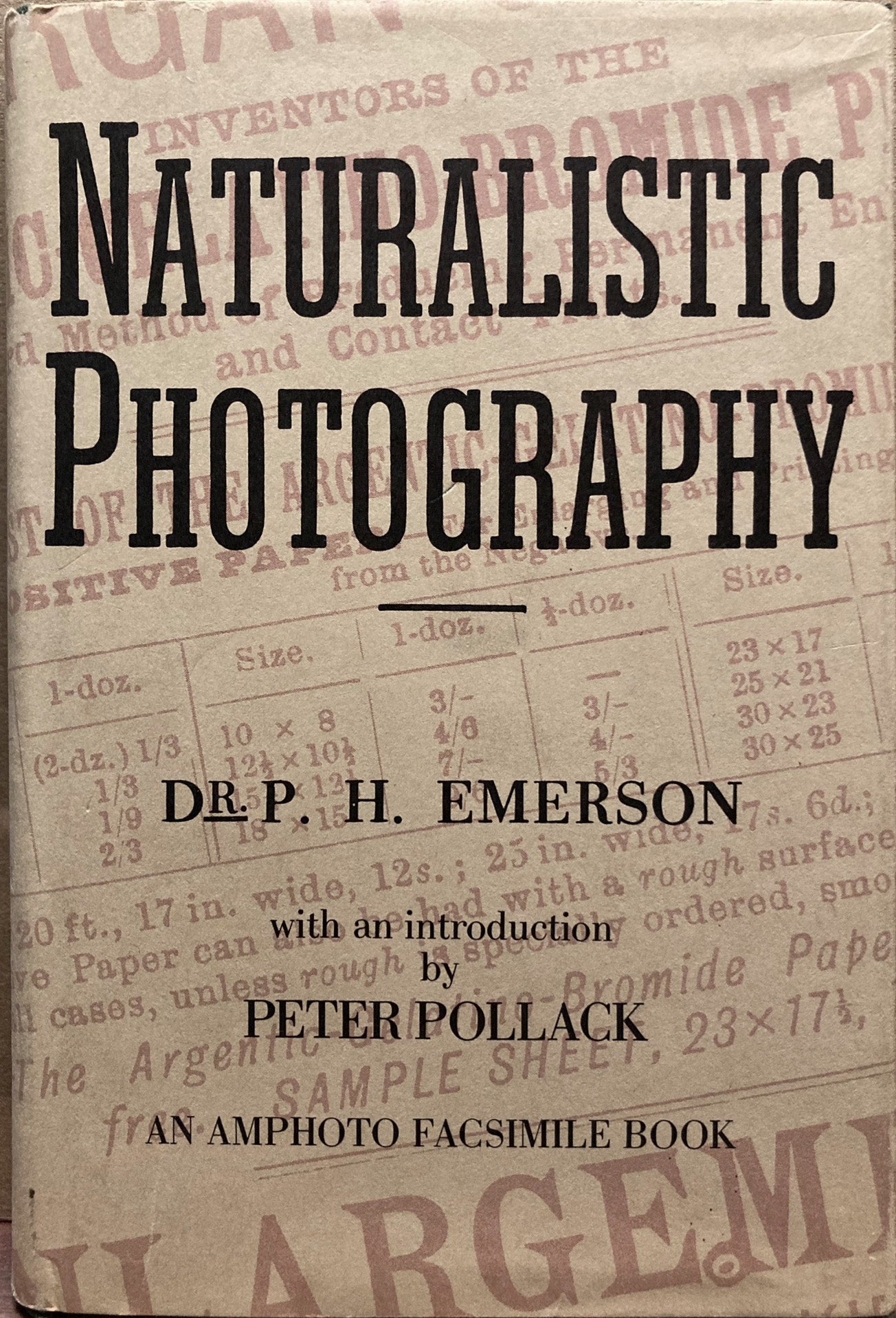
Emerson, Peter Henry. Naturalistic Photography for Students of the Art by Peter Henry Emerson.
Emerson, Peter Henry. Naturalistic Photography for Students of the Art by Peter Henry Emerson.
受取状況を読み込めませんでした
(1889, 1890). Facsmile of the Second Edition with introduction by Peter Pollack. Amphoto, 1972. Hardcover, green cloth, with protected dust jacket. One of the classic texts in the history of photography, Emerson here argues for an unmanipulated style of photography in contrast to that of Henry Peach Robinson, who advocated constructing photos from many different negatives. Emerson's photographs were similar in technique and spirit to those of the younger Alfred Stieglitz in his formative period. Stieglitz was encouraged by Emerson through the award of a first prize in a competition. Stieglitz later was the founder of the Photo-Secession, a group of Pictorialist photographers that included Edward Steichen, Frederick Evans, Gertrude Kasebier, Eva Watson-Schütze, Clarence White, Alvin Langdon Coburn, Craig Annan, Baron de Meyer, Anne Brigman, and Alice Boughton, and edited the Secession's journal Camera Work magazine. To some degree, Stieglitz succeeded Emerson as the leading advocate for photography as an art form and carried forward Emerson's advocacy of straight photography. Consequently, photo historians such as Beaumont Newhall have emphasized Emerson's importance in the history of photography. This edition of Naturalistic Photography includes all the fascinating advertisements for cameras, lenses, photographic papers, and other photographic products that appeared in the front and back of the 1890 edition. Also lists of Emerson’s works, reviews, etc. More than 313 pages.
Peter Henry Emerson (1856–1936) was a British photographer and writer who played a pivotal role in promoting photography as an independent art form through his aesthetic theory of "naturalistic photography." Trained as a physician, Emerson turned to photography to document the authentic rural life, landscapes, and traditional labor of the fishermen and peasants of East Anglia, publishing these intimate observations in influential works such as Life and Landscape on the Norfolk Broads (1886) and Pictures of East Anglian Life (1888). He fiercely opposed the contemporary Victorian fashion for staged, composite photographs and heavily manipulated prints, arguing instead that images should be direct, unretouched records that realistically captured subjects in their true environments. Although he later published a controversial pamphlet in 1891 expressing disillusionment with photography's status as a fine art, his pioneering philosophy and naturalistic approach left a lasting impact on 20th-century photographic aesthetics.
Copies available:
- Hardcover, fine, with near fine dust jacket that has one tiny chip and a very small closed tear. Protected dust jacket.
- Hardcover with VG chipped dust jacket.
