Gary Saretzky Photo Books
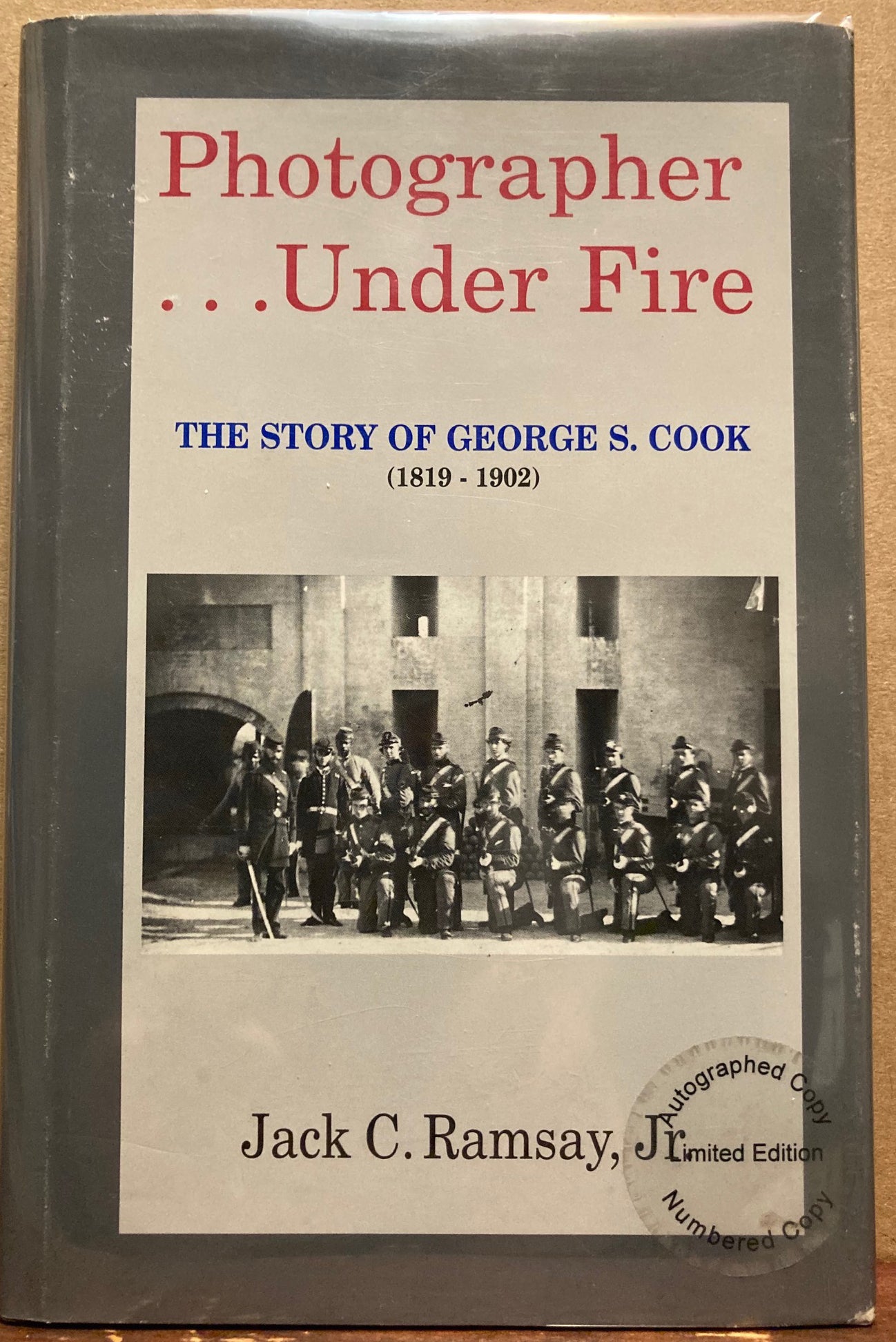
Cook, George S. Photographer... Under Fire: The Story of George S. Cook by Jack C. Ramsey, Jr.
Cook, George S. Photographer... Under Fire: The Story of George S. Cook by Jack C. Ramsey, Jr.
受取状況を読み込めませんでした
Historical Resources Press, 1994. Limited edition; Copy #717 of 1,000. Double signed and inscribed to “Gerry.” Based during the Civil War in Charleston, South Carolina, Cook has been called, “The Mathew Brady of the South." Fine hardcover with dust jacket.
Note: Born on February 23, 1819, in Stratford, Connecticut, George S. Cook was orphaned as an infant, Cook was brought up by his maternal grandmother in Newark, New Jersey. Beginning at age 14, he traveled widely, became a daguerreotypist in New Orleans, then returned to Newark in 1845 to court Elizabeth Smith Francisco. He was active in Newark and New York in 1845-1846 and traveled in the South before settling with his wife and son George LeGrange Cook in Charleston, South Carolina, but his career continued to take him to other cities for varying periods, including New York, where he filled in at Mathew Brady’s in 1851 while Brady was in Europe. Cook had branch galleries in Philadelphia and Chicago, where his partner, S.M. Fassett, photographed Abraham Lincoln. Back in Charleston, Cook became the leading photographer of the Confederacy and its leading supplier of photographic materials. In 1865, he returned to Newark and married his second wife, Lavinia Pratt, a niece of his deceased first wife. He spent most of his later years in Charleston and Richmond, Virginia, where he relocated in 1880. An extensive Cook collection is at the Valentine Museum in Richmond. Cook died in 1902.
Photographer... Under Fire: The Story of George S. Cook by Jack C. Ramsay, Jr. (published in 1994 by Historical Resources Press) is a detailed biographical account of one of the 19th century’s most resilient and influential American photographers.
Key Summary & Highlights
-
Primary Source Foundation: Drawing extensively on family diaries, letters, business ledgers, and photographic recipe books preserved by Cook’s descendants, the book offers a rich, personal perspective on the evolution of early American photography.
-
Commercial Ambition & Entrepreneurship: Ramsay chronicles Cook’s life from his beginnings as an itinerant street artist to becoming a major photographic entrepreneur. The text details his studio ventures across New York, Philadelphia, Chicago, and Charleston, including his temporary management of Mathew Brady’s New York gallery in 1851.
-
"The Mathew Brady of the Confederacy": A central focus of the book is Cook's work in Charleston, South Carolina, during the American Civil War, where he emerged as the leading photographer and photographic supplier for the Confederacy.
-
Historic Combat Photography: The title Under Fire highlights Cook’s most famous historical feat: capturing combat images from inside Fort Sumter while under Union bombardment, including legendary photographs of ironclad warships in action and an exploding shell.
George S. Cook (1819–1902)
George Smith Cook was a pioneering 19th-century American photographer, studio owner, and photojournalism innovator. Born in Stratford, Connecticut, and raised in Newark, New Jersey, he traveled south as a young man, starting out as an itinerant painter before learning the daguerreotype process in New Orleans. Cook established galleries throughout the East Coast and Midwest—briefly overseeing Mathew Brady’s New York studio—before permanently settling in Charleston, South Carolina, where he earned the moniker "Mathew Brady of the Confederacy". During the Civil War, he documented Confederate forces and achieved lasting acclaim for taking the world's first photographs of actual combat under enemy bombardment at Fort Sumter in September 1863. Following the war, Cook relocated his business to Richmond, Virginia, in 1880, continuing to build a massive photographic archive of southern life and historical portraiture until his death in 1902.
