Gary Saretzky Photo Books
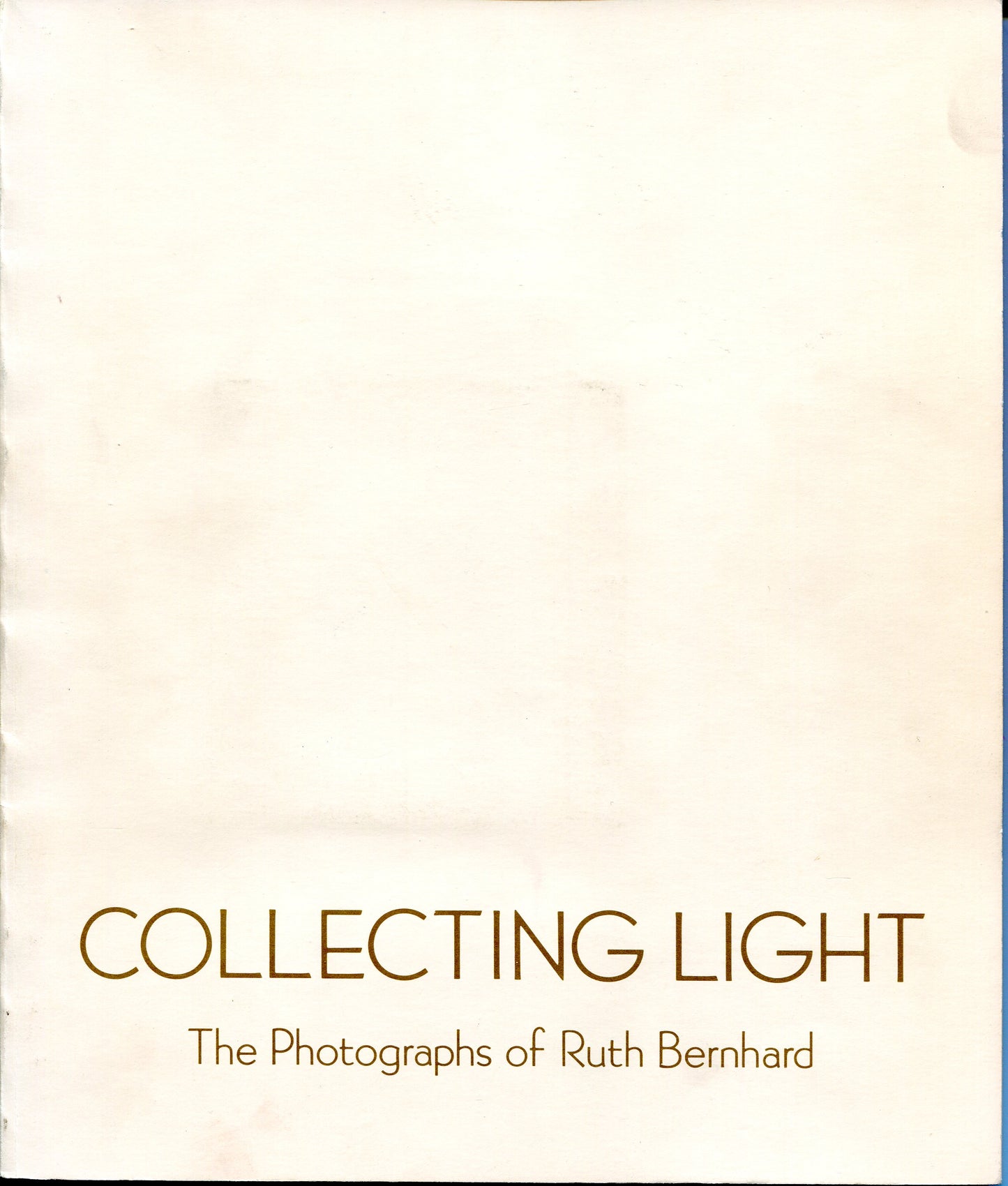
Bernhard, Ruth. Collecting Light: The Photographs of Ruth Bernhard.
Bernhard, Ruth. Collecting Light: The Photographs of Ruth Bernhard.
受取状況を読み込めませんでした
Untitled 20. By James Alinder. Friends of Photography, 1979. 35 plates. Wraps. Fine. Summary:
Published in 1979 by the Friends of Photography as Untitled 20, Collecting Light is a significant retrospective monograph that celebrates the career of Ruth Bernhard, one of the 20th century’s most influential masters of light and form.
Core Focus and Aesthetic
The book showcases Bernhard’s meticulous approach to large-format film photography, defined by her belief that "light is the universal language."
-
The Female Nude: The volume features inclusion of Bernhard's classic nudes. She treats the human body not as a provocative subject, but as a series of sculptural, geometric forms, often using high-contrast lighting to transform skin into glowing marble.
-
Meticulous Lighting: The title reflects her process—she was known to spend days in her studio arranging a single shot, "collecting" and shaping light to reveal the essential spirit of her subjects.
-
Symbolic Still Lifes: Beyond nudes, the book includes her work with shells, plants, and dolls, often imbuing inanimate objects with a sense of mystery and psychological depth.
Key Themes
-
Universal Connection: Bernhard’s work seeks a spiritual link between all things, suggesting that a shell and a human torso share the same divine mathematical curves.
-
Abstraction through Realism: While her photos are "straight" (unmanipulated), her extreme close-ups and dramatic shadows push the imagery toward abstraction.
-
The Transcendence of Matter: She focuses on the "essence" of an object rather than its literal function, turning the mundane into something monumental.
Historical Significance
As Untitled 20, this book was crucial in cementing Bernhard's legacy alongside contemporaries like Edward Weston and Ansel Adams. It highlights her unique contribution to West Coast formalist photography, specifically her ability to blend technical precision with a deeply poetic, almost mystical sensitivity to the visual world.
Ruth Bernhard (1905–2006) was a German-born American photographer celebrated for her masterly black-and-white female nude studies, precise still lifes, and luminous control of studio light. Born in Berlin to visual artist parents, she studied art at the Academy of Fine Arts before emigrating to New York City in 1927, where she began working as a commercial photographer. A pivotal 1935 meeting on a Santa Monica beach with Edward Weston transformed her artistic trajectory; deeply influenced by his "straight photography" aesthetic, she relocated to California, eventually settling in San Francisco. Over the following decades, Bernhard developed a signature style characterized by sculpturally modeled form, intimate compositions of natural and everyday objects—such as shells, hoses, and teapots—and classical female figure studies that emphasized organic geometry and timeless transcendence over eroticism. Lauded by Ansel Adams as "the greatest photographer of the nude," she spent much of her later life dedicated to teaching and lecturing, leaving an influential legacy in West Coast modernist photography.
Copies available:
- Pristine copy, fine, housed in a custom-made 4-mil polyester jacket.