Gary Saretzky Photo Books
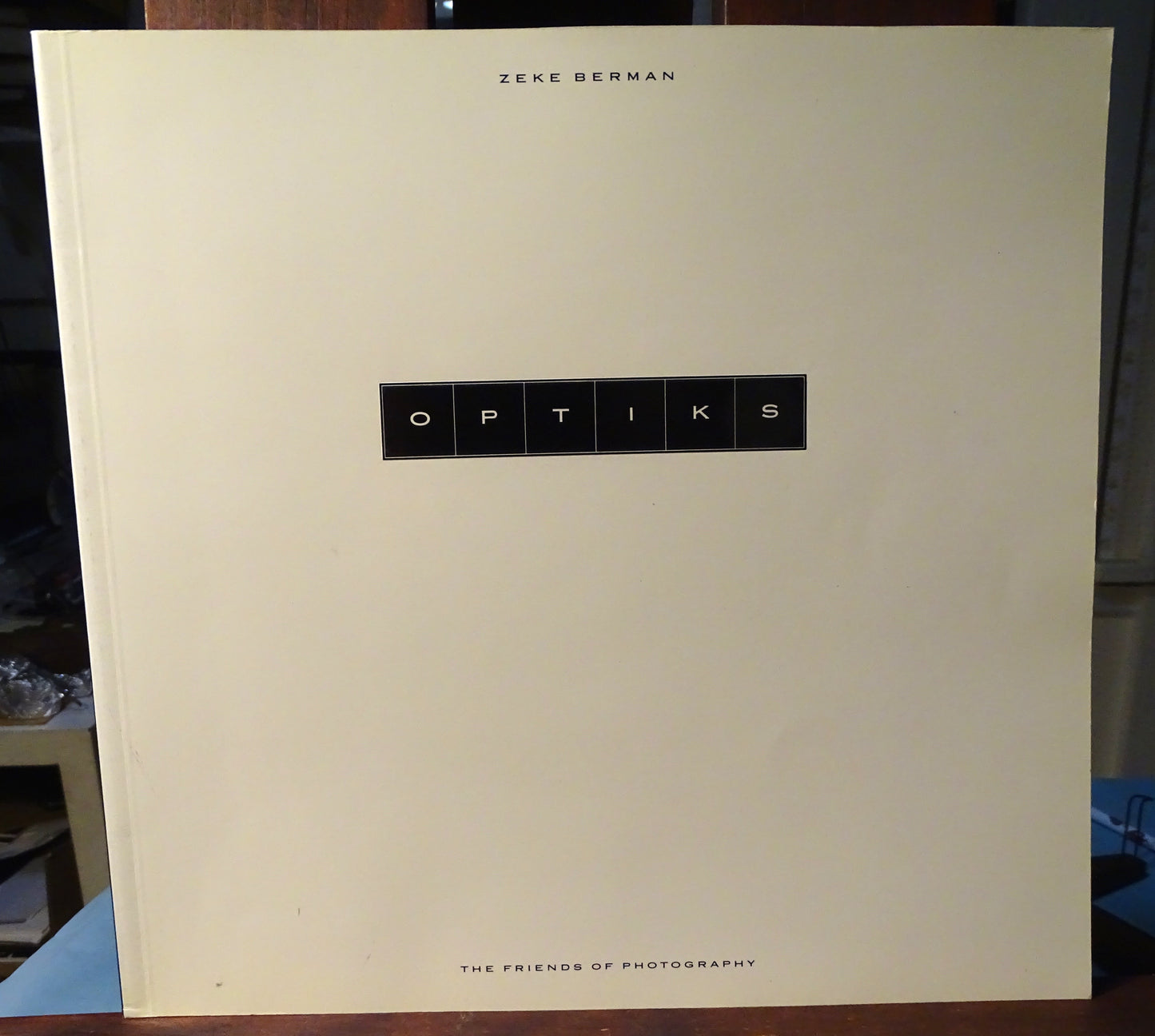
Berman, Zeke. Optiks by Zeke Berman. Issued as Untitled 53.
Berman, Zeke. Optiks by Zeke Berman. Issued as Untitled 53.
受取状況を読み込めませんでした
Friends of Photography, 1991. 21 plates printed on one side of each leaf plus several smaller reference images of objects constructed and arranged by the artist photographer. Includes vita of the photographer Zeke Berman. Text by Debra Heimerdinger. Catalog for exhibition, December 11, 1991 to March 8, 1992, at the Ansel Adams Center, San Francisco. Afterword by Andy Grundberg. Shiny wraps, like new with virtually no signs of use. Summary:
Published in 1991 by the Friends of Photography as part of their Untitled series (Untitled 53), Optiks is a monograph exploring the conceptual and perceptual photography of Zeke Berman. The book serves as a mid-career survey of his work from the 1980s.
Core Concept and Aesthetic
Berman’s work is rooted in the tradition of the studio still life, but he uses the genre to deconstruct how we perceive three-dimensional space on a two-dimensional surface.
-
Construction and Illusion: Berman builds elaborate, temporary sculptures and dioramas in his studio specifically to be photographed. He often uses mundane materials—string, clay, glass, water, and paper—to create visual puzzles.
-
The "Drawing" Quality: His photographs often mimic the appearance of sketches or diagrams. By carefully aligning objects with their own shadows or background lines, he creates "anamorphic" illusions that only resolve when viewed from the camera's specific vantage point.
-
Black and White Precision: The use of high-contrast black and white photography emphasizes texture, form, and the physical properties of light, stripping away the distraction of color to focus on the "optics" of the scene.
Key Themes
-
Perceptual Inquiry: The book is a meditation on the act of seeing. Berman challenges the viewer's brain to reconcile what it knows to be true (a flat photo) with what it sees (complex, overlapping depths).
-
The Camera as an Eye: Unlike "straight" photography that captures found reality, Optiks highlights the camera as an active participant that can flatten, distort, and rearrange the world.
-
Process over Subject: The "subject" of a Berman photo is rarely the object itself, but rather the physics of the composition—gravity, balance, and the geometry of light.
Artistic Significance
As Untitled 53, this volume solidified Berman's reputation as a "photographer’s photographer." It bridges the gap between sculpture and photography, proving that the studio can be a laboratory for testing the limits of human vision. The book is noted for its intellectual rigor and its whimsical, yet disciplined, approach to formalist art.
Zeke Berman (born 1951) is an American artist known for his studio-based, conceptual fine-art photographs that explore the boundaries between sculpture, photography, drawing, and optics. Born in New York, he earned a Bachelor of Fine Arts in sculpture from the Philadelphia College of Art in 1972. Berman originally turned to photography to record his sculptural arrangements, but he soon shifted his focus to the photographic medium itself, creating complex still lifes using everyday materials like string, clay, ice, glass, and water. His work explores visual cognition, spatial illusion, and the transformation of three-dimensional constructions into two-dimensional images. Recognized with prestigious honors—including fellowships from the John Simon Guggenheim Memorial Foundation, the National Endowment for the Arts, and the New York Foundation for the Arts—Berman has had his photographs acquired and exhibited by institutions such as the Museum of Modern Art, the Metropolitan Museum of Art, the Whitney Museum of American Art, and the Art Institute of Chicago