Gary Saretzky Photo Books
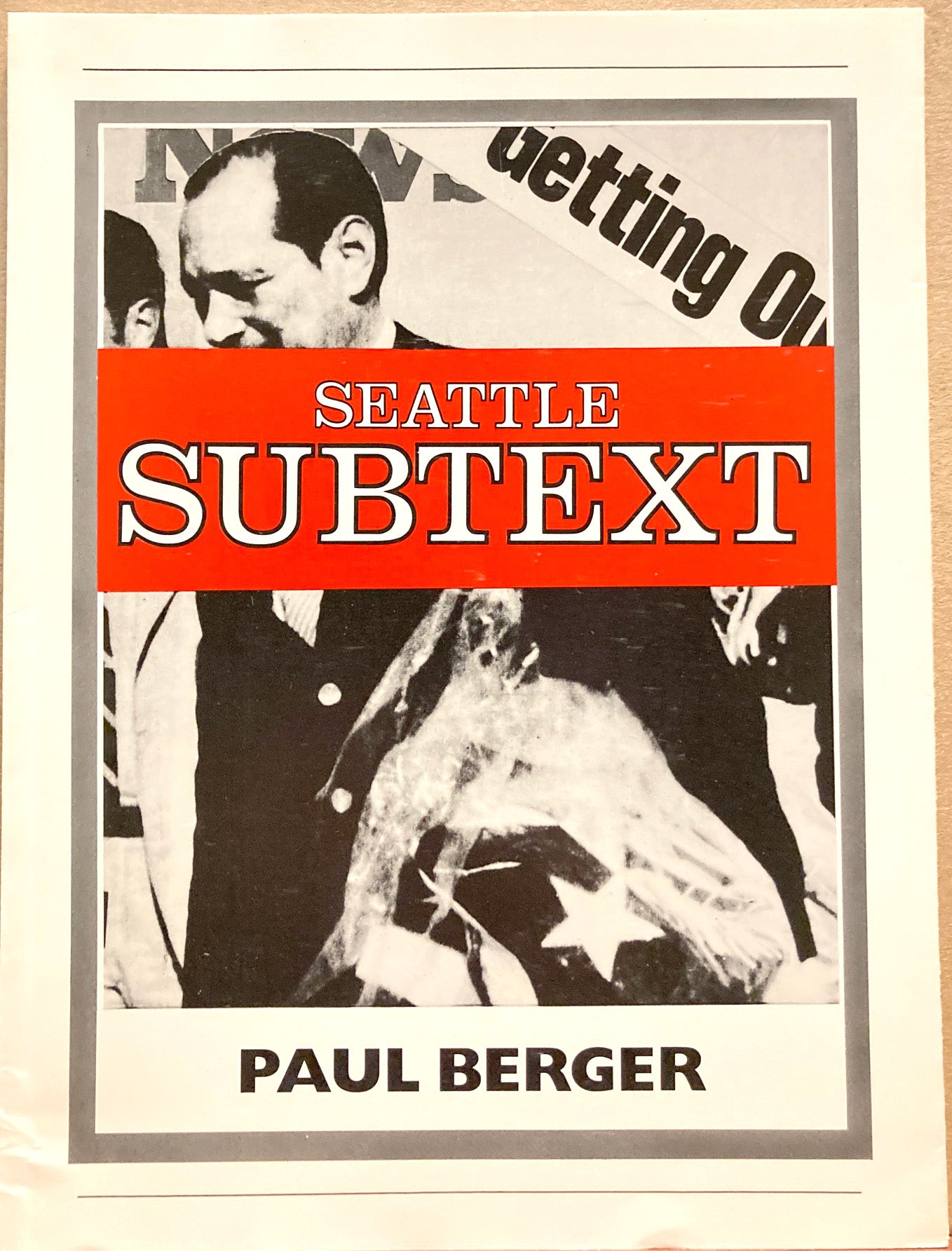
Berger, Paul. Seattle Subtext by Paul Berger. With postcard.
Berger, Paul. Seattle Subtext by Paul Berger. With postcard.
受取状況を読み込めませんでした
Visual Studies Workshop, Rochester. Real Comet Press, 1984. Smythe sewn, 48 black-and-white images, introduction by the author, 52 pages. Postmodern artist's book of re-photography using image scavenging techniques. "An imaginary and reordered magazine based on contemporary news weeklies, aimed at alerting the viewer to the power of mass media design and the constant assault of information, using overlapping television imagery and photographs." Wraps, as new. Postcard promoting the book laid in, with same illustration as cover of book, except in monochrome. Summary:
Published in 1984, Seattle Subtext by Paul Berger is a seminal work in the field of photographic art and digital-era sequencing. It is a complex, multi-layered visual narrative that explores the "subtext" of modern life—the hidden currents of information, media, and urban environments.
Core Concept and Technique
Berger utilizes a distinct aesthetic that blends traditional photography with early digital and video aesthetics:
-
The Strip Format: The book is famous for its horizontal "strip" compositions. Berger arranged multiple photographic frames into linear sequences that resemble filmstrips or the scrolling data of early computer screens.
-
Media Saturation: The imagery is heavily influenced by the 1980s media landscape. It includes snapshots of television broadcasts, newspaper fragments, weather maps, and mathematical diagrams, all layered or juxtaposed against urban scenes.
-
Sequential Logic: Unlike a standard photo book where each page is a standalone image, Seattle Subtext demands to be read as a continuous stream of information, reflecting how we consume media.
Key Themes
-
The Information Age: The book captures the transition from a purely physical world to one dominated by data and electronic signals.
-
Urban Deciphering: Despite the title, it is less about the geography of Seattle and more about the "language" of the city—how signs, architecture, and technology communicate with the observer.
-
Non-Linear Narrative: Berger challenges the viewer to find connections between disparate images, suggesting that meaning in the modern world is something we "assemble" rather than receive.
Artistic Significance
Seattle Subtext is highly regarded in the history of conceptual photography. It was pioneering in its realization that the computer and the television were not just tools, but new ways of seeing the world. For Berger, the "subtext" is the noise, the code, and the cultural static that exists just beneath the surface of our daily visual experience.
Paul Berger is an American postmodern photographer, digital media artist, and educator known as an early pioneer in the digital manipulation of photographic imagery. He earned a BA in Art from the University of California, Los Angeles in 1970, studying under Robert Heinecken and Robert Fichter, and completed his MFA at the Visual Studies Workshop in Rochester, New York in 1973 under Nathan Lyons. In 1978, he co-founded the photography program at the University of Washington's School of Art, where he taught for 35 years and introduced digital imaging coursework into the curriculum starting in 1985. Berger transitioned from traditional analog sequencing to computer-managed and digitally altered imagery in the early 1980s, culminating in his influential 1984 artist book Seattle Subtext—a multi-layered project published by Visual Studies Workshop Press and The Real Comet Press that recombined television visuals, text, and computer data to mimic news magazine spreads. A recipient of two National Endowment for the Arts grants, his work has been featured in major exhibitions across the United States and Europe, including a career retrospective at the Museum of Contemporary Photography in Chicago in 2003.