Gary Saretzky Photo Books
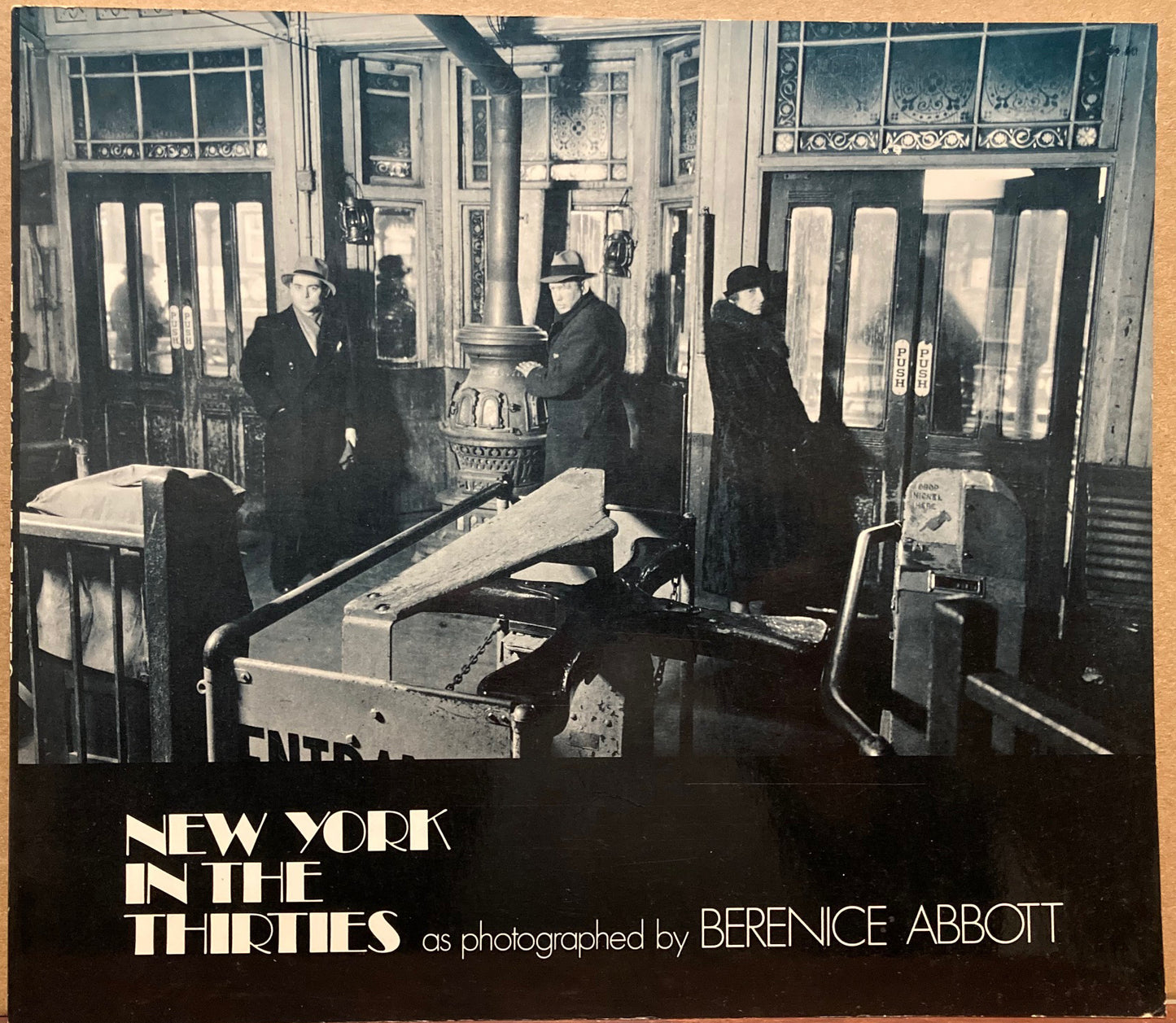
Abbott, Berenice. New York in the Thirties as Photographed by Berenice Abbott.
Abbott, Berenice. New York in the Thirties as Photographed by Berenice Abbott.
受取状況を読み込めませんでした
Dover, 1973. Text by Elizabeth McCausland. 97 photographs by Abbott. Unabridged softcover reprint of Changing New York, 1939. [Note: the 1997 Abbott book, Changing New York, is not a reprint of the 1939 book, as is this Dover reprint. Earlier edition of the Dover book seen with $3.50 price and later with $14.95 price and bar code. Printings can be differentiated by price; if bar code present, it is a later printing.] Summary:
New York in the Thirties, published by Dover Publications in 1973, is the definitive unabridged republication of the 1939 classic Changing New York. It showcases the monumental achievement of Berenice Abbott, who utilized a large-format view camera to document the city’s metamorphosis during the Great Depression under the auspices of the Federal Art Project.
Core Vision: Changing New York
Abbott returned to New York from Paris in 1929 and found a city in the throes of a violent architectural transition. Her goal was to capture the "old" New York—colonial-era houses and low-rise tenements—being literally overshadowed by the "new" skyscrapers of the modern era.
-
The Documentary Aesthetic: Influenced by the French master Eugène Atget, Abbott rejected the soft-focus "Pictorialism" of the time. Instead, she employed a sharp, objective, and realistic style that she called "straight photography."
-
The Contrast of Scale: Many of the 97 photographs in the book emphasize the juxtaposition between the human-scaled architecture of the 19th century and the soaring, impersonal steel of the 20th.
Key Subjects and Themes
-
Verticality and Perspective: Abbott famously used extreme "worm's-eye" and "bird's-eye" views to convey the dizzying energy of Manhattan, notably in her iconic shot of the Flatiron Building or the canyons of the Financial District.
-
The Vanishing City: The book meticulously records small storefronts, barbershops, oyster houses, and ferry terminals—the textures of daily life that were being erased by urban renewal.
-
Socio-Economic Reflection: While formalist in her compositions, the images inherently document the economic reality of the 1930s, showing the quiet streets of a city struggling through the Depression while still reaching for the clouds.
Production and Significance
The 1973 Dover edition is particularly valued for several reasons:
-
Unabridged Format: It restores the original 97 plates from the 1939 edition, which had been previously edited down.
-
Captions by Elizabeth McCausland: The book includes the original descriptive and historical captions by McCausland (Abbott’s partner), which provide essential context for the locations and their histories.
-
Historical Record: As many of the buildings photographed by Abbott were demolished shortly after she captured them, this volume serves as a vital architectural census of a lost New York.
Legacy
New York in the Thirties solidified Berenice Abbott’s reputation as one of the 20th century’s premier photographers. It stands as a bridge between the art of photography and the science of historical documentation, teaching us that the most profound art can often be found in the "honest" recording of a changing world.
Berenice Abbott (1898–1991) was a pioneering American photographer best known for her iconic black-and-white documentation of New York City's urban transformation and her work bridging art and science. Born in Springfield, Ohio, she moved to Paris in 1921, where she learned photography as an assistant to Man Ray, established a successful portrait studio capturing prominent avant-garde figures, and championed the rediscovery of French photographer Eugène Atget. Returning to New York in 1929, Abbott launched her landmark Federal Art Project work Changing New York (1935–1939), meticulously recording the city's rapidly evolving architecture, bridges, and streetscapes with a sharp, straight-photography aesthetic. Later in her career, she served as the picture editor for Science Illustrated and worked with MIT to create striking, precise photographs illustrating physical phenomena and laws of optics, cementing her legacy as a master of clean realism, technical innovation, and historical documentary.
Copies available:
- Very good with slight wear at corners, $7.50 original price, no bar code.
- Very good, original price $14.95, with moderate wear at extremities.