Gary Saretzky Photo Books
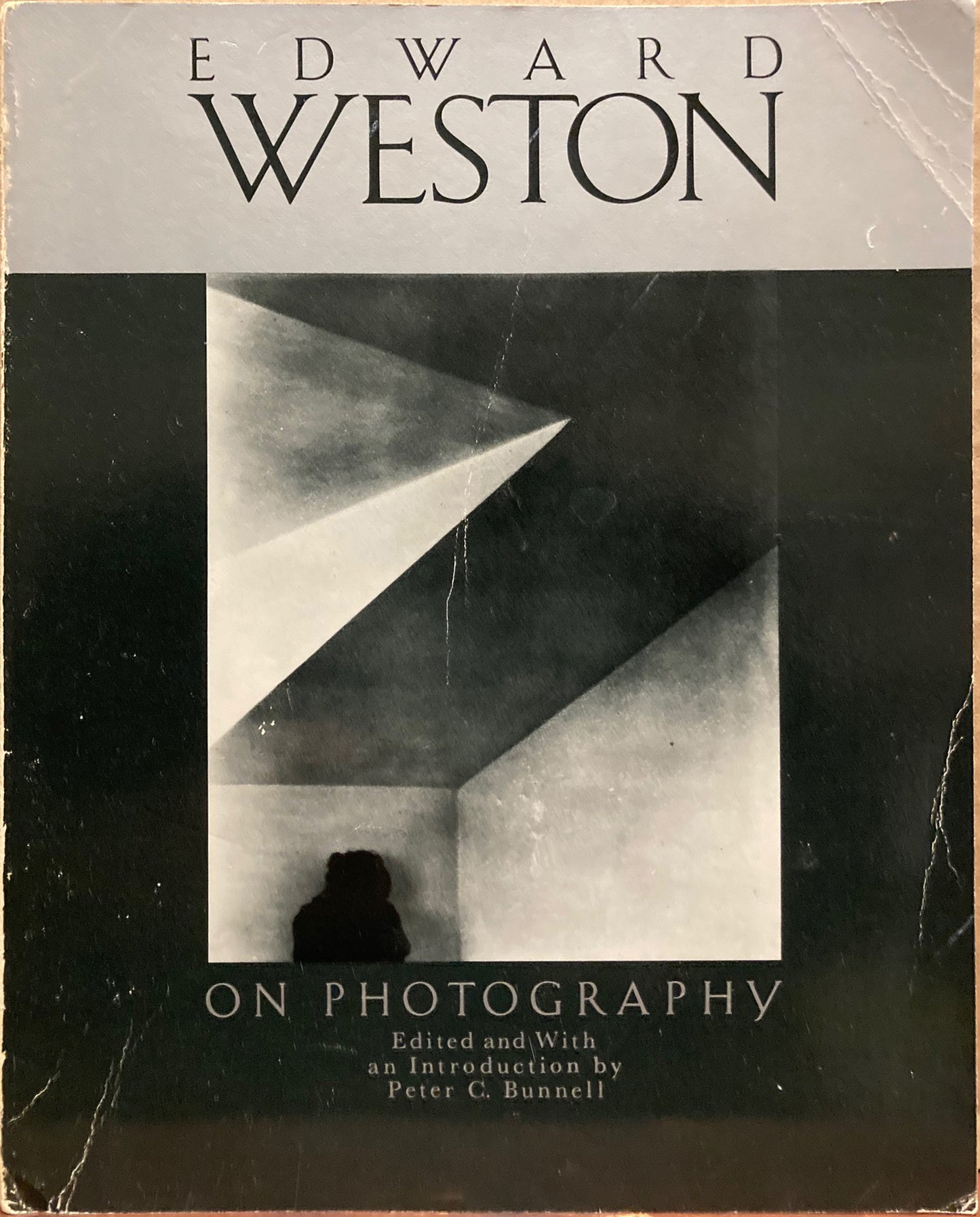
Weston, Edward. Edward Weston on Photography, edited by Peter C. Bunnell.
Weston, Edward. Edward Weston on Photography, edited by Peter C. Bunnell.
受取状況を読み込めませんでした
Gibbs M. Smith, 1983. 158 pages. About 50 writings by photographer Edward Weston, from 1911 to 1957. Most published with citation provided but also some manuscripts from the Weston archives at the Center for Creative Photography. Excellent introduction by Peter C. Bunnell. Includes some well-reproduced photographs on glossy paper but mainly a book of texts. Wraps, cover creases and well worn on spine. Summary:
Edward Weston on Photography, edited by the distinguished scholar Peter C. Bunnell (1983), is the definitive anthology of Weston’s theoretical and instructional writings. While other volumes focus on his biography or his images, this book focuses exclusively on Weston’s intellectual contribution to the medium, tracing his evolution from a professional portraitist to a radical modernist.
The Evolution of an Aesthetic
The book is structured to show the progression of Weston's thought process through his own published essays, technical notes, and manifestos.
-
The Break from Pictorialism: It includes his early writings where he rejects the "painterly" manipulation of the late 19th century in favor of a "pure" photographic vision.
-
The Concept of Previsualization: A central theme of the collection is Weston’s insistence that the photographer must "see" the finished print on the ground glass before the exposure is made. He argues that the camera's unique power lies in its ability to record "the thing itself" with a clarity the human eye cannot sustain.
-
Technical Rigor: Bunnell includes Weston's advice on equipment and technique, highlighting his preference for large-format cameras and his disdain for the "fuzzy" or "sentimental" quality of amateur photography.
Editorial Scholarship
Peter Bunnell, a former curator at MoMA and professor and museum director at Princeton, provides a rigorous scholarly framework:
-
Contextualization: Bunnell’s introduction and annotations help the reader understand the cultural and artistic landscape Weston was reacting against.
-
Chronological Mapping: By organizing the texts chronologically, Bunnell allows the reader to see how Weston’s philosophy matured, particularly during his pivotal years in Mexico and his later years at Point Lobos.
Key Philosophical Pillars
The writings in this volume reinforce three major ideas that defined the "Weston School":
-
Honesty of the Medium: Photography should not try to look like an etching or a painting; it should celebrate its own mechanical and chemical nature.
-
The Significance of Form: Whether a shell, a nude, or a landscape, the photographer’s job is to reveal the underlying structural rhythm of the subject.
-
The "Straight" Print: Weston advocates for uncropped, unmanipulated prints that rely on perfect exposure and development.
Significance
Edward Weston on Photography is essential for anyone seeking to understand the theory behind the image. It serves as a primary source for the "Straight Photography" movement and remains one of the most influential texts in photographic education, cementing Weston's legacy as the philosopher-king of 20th-century modernism.