Gary Saretzky Photo Books
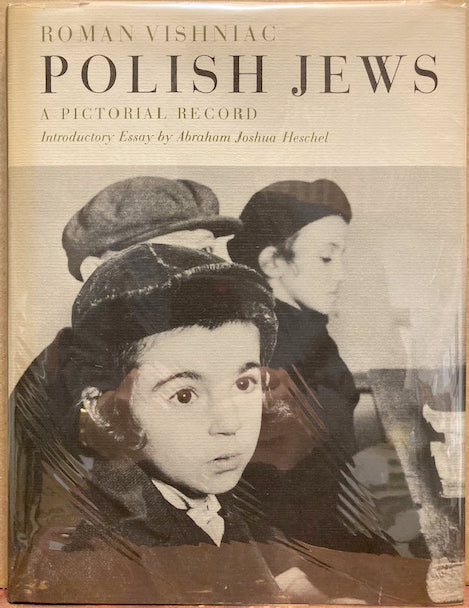
Vishniac, Roman. Polish Jews: A Pictorial Record by Roman Vishniac.
Vishniac, Roman. Polish Jews: A Pictorial Record by Roman Vishniac.
受取状況を読み込めませんでした
Introductory Essay by Abraham Joshua Heschel. Schocken, 1976. 5th printing. [While living in Berlin in the 1930s, Roman Vishniac (1897–1990) was commissioned by the American Jewish Joint Distribution Committee to make photographs of impoverished Jews in Central and Eastern Europe that could be used to promote charitable donations. About 2,000 of an estimated 16,000 negatives survived World War II.] Hardcover, fine with protected dust jacket that has a small chip on bottom edge of rear cover but no other significant defects. (Scarce in hardcover in this condition.) Summary:
Polish Jews: A Pictorial Record, published in 1947 by Schocken Books, is the first and rarest collection of Roman Vishniac’s work. While later volumes like A Vanished World (1983) were expansive retrospectives, this 1947 hardcover is a raw, immediate historical document released when the world was first coming to grips with the magnitude of the Holocaust.
Historical Context and Rarity
The scarce hardcover edition is highly prized by collectors for its proximity to the events it documents. Released just two years after the end of World War II, it was intended as a visual eulogy for the six million Jews murdered by the Nazis, focusing specifically on the core of that population: the Jews of Poland.
Content and Editorial Vision
The book features 31 masterfully printed plates, curated to show the soul of a community rather than just its destruction.
-
The "Concerned" Image: The selection emphasizes the humanity, dignity, and intellectual intensity of Polish Jewry. Unlike traditional travelogues, these images are deeply intimate, captured by Vishniac between 1937 and 1939 with a hidden camera.
-
Abraham Joshua Heschel's Essay: The book is prefaced by a profound introductory essay by the renowned philosopher and theologian Abraham Joshua Heschel. His text provides the spiritual and cultural framework for the images, describing the "inner world" of the Polish Jew that Vishniac so effectively captured.
Key Visual Themes
-
The Scholarly Life: Many of the plates focus on the centers of learning—Yeshivas and Heders—showing the transmission of tradition from elderly rabbis to young students.
-
Urban and Rural Realities: The book captures the stark contrast between the bustling Jewish quarters of Warsaw and the impoverished, snow-blanketed villages of the rural interior.
-
Dignity in Adversity: The portraits emphasize the resilience of a people living under the dual shadows of the Great Depression and rising antisemitism.
Aesthetic Style
The 1947 edition is noted for its rich, deep-toned gravure printing. Vishniac’s use of natural light and "candid" perspectives (necessary because many religious subjects avoided the "graven image" of the camera) creates a sense of being an unobserved witness to a civilization's final moments.
Significance
Polish Jews: A Pictorial Record is a cornerstone of 20th-century photographic literature. While later editions of Vishniac's work are more common, this 1947 hardcover remains the primary archival link between the pre-war world and the post-war memory. It transformed Vishniac from a JDC documentation photographer into a visual historian of the lost Jewish experience.
Collector's Note: The 1947 Schocken edition is easily identified by its simple cloth binding and its role as the first major publication to present the Shtetl as a sacred space through the lens of modern photography.