Gary Saretzky Photo Books
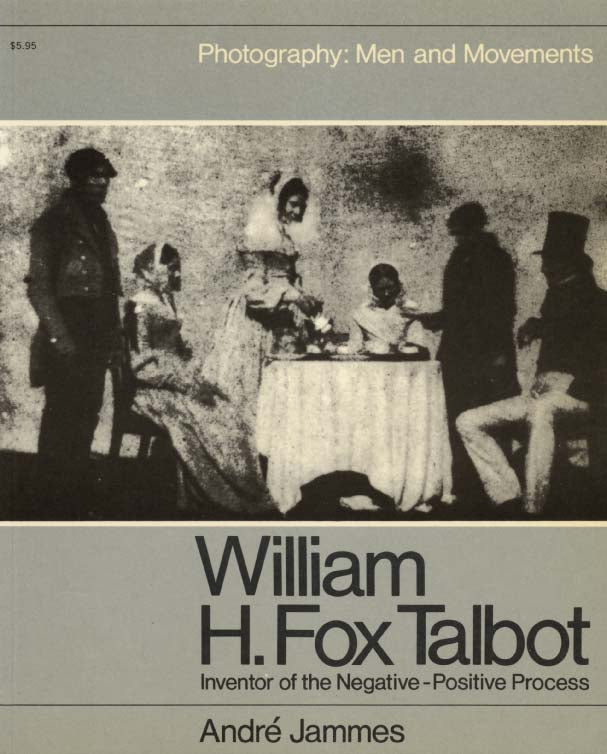
Talbot. William H. Fox Talbot: Inventor of the Negative-Positive Process by Andre Jammes.
Talbot. William H. Fox Talbot: Inventor of the Negative-Positive Process by Andre Jammes.
受取状況を読み込めませんでした
Collier, 1973. First American Edition. Wraps, 96 pages, 71 illustrations. Thorough treatment of the range of Talbot's experiments and photographic oeuvre. Issued in series, Photography: Men and Movements. Fine. Not issued with ISBN number. Summary:
William H. Fox Talbot: Inventor of the Negative-Positive Process is a landmark monographic study authored by the distinguished French photo historian and collector André Jammes, published by Macmillan as part of the Collier Books photography series. The concise volume serves as an authoritative critical and visual examination of the foundational breakthroughs achieved by the British polymath who single-handedly invented the reproducible photographic process.
Key Content and Themes
-
The Evolution of the Calotype: The core of the text meticulously traces the development of "photogenic drawing" and the patented "calotype" process. The analysis chronicles how paper sensitized with silver salts allowed for the creation of a negative image from which multiple positive prints could be made—a conceptual breakthrough that established the structural blueprint for analog photography for the next century and a half.
-
The "Pencil of Nature" Philosophy: The monograph features pristine reproductions of early images, including botanical silhouettes, intricate lace patterns, classical architecture, and everyday street scenes. Jammes analyzes these plates within the context of the historic publication The Pencil of Nature, illustrating how the camera was envisioned not merely as a passive recording tool, but as a revolutionary medium destined to transform art, science, and global communication.
-
Artistic and Scientific Duality: A central theme of the book is the dual identity of early photography as both a rigorous scientific specimen and a visual marvel. The text explores how chemistry, optics, and botany intersected to force nature to record its own image, driven by the inventor's frustration with his own inability to sketch while traveling.
-
Critical Reappraisal and Historical Context: The imagery is accompanied by insightful scholarly commentary that provides vital historical context. The text balances technological analysis with a broader appreciation of the artistic qualities of early paper photography, examining the fierce mid-nineteenth-century rivalries and patent battles that shaped the medium's infancy.
Significance
William H. Fox Talbot: Inventor of the Negative-Positive Process stands as a definitive tribute to the dawn of the photographic medium. By presenting fragile, century-old salt prints and paper negatives through a rigorous historical lens, the publication bridges the gap between historical artifact and fine art, cementing the subject's legacy as the true architectural father of reproducible photography.
Note: On January 25, 1839, the Englishman William Henry Fox Talbot made public his photogenic drawing process which produced negatives on paper. Since 1834, Talbot had been “sensitizing writing paper by dipping it in a solution of sodium chloride [salt water] and coating one side with silver nitrate, a compound which quickly turns dark when exposed to sunlight. An impression of an object was then made by placing it on the sensitized side of the paper and exposing it to the sun.” Talbot also began using the process to make images with a small camera he called a “mousetrap.” Talbot’s invention was the precursor to his calotype process (1840-1841), which employed additional chemicals to increase light sensitivity and became the first widely used photographic process on paper. (Reference: Salt Prints at Harvard webpage)
