Gary Saretzky Photo Books
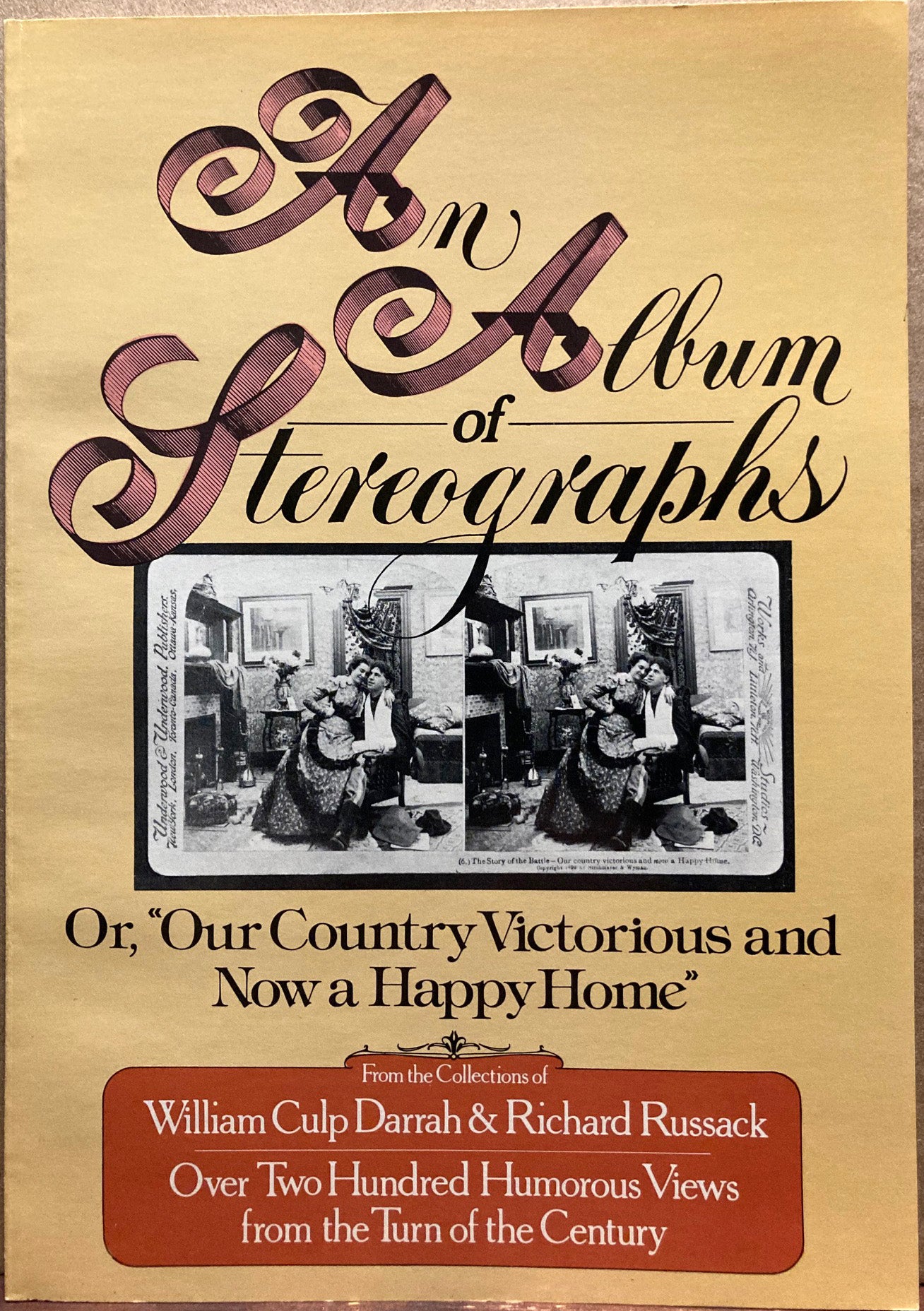
Stereographs. An Album of Stereographs Or, "Our Country Victorious and Now a Happy Home by William Culp Darrah and Ruchard Russack.
Stereographs. An Album of Stereographs Or, "Our Country Victorious and Now a Happy Home by William Culp Darrah and Ruchard Russack.
受取状況を読み込めませんでした
Doubleday, 1977. More than 200 humorous stereoviews from the turn of the twentieth century from the authors’ collections, wraps, 111 pages. With custom made polyster jacket. Like new. Summary:
An Album of Stereographs: Or, "Our Country Victorious and Now a Happy Home" (1977), compiled by William Culp Darrah and Richard Russack, is a specialized photographic anthology published by Doubleday & Company. Drawing directly from the extensive private archives of its authors—most notably Darrah, a preeminent pioneer of American stereoscopic scholarship—the 111-page volume isolates a specific and frequently overlooked genre of popular late 19th- and early 20th-century visual culture: humorous and narrative-driven stereoviews.
Key Elements of the Work
-
Focus on Vernacular Humor: Unlike traditional photo histories that focus on historic landscapes or wartime documentation, this album features more than 200 humorous and illustrative stereographs from the turn of the 20th century. It highlights the staged, sequential comic narratives that served as a precursor to modern comic strips and television sitcoms.
-
The Domestic and Social Lens: The curated images provide an intimate, often satirical look at the social anxieties, domestic lives, and cultural tropes of Victorian and Edwardian America. The thematic chapters organize cards depicting courtship rituals, marital disputes, misbehaving children, servant dynamics, and the introduction of new technologies into the late-1800s household.
-
Preservation of the Mass-Market Industry: The volume showcases the output of major commercial publishers who mass-produced these cards for home parlor entertainment. By compiling these specific examples, the authors document the highly calculated studio production techniques—such as dramatic staging, prop construction, and hand-painted tinting—required to optimize comedic timing in a three-dimensional format.
-
Scholarly Contextualization: As a key authority on early photographic history, Darrah provides analytical commentary alongside Russack to ground these lighthearted images within the broader trajectory of American entertainment history, shifting the academic view of stereoscopy away from mere scientific equipment to a vital mass-media phenomenon.
Narrative Intent
The publication functions as a celebration of popular historical taste. By collecting and analyzing these mass-produced comic cards, Darrah and Russack demonstrate that the humble parlor stereoview was an essential vehicle for early American pop culture, illustrating how the era's collective humor and social values were physically manifested through three-dimensional optical illusions.
