Gary Saretzky Photo Books
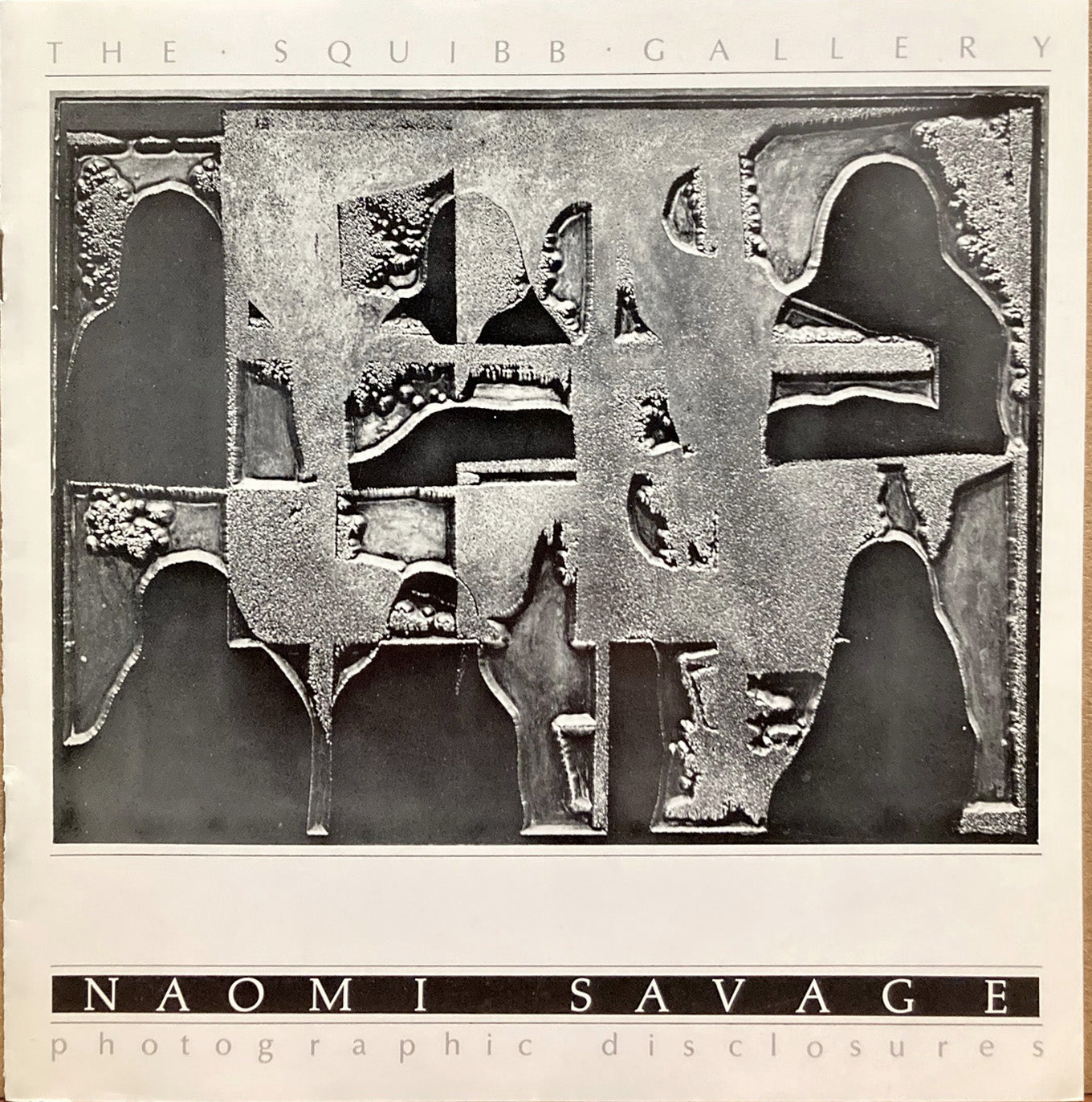
Savage, Naomi. Naomi Savage. Photographic Disclosures.
Savage, Naomi. Naomi Savage. Photographic Disclosures.
受取状況を読み込めませんでした
Squibb Gallery, Princeton, 30 January - 28 February 1982. Exhibition catalog, wraps, 8 pages, 6 illustrations (including cover), checklist of 74 works. Introduction by Arline Snyder, Director, Princeton Gallery of Fine Arts. [Major exhibit by Savage, known for her postvisualization techniques influenced by her mentor and uncle, Man Ray.] Like new.
Naomi Savage (1927–2005) was an influential American photographer and multimedia artist celebrated for her groundbreaking experimentation with photographic printmaking, photo-engraving, and metal etching processes. Born Naomi Siegler in Jersey City, New Jersey, she studied photography under Berenice Abbott at the New School for Social Research and art at Bennington College before serving a formative apprenticeship in California with her uncle, the Dada master Man Ray. Guided by Man Ray’s spirit of risk-taking, Savage pushed beyond standard darkroom techniques to transform the photographic image into a tactile, sculptural object. She pioneered photo-engraving on copper, bronze, and aluminum plates—often treating the etched metal plates themselves as finished artworks rather than mere matrices for printing. Her most famous public commission, a monumental 50-foot etched-brass mural titled Environs (1970) installed at the Lyndon Baines Johnson Presidential Library in Austin, Texas, demonstrated her ability to scale intimate photographic textures into public art. A recipient of a National Endowment for the Arts fellowship, Savage spent much of her later life living and working in Princeton, New Jersey, leaving behind an innovative body of work held in major institutions including the Museum of Modern Art and the Metropolitan Museum of Art.
Naomi Savage: Photographic Disclosures is an exhibition catalogue published to document a major solo retrospective of the influential American photographer and printmaker Naomi Savage. Held at the Squibb Gallery in Princeton, New Jersey, the publication surveys Savage's deeply experimental, decades-long career. The catalogue acts as an analytical overview of her unique philosophy, which treated photographic exposure not as an end result, but as the initial step in a fluid printmaking process.
Key Overview and Objectives
-
Honoring a Local Pioneer: Having settled in Princeton in the 1950s, Savage was championed by the gallery as a major local figure with a global impact. The publication outlines her artistic lineage, noting her early studies under Berenice Abbott and her formative apprenticeship in California with her uncle, the legendary Surrealist master Man Ray.
-
Process as Medium: The main objective of the text is to contextualize Savage’s role in the mid-to-late 20th-century postmodern shift, where photography transitioned away from straight, objective documentation and toward radical, hands-on physical manipulation.
Core Themes and Artistic Styles
-
Beyond the Darkroom: The catalogue details Savage's restless, avant-garde experimentation with alternative mechanical and chemical techniques. It highlights her use of photogravure, solarization, photograms, multiple exposures, texture screening, and printing on non-traditional surfaces like metallic foils.
-
The Etched Metal Plate: A central theme of the publication is Savage's groundbreaking technique of using photoengraving for aesthetic expression rather than duplication. The text explores how she pulled inked and intaglio relief prints from etched metal plates, and crucially, how she began exhibiting the raw, incised metal plates themselves—often made of copper, magnesium, or zinc—as standalone, three-dimensional sculptural artworks.
-
Playful Abstraction of the Everyday: Savage’s subject matter, as organized in the catalogue, shifts seamlessly from traditional forms to whimsical, abstract studies. It captures her sensitivity to shape and texture across a massive range of motifs, including close-up human torsos, landscapes, facial masks, toys, and everyday kitchen utensils.
Significance
Photographic Disclosures remains a vital reference text for understanding Naomi Savage’s contributions to the history of photographic printmaking. By documenting her radical bridging of photography, sculpture, and graphic arts, the gallery publication solidifies her legacy as a key figure who helped stretch the boundaries of the photographic medium in the post-war era.
