Gary Saretzky Photo Books
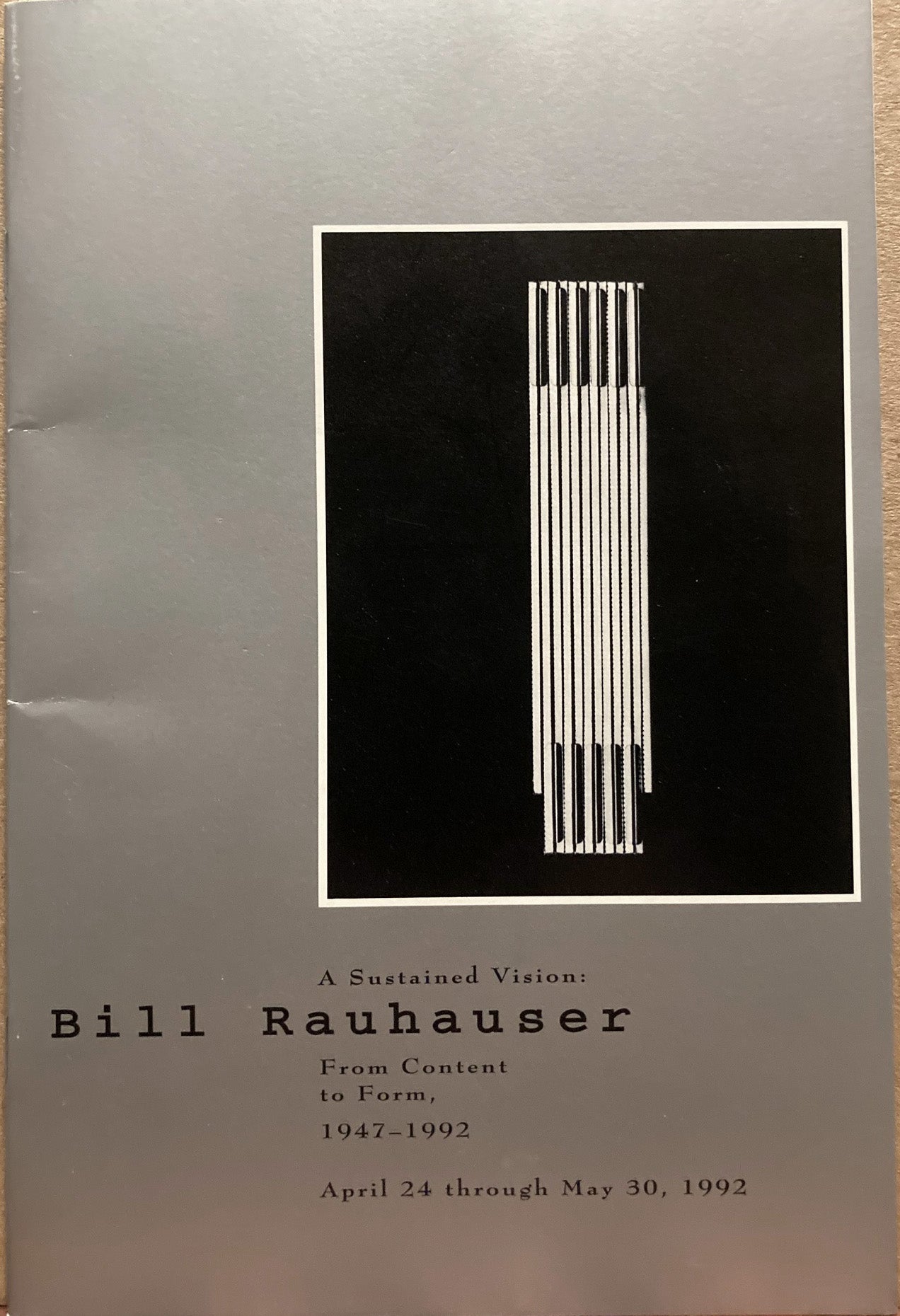
Rauhauser, Bill. A Sustained Vision: Bill Rauhauser. From Content to Form, 1946-1992.
Rauhauser, Bill. A Sustained Vision: Bill Rauhauser. From Content to Form, 1946-1992.
受取状況を読み込めませんでした
Detroit Focus Gallery, April 24 through May 30, 1992. Foreword by Mary M. Denison. Essay by Ellen Sharp. Stiff illustrated wraps, 16 pages printed on heavy-weight paper, illustrated with 19 black-and-white photographs with varied subject matter. Includes checklist of 53 works and biographical information on the Detroit photographer, whose work was included in the 1955 Family of Man exhibit at the Museum of Modern Art, New York. Very good with minor shelf wear. Summary:
A Sustained Vision: Bill Rauhauser. From Content to Form, 1946–1992 is an exhibition catalog published by the Detroit Focus Gallery to accompany a major retrospective of the prominent mid-century American street photographer Bill Rauhauser.
Spanning nearly five decades of work, the publication documents Rauhauser’s lifelong dedication to chronicling the social, architectural, and cultural landscape of Detroit, while tracing his stylistic evolution from direct photojournalism to sophisticated formal composition.
Core Themes & Critical Framework
1. The Chronicler of Detroit
At the center of the catalog is Rauhauser's role as Detroit's preeminent visual poet. Unlike outsiders who visited the city to capture sensationalized headlines, Rauhauser lived and worked there his entire life. The images documented in the catalog capture the vibrant, complex, and changing pulse of the city across its industrial peak and subsequent transitions:
-
Casual, candid interactions on city sidewalks, buses, and public parks.
-
The bustling energy of downtown shopping districts, theaters, and local auto culture.
-
The quiet, stark geometry of changing urban architecture and neighborhood storefronts.
2. Theoretical Shift: From Content to Form
The subtitle of the exhibition highlights Rauhauser’s primary artistic philosophy. In his early career (the late 1940s and 1950s), his focus was heavily driven by content—the human story, the decisive moment, and the immediate narrative of the street scene. Over the decades, his work shifted toward form. He became increasingly fascinated by how abstract shapes, stark shadows, reflections, and spatial geometry could frame a human subject, moving street photography into a highly structured, self-conscious modern art form.
3. Institutional Impact and Advocacy
The catalog also acknowledges Rauhauser’s wider impact on the photographic community in Michigan. Beyond his own camera work, he was a pivotal educator, gallery director, and curator who fought to establish photography as a serious fine art medium within Detroit’s major cultural institutions, serving as an intellectual anchor for generations of Midwestern photographers.
A Sustained Vision serves as both an essential historical record of 20th-century Detroit and an exemplar of street photography. It illustrates how a photographer can dedicate a lifetime to a single municipality and continuously reinvent their visual language, transforming everyday urban documentation into timeless artistic expression.
