Gary Saretzky Photo Books
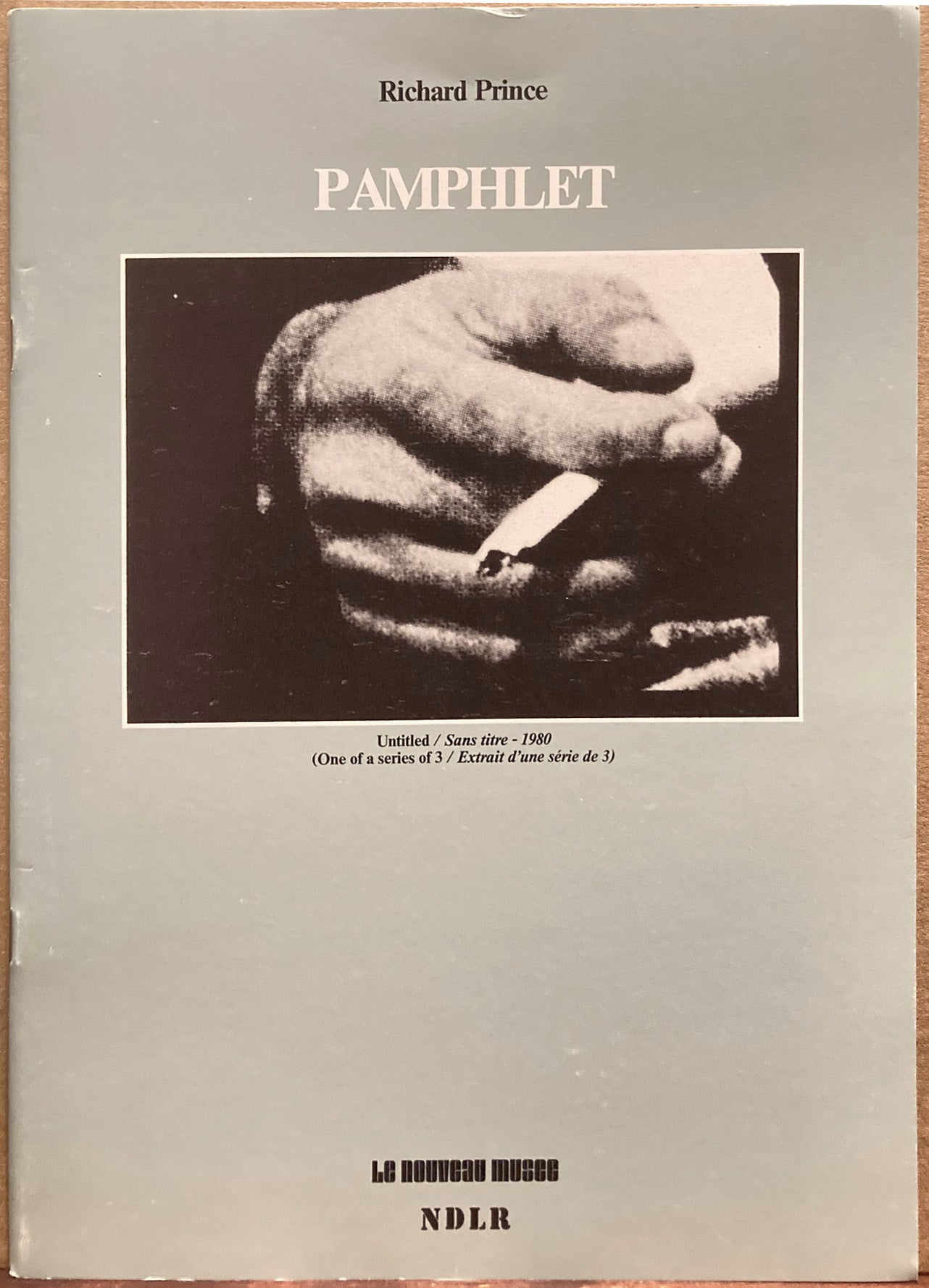
Prince, Richard. Richard Prince: Pamphlet.
Prince, Richard. Richard Prince: Pamphlet.
受取状況を読み込めませんでした
Le Nouveau Musée, 1983. Essay by Kate Linker. Issued on the occasion of Richard Prince's first solo exhibition at the Nouveau Musée, Villeurbanne, France, January 21 - March 6, 1983. Text in English and French. Stiff wraps, 32 pages. Issued in an edition of 1,000. (Also issued in a deluxe edition of 50 numbered copies, both editions rare.) Purchased when new and carefully stored, still fresh, near fine with small bump top middle edge. Copy offered at Swann Auction, May 2010, with estimate of $900-1,200.
Richard Prince (b. 1949) is an influential American painter, photographer, and conceptual artist best known as a pioneer of Appropriation Art and a prominent member of the "Pictures Generation". Born in the Panama Canal Zone, Prince moved to New York City in the 1970s, where he began working in the tear-sheet department at Time Inc., an environment that directly sparked his interest in mass-media imagery and advertising graphics. He gained international attention by developing the practice of "rephotography"—photographing pre-existing commercial advertisements, magazine spreads, and pop-culture motifs to isolate and critique consumer desires, gender stereotypes, and American mythology. His most famous body of work, the Cowboys series begun in the late 1970s, featured cropped, rephotographed images of Marlboro advertisements that stripped away brand text to lay bare the engineered tropes of hyper-masculinity and Western individualism. While his provocative methods have frequently ignited high-profile legal debates surrounding copyright and fair use, Prince's work remains widely exhibited and collected by major global institutions, including the Solomon R. Guggenheim Museum, the Whitney Museum of American Art, and the Metropolitan Museum of Art, securing his position as a central figure in contemporary art discourse.
Richard Prince: Pamphlet (published by Le Nouveau Musée, Villeurbanne in 1983) is a highly collectible artist publication and the first exhibition catalog of major significance dedicated to the American contemporary artist Richard Prince. Issued in a limited print run of 1,000 copies to accompany his solo exhibition spanning January 21 to March 6, 1983, the bilingual volume (English and French) features fifteen reproductions of Prince’s early work alongside an influential introductory essay by art critic and historian Kate Linker.
Core Themes & Critical Framework
1. The Mechanics of Rephotography
The catalog documents a crucial window of Prince’s output (1977–1982), a period during which he emerged as a pioneer of rephotography and a leading figure of the "Pictures Generation." The included illustrations show how Prince pulled imagery directly from luxury lifestyle advertisements and consumer media, cropped out text, and refilmed the photographs to isolate the underlying social fantasies. Linker’s essay contextualizes this practice, analyzing how Prince treats existing images as raw material to question authorship and the status of original artworks.
2. Deconstructing Consumer Desire
A central focus of the publication is the critique of late-capitalist mythology. The curated selection of images highlights Prince’s fascination with stylized, mass-media typologies—such as pristine models, luxury watches, and idealized domestic spaces. Both Linker’s text and Prince’s own brief, accompanying writings dissect how advertising fabricates artificial desires, demonstrating that the "rephotograph" functions as a mirror reflecting the viewer’s own subconscious conditioning.
3. Text and Image Juxtaposition
The architecture of the pamphlet places heavy emphasis on the interplay between visual art and experimental literature. Rather than acting as a standard, passive checklist of objects, Prince utilizes the layout to interweave his own short, enigmatic texts with the illustrations. This structural choice highlights his dual practice as both a visual artist and a writer, disrupting traditional editorial formats to construct an unsettling, fragmented narrative about contemporary life.
Pamphlet stands as an essential primary document of early postmodern artistic theory. By providing a rigorous intellectual framework for Prince's controversial appropriation strategies, Kate Linker's essay and Le Nouveau Musée’s publication helped legitimize rephotography, defining a seismic shift in how the art world evaluated duplication, copyright, and mass-media consumption in the late twentieth century.
