Gary Saretzky Photo Books
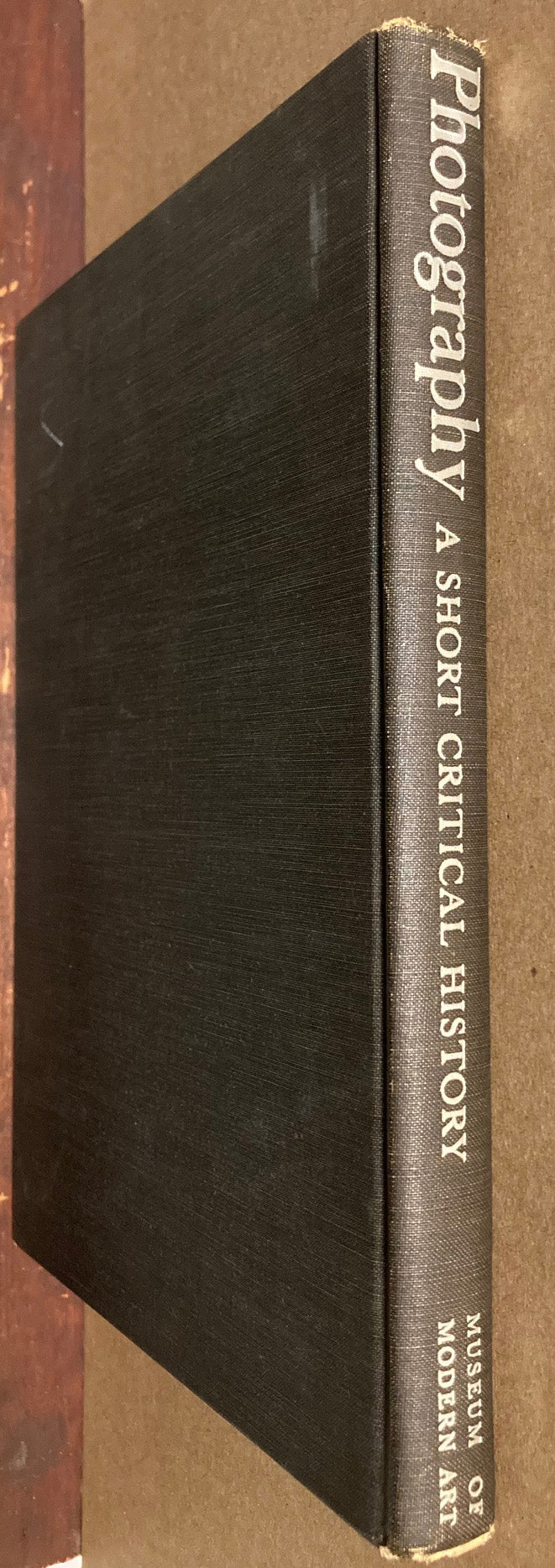
Newhall, Beaumont. Photography: A Short Critical History, 1839-1937 by Beaumont Newhall.
Newhall, Beaumont. Photography: A Short Critical History, 1839-1937 by Beaumont Newhall.
受取状況を読み込めませんでした
NY: Museum of Modern Art, 1938. One of 3,000 copies. Second revised edition of Newhall's 1937 history of photography, entitled Photography, 1839-1937, issued as the catalog for the survey exhibit at the Museum of Modern Art, for which Newhall was unable to get the participation of Alfred Stieglitz. Stieglitz was pleased with Newhall's curatorial efforts and the 1938 edition includes a frontispiece by Stieglitz, whose late endorsement of Newhall had long-term effects on the historiography of photography. Newhall's book was revised again several more times in future decades, with the third and subsequent editions titled, The History of Photography. As the second edition of of Newhall's first book, with important changes, this volume is of singular importance in the literature of photography. Moderate wear at spine tips, otherwise fine. Lacks the scarce dust jacket. Summary:
hotography: A Short Critical History, 1839–1937 (published in 1938 by the Museum of Modern Art) is a seminal work by art historian, librarian, and curator Beaumont Newhall.
The book is an expanded and revised version of the catalog Newhall wrote for MoMA's landmark 1937 exhibition, Photography 1839–1937, which marked the first major retrospective of the medium's first century within a modern art museum. This text laid the groundwork for his later definitive textbook, The History of Photography.
Core Themes & Content
-
The Medium's First Century: Newhall traces the chronological evolution of photography from its official birth in 1839 up to the late 1930s. He divides this first century into distinct eras: "Primitive Photography" (the pioneer days of the daguerreotype and calotype), "Early Photography" (the rise of wet-collodion and dry plates), and "Contemporary Photography" (the post-WWI era).
-
The Machine Aesthetic: Influenced by the modernist movements of the 1930s, Newhall champions the idea that the camera is a machine with its own unique visual language. Rather than judging a photograph by how closely it mimics a painting or drawing, he argues it should be evaluated based on the inherent laws of optics and chemistry.
-
Defining the Canon: The book serves as an elite cataloging effort that helped solidify the Western photographic "canon." It features and contextualizes the work of historic masters (such as David Octavius Hill, Robert Adamson, and Julia Margaret Cameron) alongside major contemporary figures of the time (including Walker Evans, Henri Cartier-Bresson, Edward Weston, and László Moholy-Nagy).
-
Expanding the Scope: While heavily focused on artistic expression, the 1938 edition also acknowledges photography's broader utility, dedicating chapters to news photography, color processes, scientific imaging, and moving pictures.
Critical and Technical Approach
Newhall balances a strict, logical breakdown of technical innovations—such as the transition from heavy view cameras to hand-held roll-film devices—with aesthetic theory.
He heavily advocates for "straight photography"—pictures that rely on sharp focus, clean composition, and the natural properties of the medium, rather than "pictorialism" (a late 19th-century style where photographers heavily manipulated prints to make them look like soft-focus paintings). He establishes that a photographer's ultimate goal is to "express inner significance through outward form."
Photography: A Short Critical History was a watershed publication that successfully argued for photography's legitimacy as a fine art. By linking technological evolution directly to creative breakthroughs, Newhall gave the English-speaking world its first structured, academic framework for criticizing and appreciating the photographic medium.
