Gary Saretzky Photo Books
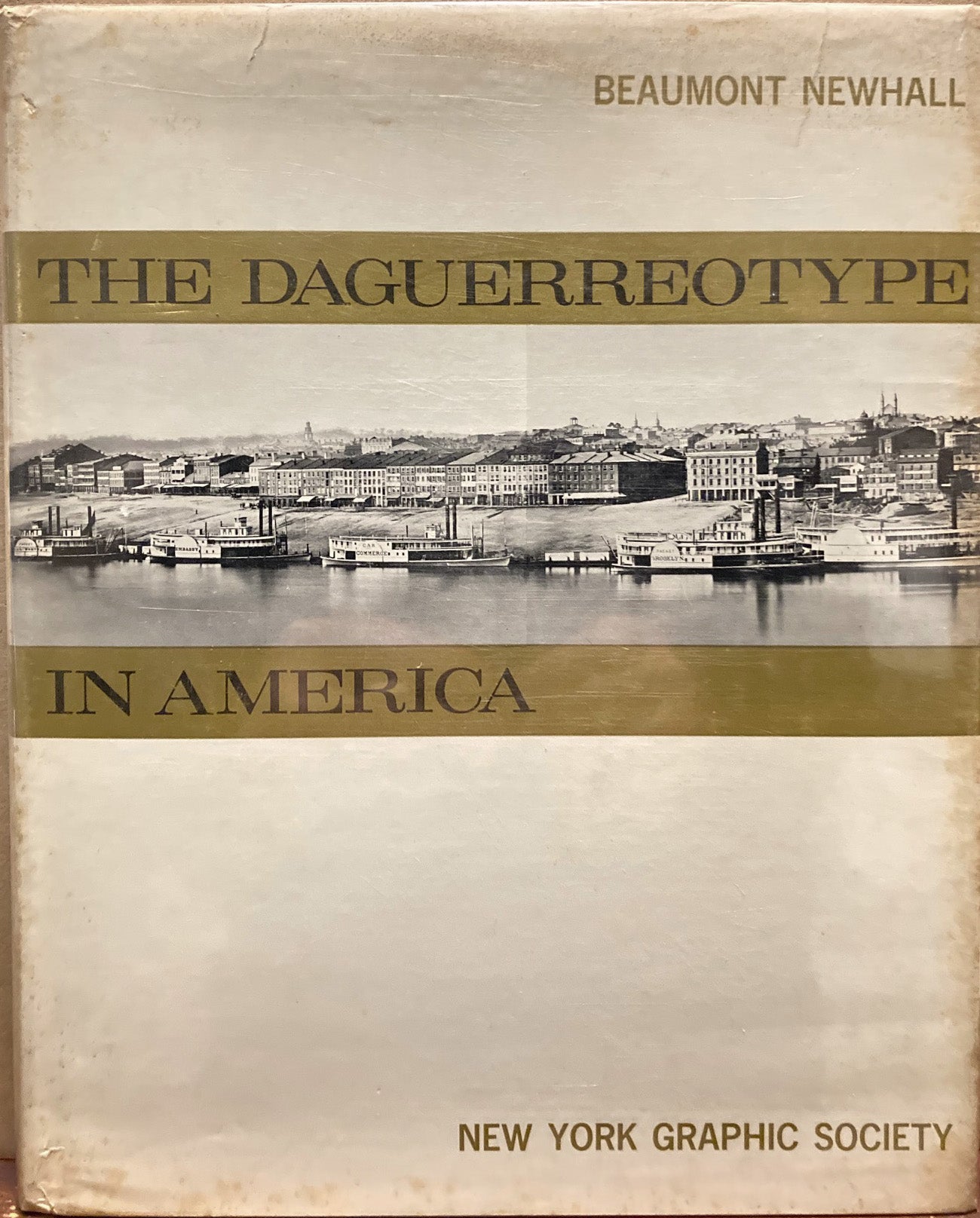
Newhall, Beaumont. The Daguerreotype in America by Beaumont Newhall.
Newhall, Beaumont. The Daguerreotype in America by Beaumont Newhall.
受取状況を読み込めませんでした
Revised Edition. New York Graphic Society, 1968. [The revisions are listed on page 13. 83 plates with masterful daguerreotypes by Platt D. Babbitt, Southworth and Hawes, George N. Barnard, and others.] Green cloth, very good with two corner bumps, with protected dust jacket that has soiling on edges and along spine and a few very short tears on edges. Edges of text block have small light brown specks as common with this book. Note to be confused with the later more commonly found softcover reprint by Dover. Summary:
The Daguerreotype in America (originally published in 1961 by Duell, Sloan & Pearce) is a definitive historical study by renowned photo historian and curator Beaumont Newhall.
The volume chronicles the meteoric rise and eventual decline of photography's earliest commercial process in the United States, spanning from its introduction in 1839 through its heyday in the 1840s and 1850s, up to the eve of the American Civil War.
Core Themes & Content
-
The American Modification: Newhall traces how Louis Daguerre’s original French invention—which produced a miraculous, highly detailed image on a silver-plated copper sheet—was rapidly adapted by American scientists and entrepreneurs. He details how American technical innovations, such as accelerating the chemical process with bromine, shortened exposure times from several minutes to mere seconds.
-
The Rise of a Democratic Art: The book highlights how the daguerreotype became a massive, populist industry in the United States. Because it provided an affordable means of capturing likenesses, a portrait boom emerged, breaking the monopoly that wealthy elites held on oil-painted portraiture.
-
The Broadway Galleries: Newhall explores the cultural phenomenon of lavish metropolitan daguerreotype galleries, most notably those of Mathew Brady, Marcus Aurelius Root, and John Plumbe on Broadway in New York. These studios functioned as both elite social hubs and public galleries displaying portraits of the nation's most famous politicians, authors, and celebrities.
-
Beyond Portraiture: While portraits were the economic engine of the trade, the book documents how the medium was pushed into new territories. Newhall examines early geographical views, street scenes, architectural records, industrial documentation, and early attempts to capture scientific anomalies and solar eclipses.
-
The Search for Color and the Final Decline: The text covers the intense, competitive quest among early operators to find a natural color process, including the famous "Hillotype" hoax. Newhall ends the historical timeline by mapping how the non-reproducible daguerreotype was ultimately made obsolete by faster, cheaper, paper-based negative-positive processes.
Technical Appendix & Plates
A valuable segment of the book is a dedicated technical chapter detailing the precise chemical and mechanical steps of the historical American process—from polishing the plate to mirror-sharpness, fuming it with volatile chemicals, exposing it in a heavy wooden camera box, and developing it over heated mercury vapors. This narrative is supported by a curated plate section reproducing pristine examples of the art, capturing both famous historical figures and ordinary citizens.
The Daguerreotype in America serves as a brilliant cultural and technical history of a young nation eagerly embracing a technological marvel. Newhall framing this brief, twenty-year phenomenon not just as an artistic evolution, but as a crucial intersection of American industrial progress, democratic media consumption, and scientific curiosity.
