Gary Saretzky Photo Books
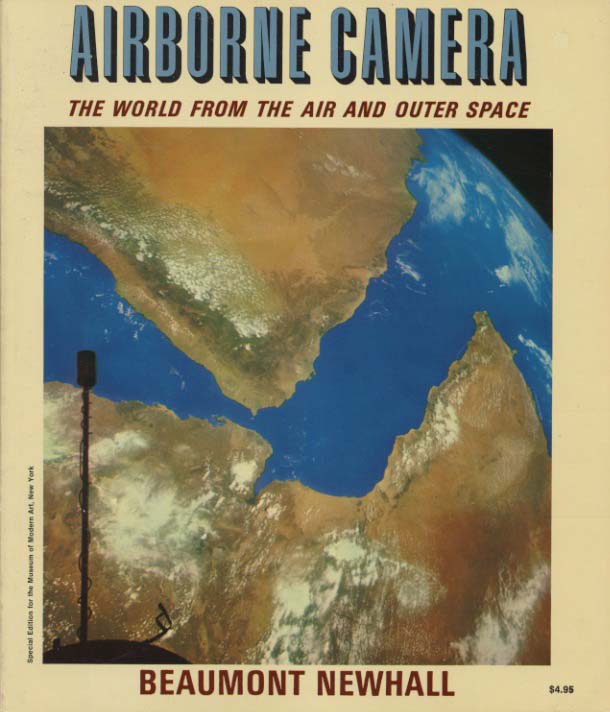
Newhall, Beaumont. Airborne Camera: The World from the Air and Outer Space by Beaumont Newhall.
Newhall, Beaumont. Airborne Camera: The World from the Air and Outer Space by Beaumont Newhall.
受取状況を読み込めませんでした
Hastings House in collaboration with The George Eastman House, 1969. Special edition for The Museum of Modern Art. Stiff illustrated wraps. Amazingly fine condition for a book of this vintage. A history of aerial photography dating back to Felix Nadar's photographs from balloons, circa 1860, to photographs taken by cameras carried by pigeons, to early aircraft photography, on up to space photography in the 1960s. Newhall, who was closely associated with leading figures in photography such Ansel Adams, Paul Strand, and Alfred Stieglitz, and was married to the photography writer Nancy Newhall, is well known as one of the foremost authorities on the history of photography; his book, The History of Photography, went through a number of editions. He also wrote hundreds of other books and articles on daguerreotypes, the invention of photography, and myriad other topics, and served as the director of The George Eastman House. During World War II, he analyzed aerial reconnaissance photographs, hence his enduring interest in this subject. Summary:
Airborne Camera: The World from the Air and Outer Space (1969), published by Hastings House in collaboration with the George Eastman House, is a pioneering historical survey by photo historian Beaumont Newhall.
The 144-page book charts the comprehensive evolution of aerial photography, tracking how human perspective shifted from earthbound viewpoints to automated satellite imagery. Newhall systematically details the technical leaps and artistic implications of looking down at the planet over a span of more than a century.
Core Themes & Chronological Overview
-
Imagined Views and Early Balloons: Newhall opens the history by looking at how artists and cartographers conceptualized the Earth from above before the technology existed to capture it. He transitions to the first actual aerial breakthroughs, highlighting the work of French photographer Nadar, who took the earliest unpreserved aerial photographs from a balloon over Paris in 1858, and James Wallace Black's surviving 1860 balloon views of Boston.
-
Kites, Pigeons, and Rockets: The narrative explores a fascinating, experimental period in the late 19th and early 20th centuries where inventors sought automated ways to lift cameras. Newhall documents early automated kite photography, the whimsical use of timed miniature cameras strapped to carrier pigeons for military reconnaissance, and early rocket-borne cameras that previewed spaceflight.
-
The World War Reconnaissance Boom: A significant portion of the book focuses on how military necessity rapidly advanced the medium. Newhall maps how World War I and World War II forced the development of high-speed shutters, specialized lenses, and sophisticated mapping cameras, transforming aerial imaging from a novelty into a vital tool for intelligence, cartography, and archaeology.
-
The Leap into Outer Space: The historical timeline culminates in the late 1960s space race. Newhall tracks the progression from unmanned suborbital rocket snapshots to the iconic orbital images captured by NASA astronauts. The book concludes with a celebratory analysis of the photographs taken during the Apollo 8 mission in 1968, which provided humanity with its first clear, emotionally profound views of the entire Earth hanging in the void of space.
Visual Curation
True to Newhall’s style, the text acts as a companion to a carefully curated archive of black-and-white photographs and diagrams. He selects images that serve a dual purpose: demonstrating scientific and military breakthroughs while simultaneously highlighting the abstract, graphic beauty that landscapes take on when flattened by a vertical perspective.
Airborne Camera bridges the gap between technological history and visual art. Newhall successfully argues that aerial and space photography did not just provide new data for scientists and militaries—it fundamentally altered human consciousness, expanding our perception of geography, borders, and our place in the universe.
