Gary Saretzky Photo Books
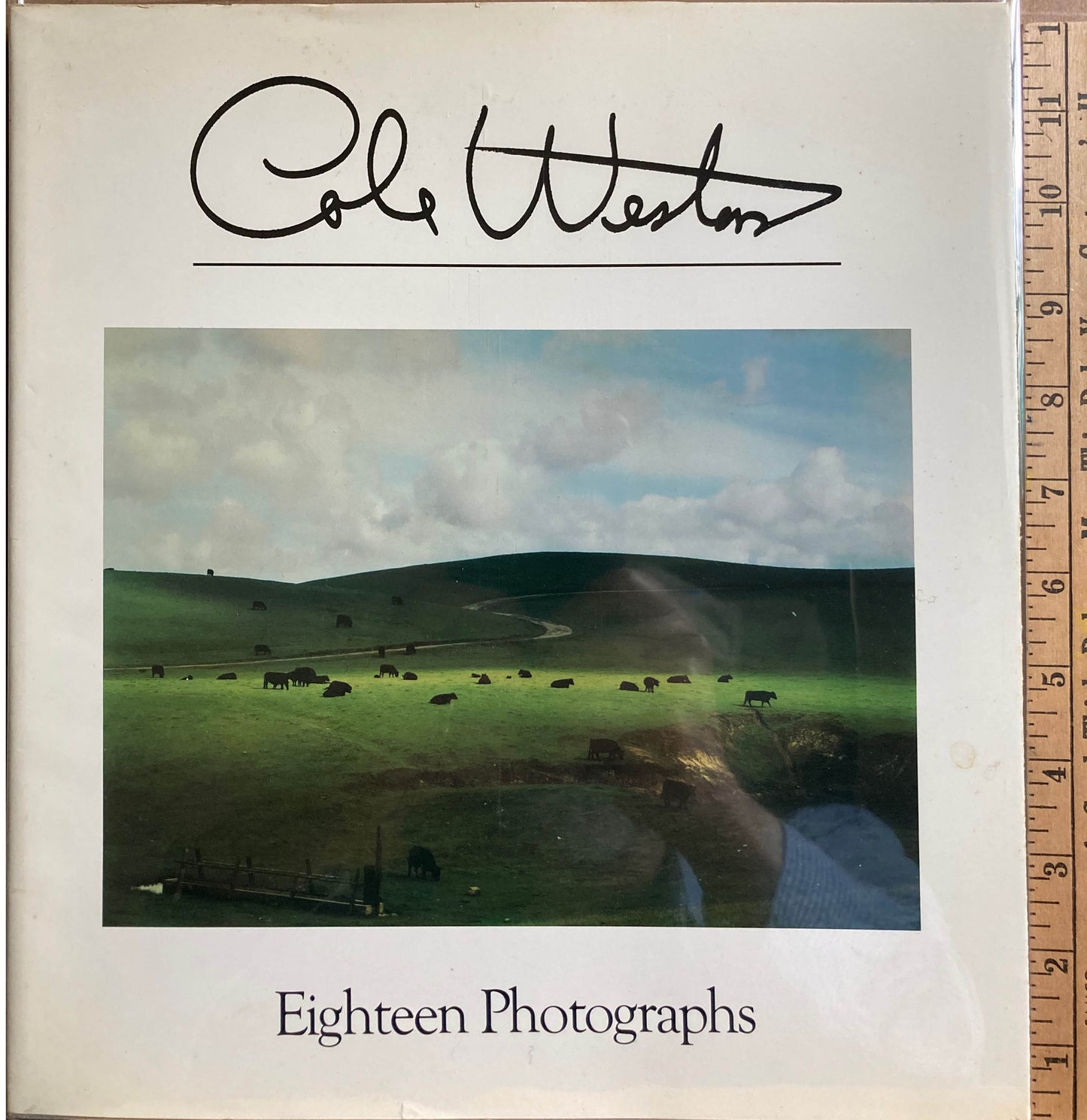
Weston, Cole. Cole Weston: Eighteen Photographs.
Weston, Cole. Cole Weston: Eighteen Photographs.
Impossible de charger la disponibilité du service de retrait
Peregrine Smith, 1981. Introduction by Charis Wilson, who was married to Cole Weston's father Edward Weston. Foreword by Ben Maddow, Edward Weston's biographer. Oversize wraps with dust jacket, near fine with custom-made 4-mil protective polyester jacket. Color landscape photographs made with a large format camera by Cole Weston, some with female nudes. An exceptionally attractive copy of a book by a master of color photography. Summary:
Cole Weston: Eighteen Photographs, published in 1981 by Peregrine Smith, is a slender but significant monograph that highlights the distinctive career of Cole Weston, the youngest son of Edward Weston. While Cole spent much of his life managing his father’s legacy, this collection asserts his own artistic identity, specifically his pioneering use of color photography.
Artistic Focus
Unlike his father, who was a master of black-and-white tonality, Cole Weston became a champion of the Cibachrome process. This book showcases his ability to translate the "Weston Aesthetic" into a vibrant color palette:
-
The "Weston Eye": The photographs maintain the family tradition of sharp focus, meticulous composition, and a reverence for natural forms.
-
Saturated Color: The eighteen plates are celebrated for their rich, saturated hues, using color not just as a descriptive tool but as a primary emotional and formal element of the image.
-
Subject Matter: The collection features classic Western landscapes, including the rugged coastlines of Carmel and Big Sur, as well as intimate studies of flora and weathered architecture.
Key Themes
-
Legacy vs. Innovation: The book serves as a bridge between the traditional "Straight Photography" movement and the modern acceptance of color as a fine-art medium.
-
Nature and Light: Weston’s work emphasizes the transformative power of light on the landscape, capturing the dramatic atmosphere of the American West with a clarity that borders on the surreal.
Significance
This volume is a definitive tribute to Cole Weston’s unique contribution to the medium. It demonstrates that while he inherited his father’s technical discipline, his chromatic vision allowed him to forge a separate path, proving that the "Weston tradition" could evolve and thrive in a world of color.
Cole Weston (1919–2003) was an American fine-art photographer, theatrical director, and master printmaker celebrated both for pioneering fine-art color landscape photography and for preserving the artistic legacy of his father, Edward Weston. Born in Los Angeles, California, Cole studied theater before graduating from the Art Center School of Design in 1937 and serving as a photographer for the U.S. Navy during World War II. Following the war, he moved to Carmel, California, to work closely alongside his father, eventually being entrusted as the sole authorized executor to print Edward's master negatives after his father was incapacitated by Parkinson’s disease. While faithful to the straight-photography traditions of West Coast modernism, Cole carved out his own distinct artistic identity in the 1950s by embracing Kodachrome film, becoming one of the earliest fine-art photographers to work exclusively in high-contrast, saturated color long before the medium gained widespread institutional acceptance. Over a career spanning more than five decades, he combined his passions by serving as artistic director for the Forest Theater in Carmel while photographing evocative, richly toned landscapes from Big Sur and the American West to New Zealand and Europe, solidifying his stature as a master of color photography and a central pillar of California’s photographic heritage.