Gary Saretzky Photo Books
Plicka, Karol. Prague: The Golden City by Karel Plicka.
Plicka, Karol. Prague: The Golden City by Karel Plicka.
Impossible de charger la disponibilité du service de retrait
Paul Hamlyn, London, UK, 1965. Hardcover in cloth, large volume, no dust jacket, solid binding. Very good with small stain on back cover. 198 pages. Introduction in several languages, including English, by Jaroslav Seifert. Summary:
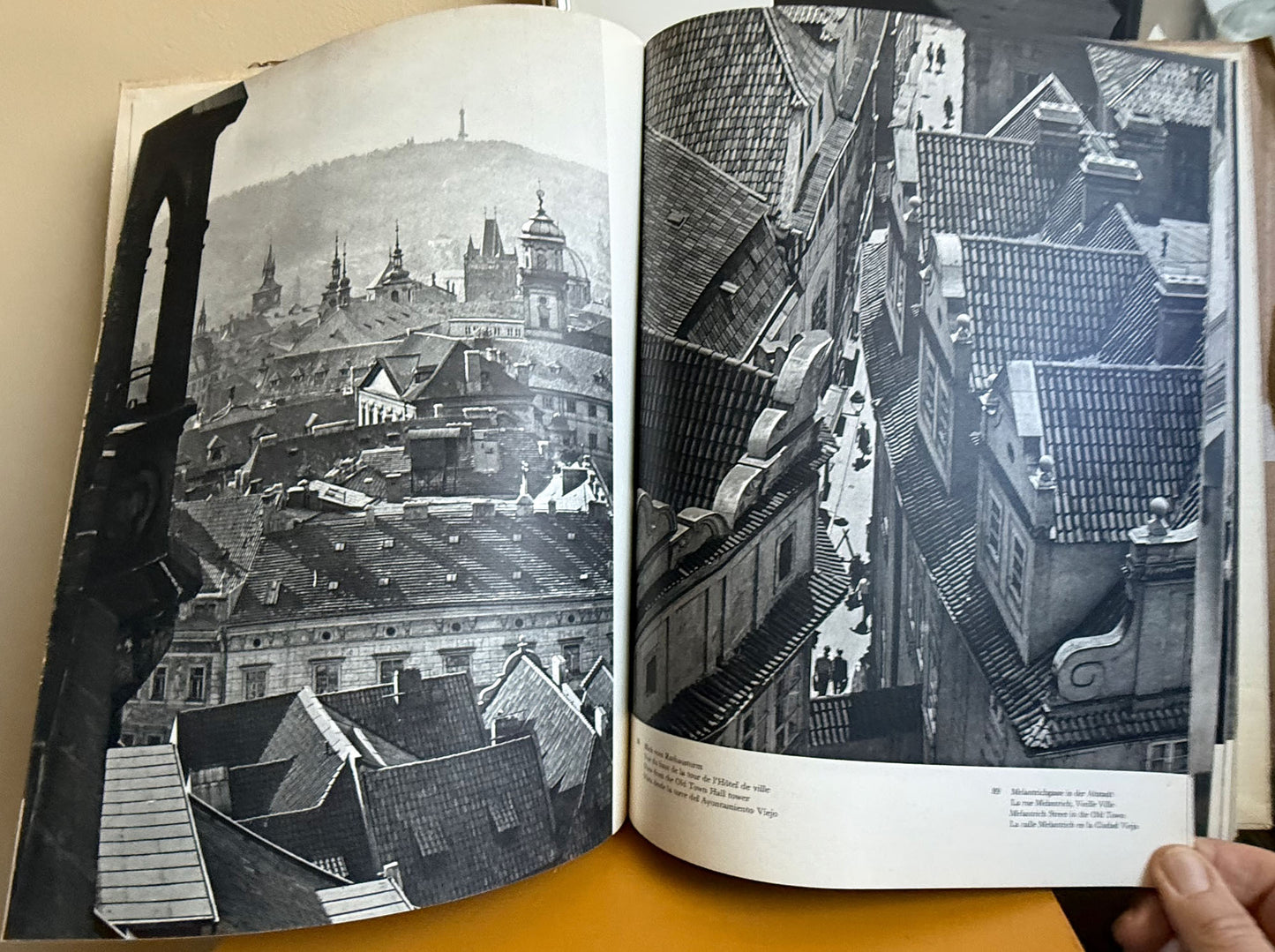
Prague: The Golden City is a photographic and visual celebration of Prague by the renowned Czechoslovak photographer Karel Plicka, first published in English in 1965. The book presents a rich collection of black-and-white images that capture the architecture, streets, historic monuments, and atmospheric details of Prague—often referred to as the “Golden City” for its glowing spires, historic charm, and centuries-old cultural heritage. The photographs showcase the city’s medieval, Gothic, Baroque, and Renaissance structures, bringing to life its riverfront vistas along the Vltava and the layered urban landscape that has made Prague one of Europe’s most visually compelling capitals.
Rather than focusing on narrative text, the book uses carefully composed images with multilingual captions (English, French, German, and Spanish) to evoke the city’s character and history through its built environment and visual textures. Plicka’s work emphasizes architectural detail, light and shadow, and the enduring spirit of Prague’s public spaces, offering readers both a photographic record and an artistic interpretation of the city’s beauty and historical depth.
In essence, Prague: The Golden City serves as an evocative portrait of Prague, blending documentary photography with aesthetic engagement to celebrate the rich heritage and enduring allure of one of Europe’s most scenic and storied urban centers.
Karel Plicka (1894–1987) was a prominent Czechoslovak photographer, film director, cinematographer, folklorist, and educator who played a foundational role in establishing ethnographic filmmaking and film education in Czechoslovakia.Born in Vienna to Czech parents, Plicka initially pursued music and ethnography, compiling an extensive collection of tens of thousands of regional folk songs, lyrics, and melodies while traveling throughout the region. In the late 1920s, he turned to visual media to document rural folk culture, creating celebrated ethnographic silent films such as Po horách, po dolách (1929)—which won a award at the 1932 Venice International Film Festival—and co-creating the landmark documentary film poem Zem spieva (The Earth Sings, 1933) alongside Alexandr Hackenschmied. A pioneer in creative arts education, Plicka established early film production courses in Bratislava in 1938 and went on to co-found the prestigious Film and TV School of the Academy of Performing Arts in Prague (FAMU) in 1946, serving as its first dean.In the latter half of his career, he focused heavily on landscape, cultural, and architectural photography, producing acclaimed photographic books dedicated to the natural beauty of Slovakia and the historic architecture of Prague.Recognized as a National Artist in 1968, Plicka remains an enduring figure in both Czech and Slovak visual heritage.