Gary Saretzky Photo Books
Nadar. When I Was a Photogapher by Felix Nadar. Translated by Eduardo Cadava and Liana Theodoratou.
Nadar. When I Was a Photogapher by Felix Nadar. Translated by Eduardo Cadava and Liana Theodoratou.
Impossible de charger la disponibilité du service de retrait
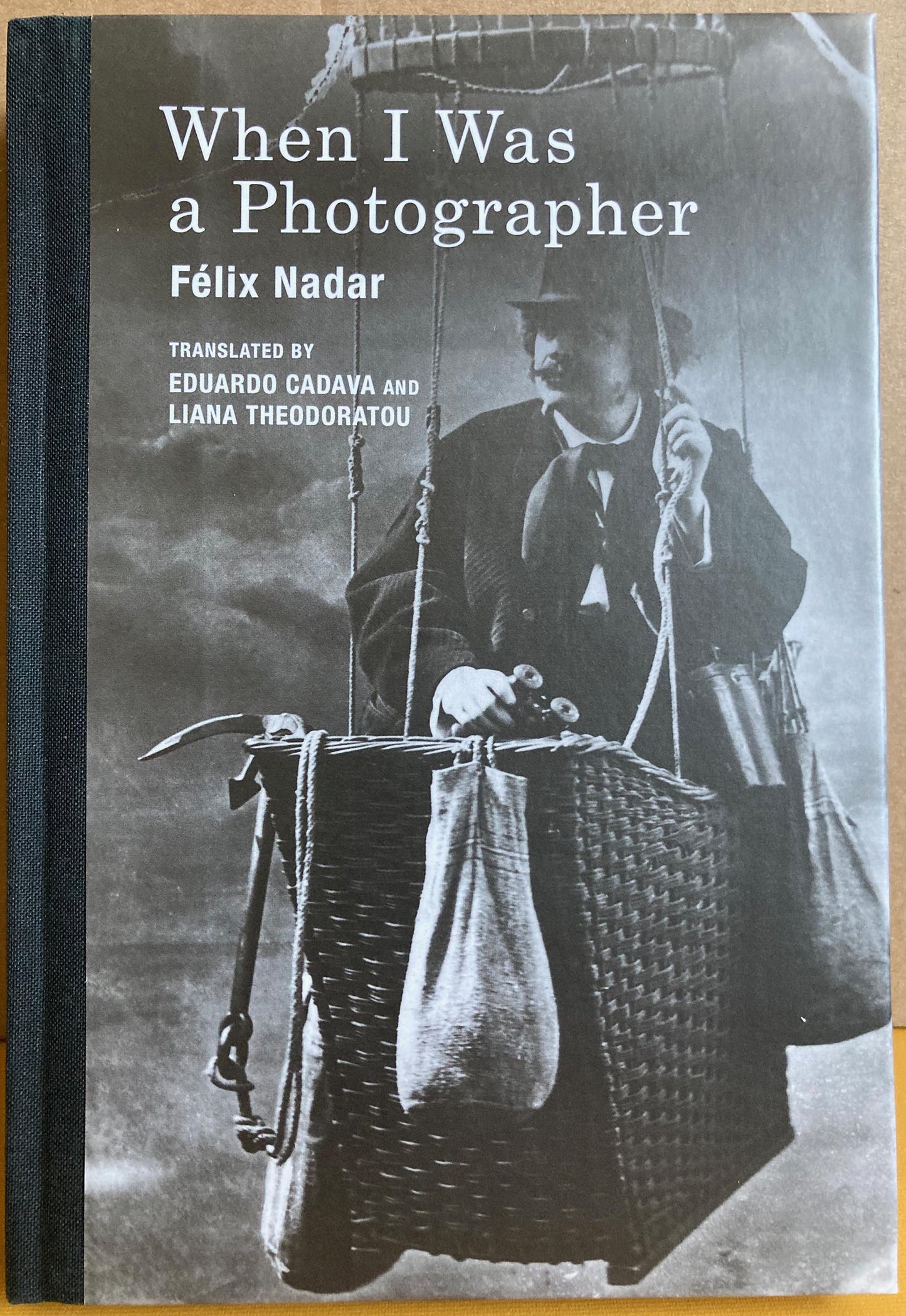
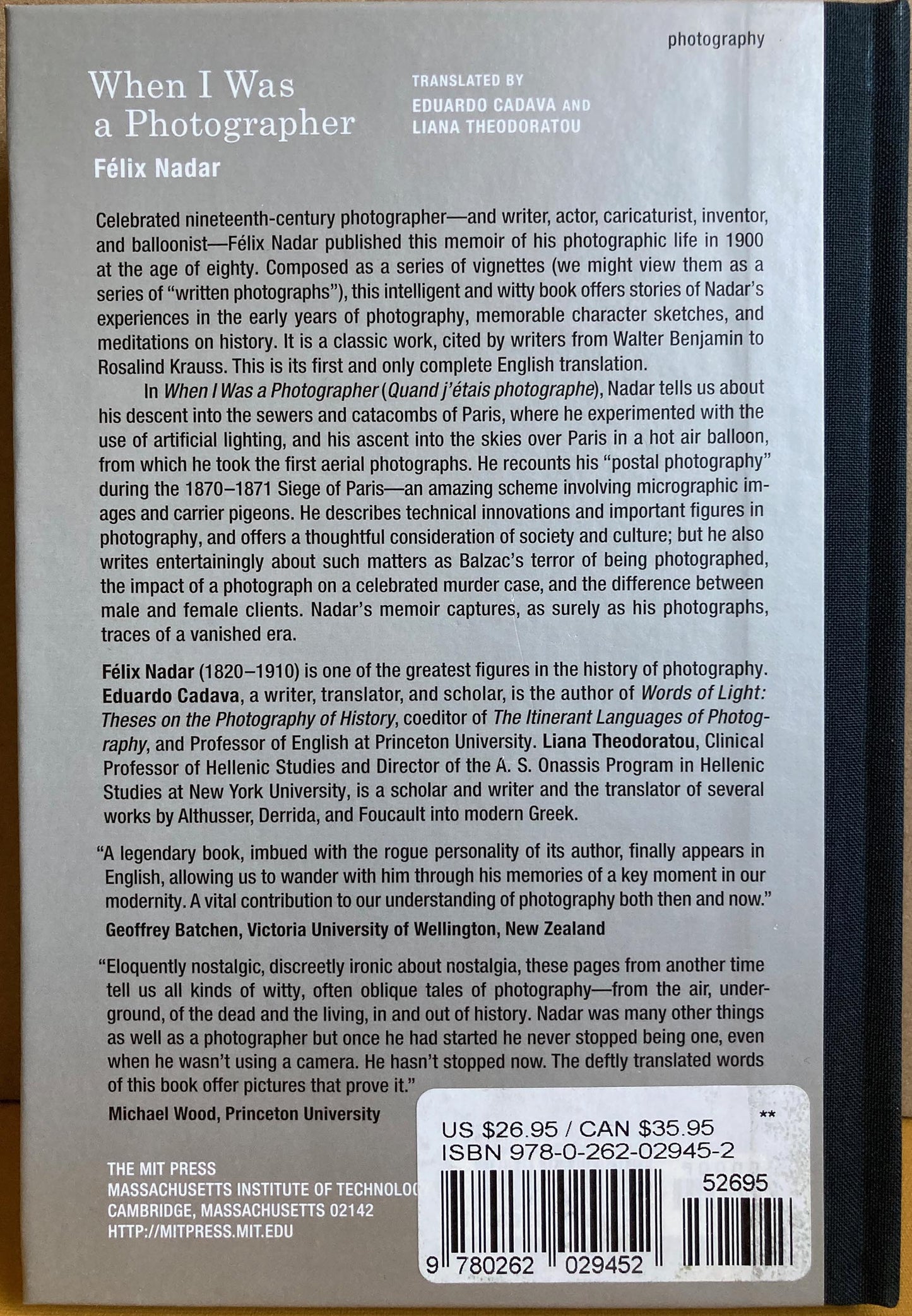
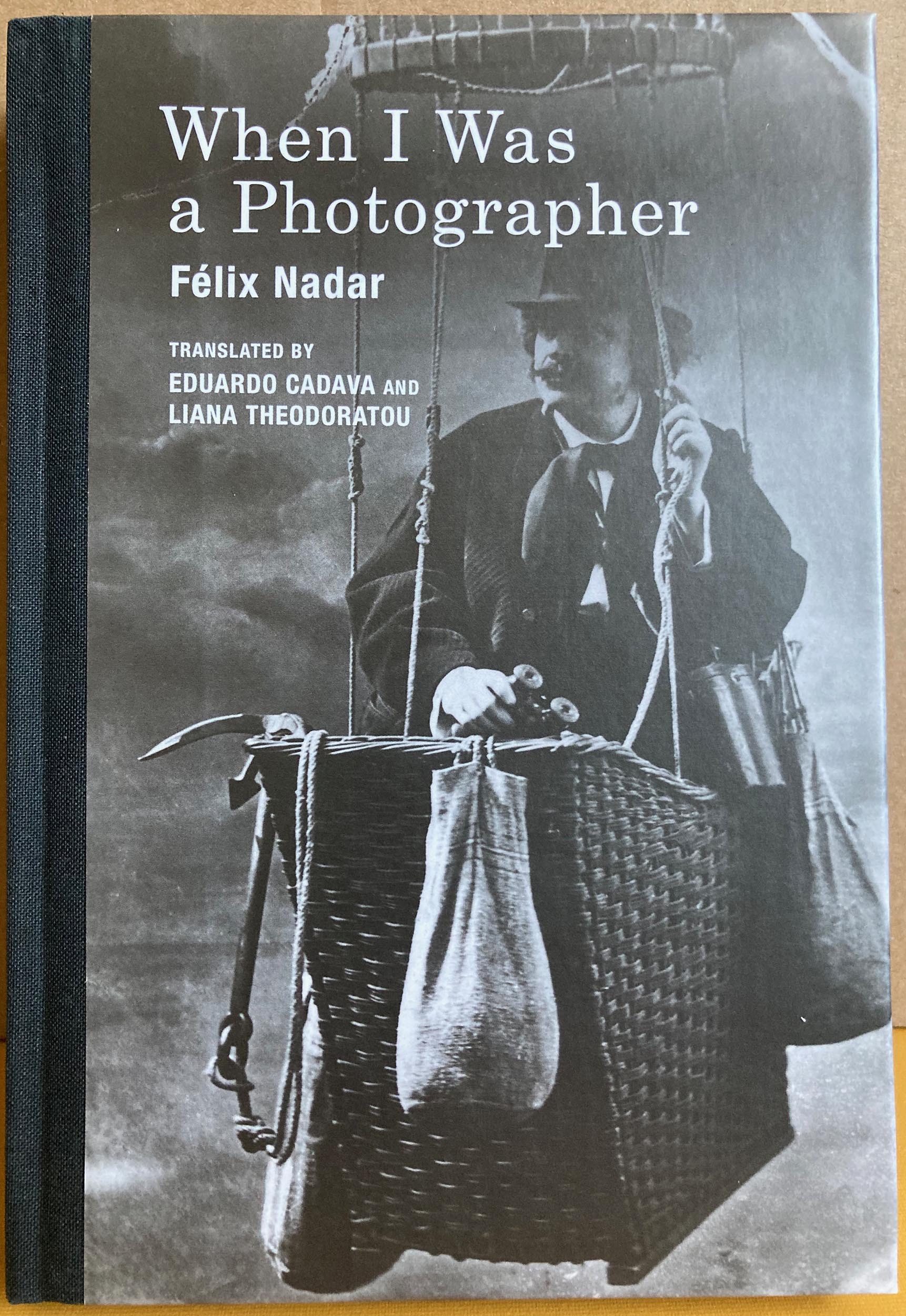
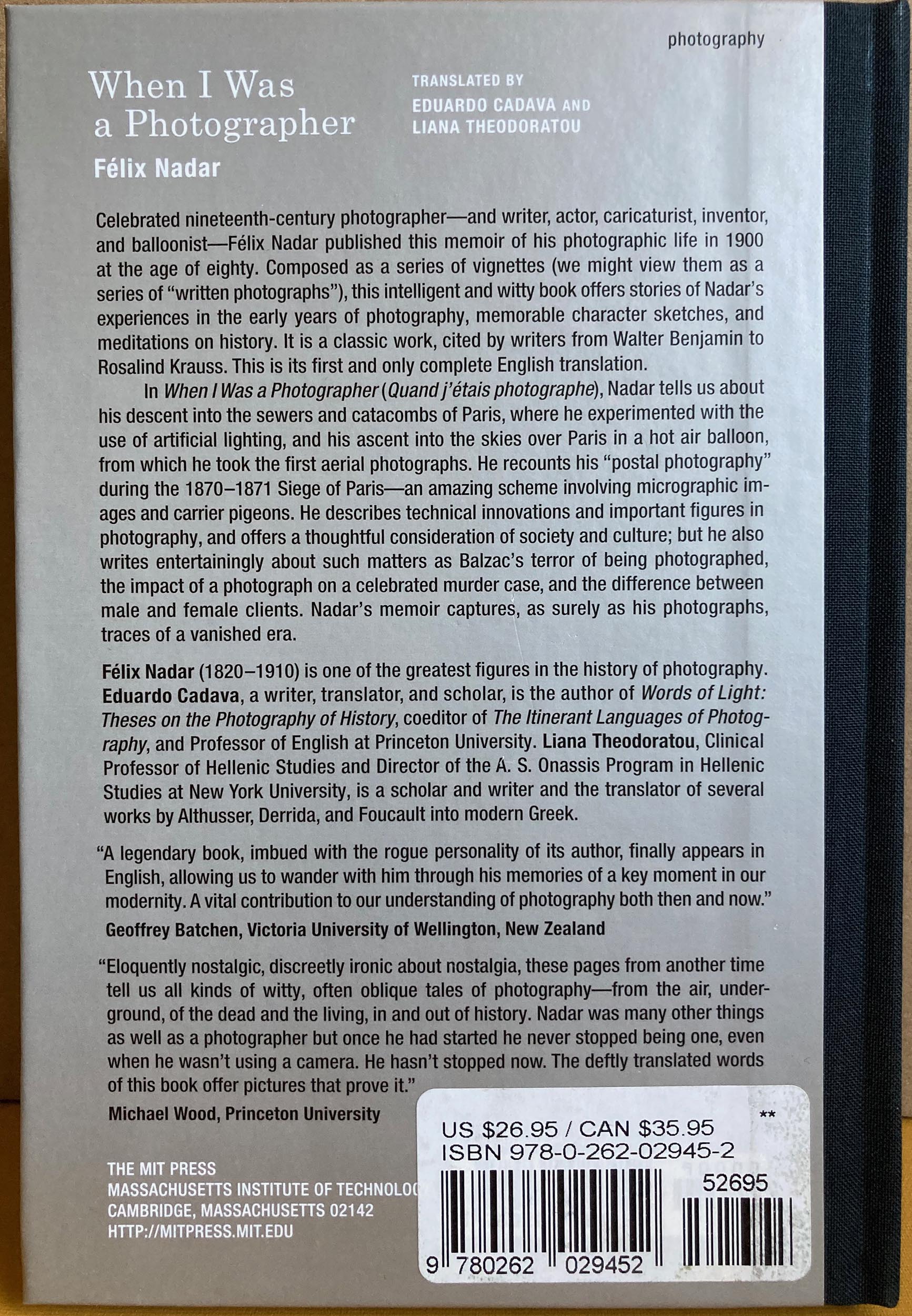
M.I.T. Press, 2015. First printing with complete number line. Hardcover in illustrated boards. Like new with discreet remainder dot at bottom of text block near spine. First complete English translation of Nadar's entertaining and informative memoirs published in France in 1900. Includes Nadar's pioneering work in aerial and underground photography, his innovative air mail service during the 1870-1871 Siege of Paris during the Paris Commune, important figures in photography, celebrities he photographed, and many other topics. Fourteen chapters include one on Etienne-Jules Marey. With a substantial introductory essay by Cadava, chronology, end notes, and an index not in the original French edition. Note: not illustrated except for photo of Nadar on front cover. Summary:
When I Was a Photographer (originally published in 1900 as Quand j’étais photographe) is the vivacious and sprawling memoir of Gaspard-Félix Tournachon, better known as Nadar. The 2015 translation by Eduardo Cadava and Liana Theodoratou finally brought this essential primary text—written by the man who was arguably the first "superstar" of the medium—to an English-speaking audience.
Core Themes and Narrative
-
The Renaissance Man of the Air: Nadar reflects on his life as a caricaturist, writer, balloonist, and photographer. He recounts his "firsts" with cinematic flair: the first aerial photograph (taken from a balloon) and the first photographs taken underground by artificial light in the Paris Catacombs.
-
The "Primitive" Era: The book captures the 19th-century sense of wonder and terror surrounding the "New Machine." Nadar writes about the "savages" (and the Parisian elite) who feared that the camera would literally strip layers of their "soul" or "envelope" away with every exposure.
-
The Psychology of the Sitter: A central theme is the "intimate" portrait. Nadar believed that a technician could take a picture, but only an artist could find the "moral intelligence" of the subject. He provides anecdotes about his famous friends—Balzac, Baudelaire, and Hugo—treating the studio as a confessional.
Visual and Technical Scope
-
The Chemical Heroics: Nadar details the physical and chemical characteristics of the Collodion (Wet-Plate) process. He describes the life-and-death struggle of keeping chemicals stable while suspended in a balloon or deep in a lightless crypt.
-
Electricity and Progress: The book documents the transition from sunlight to electric light (the "Servin" carbon-arc lamps). Nadar saw electricity as the "fluid" that would allow photography to finally conquer the night and the subterranean world.
- Nadar (1820–1910), born Gaspard-Félix Tournachon, was a legendary French photographer, caricaturist, journalist, and aeronaut whose bohemian flair and technical daring made him one of the pivotal figures in 19th-century visual culture. Starting his career as a novelist and satirical cartoonist in Paris, Nadar opened a portrait studio in 1854, quickly revolutionizing portrait photography by stripping away artificial painted backdrops and elaborate props in favor of simple, soft natural lighting that captured the psychological depth of his sitters. His studio became a famed salon for the French intelligentsia, resulting in definitive, iconic portraits of luminaries like Charles Baudelaire, Victor Hugo, Sarah Bernhardt, and George Sand. A restless technical innovator, Nadar took the world’s first aerial photograph from a tethered hot-air balloon over Paris in 1858 and pioneered artificial lighting techniques using battery-powered electric lamps to document the subterranean sewers and catacombs of Paris in the early 1860s. Always at the center of artistic avant-garde life, Nadar also hosted the landmark first Impressionist exhibition in his Boulevard des Capucines studio in 1874, securing a enduring legacy as a visionary who elevated photography from a mechanical craft to an expressive fine art.