Gary Saretzky Photo Books
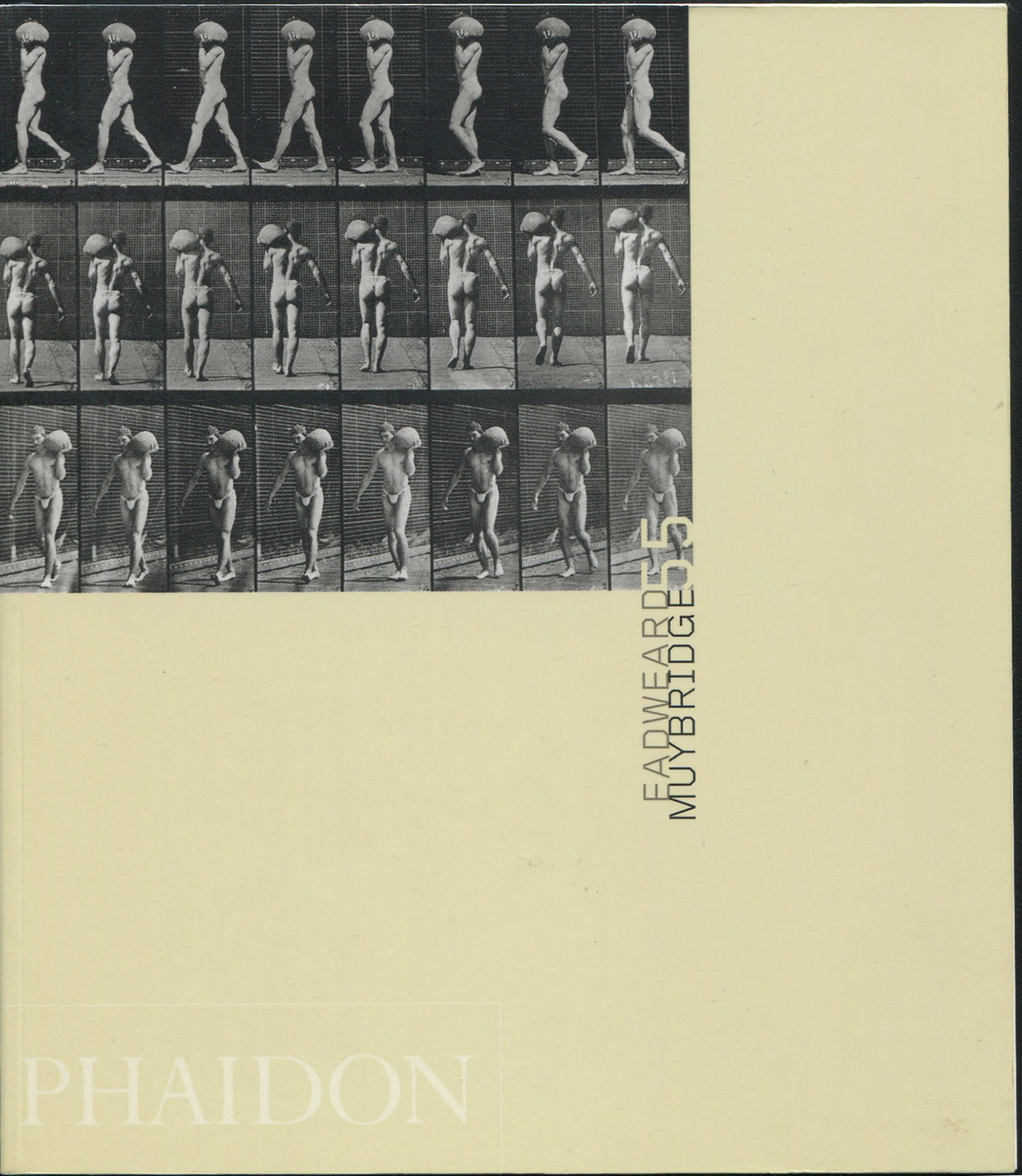
Muybridge, Eadweard. Eadweard Muybridge 55 by Paul Hill.
Muybridge, Eadweard. Eadweard Muybridge 55 by Paul Hill.
Impossible de charger la disponibilité du service de retrait
Phaidon, 2001. Stiff wraps, 128 pages. Includes essay, informative captions, and chronology. Muybridge's photos include landscapes, American Indians, San Francisco, his Animal Locomotion series, and others, including, surprisingly, one taken in Atlantic City, New Jersey. One of the Series 55 books on different photographers. Like new with "Phaidon Non-Mint Copy" stamped on title page and may have remainder mark at bottom of text block. This stamp does not necessarily signify any defects when found in a Phaidon book and this copy doesn't have any. Summary:
Eadweard Muybridge (2001), part of the Phaidon 55 series by Paul Hill, is a compact yet authoritative survey of the 19th-century visionary who "stopped time." The book distills Muybridge’s complex, often scandalous life and his monumental contributions to both photography and the precursors of cinema into 55 key images.
Core Themes and Content
-
The Pioneer of Motion: The book focuses heavily on Muybridge’s groundbreaking work at Palo Alto (commissioned by Leland Stanford), where he used a battery of 24 cameras triggered by tripwires to prove that a galloping horse at one point has all four hooves off the ground.
-
Animal Locomotion: Hill explores the massive "scientific atlas" Muybridge produced at the University of Pennsylvania, featuring over 700 plates of humans and animals in motion. This work bridged the gap between fine art and forensic science.
-
The Landscape Roots: Before he was the "Man of Motion," Muybridge was "Helios," a celebrated landscape photographer. The book includes his dramatic, large-format views of Yosemite and his 360-degree panorama of San Francisco, showcasing his mastery of early wet-plate negative processing.
Visual and Technical Significance
-
The Grid Aesthetic: Hill highlights how Muybridge’s sequential grids prefigured modern conceptual art and the "chronophotography" that led directly to the invention of the motion picture.
-
Technical Mastery: Despite the primitive nature of 1870s chemistry, Muybridge developed high-speed shutters and electromagnetic triggers—patented inventions that allowed for exposure times as fast as 1/1000 of a second.
- Eadweard Muybridge (1830–1904) was an English-born photographer and inventor whose pioneering high-speed photographic experiments and motion studies laid the foundational groundwork for the development of motion pictures. Born Edward James Muggeridge in Kingston upon Thames, he emigrated to the United States in 1850 and established himself in San Francisco as a successful bookseller and landscape photographer, earning acclaim under the pseudonym "Helios" for his large-format views of Yosemite and the American West. In 1872, former California governor Leland Stanford commissioned Muybridge to settle a popular debate over whether all four hooves of a trotting horse leave the ground simultaneously; using a battery of high-speed, tripwire-triggered cameras at Stanford's Palo Alto stock farm, Muybridge proved in 1878 that they indeed do (The Horse in Motion). He subsequently invented the zoopraxiscope—a device that projected sequential images from rotating glass disks, creating the illusion of movement—and produced over 100,000 photographic studies of human and animal locomotion under the auspices of the University of Pennsylvania, published in his landmark 11-volume work Animal Locomotion (1887).